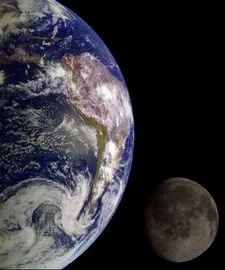
A scientist believes that our natural satellite would not have formed from Earth due to a collision of our planet with another large body, but would have formed inside Mercury's orbit and then been adopted by its current "cosmic partner".
The idea goes against the hypothesis with the greatest scientific consensus: the giant impact hypothesis, which holds that the Moon formed from the debris left by a collision between a Mars-sized object that hit Earth 4,500 million years ago.
However, the Moon has some characteristics that might not be explained by that hypothesis and, for several years, Robert Malcuit of Denison University has been postulating an alternative view for the history of our natural satellite.
Malcuit's version of events goes in the opposite direction of a hot primitive Earth and, instead, is consistent with recent findings of minerals in Australia, from 4,000 million years ago, which suggest the planet was too cold.
If Earth had had a giant impact with a Mars-sized object, it would have been very hot, so the findings in Australia would not agree with the general view of the Moon's origin.
"Everything in the giant impact model is hot, hot, hot. It is incompatible with what we see in the geological records. Earth was cold enough at that time to have sustained an early impact in its history that formed the Moon," said Malcuit.
The computational models the scientist has worked on since the 1980s show that it would be possible for our planet's gravity to capture the Moon. At first, our satellite's orbit would have been highly elliptical, passing very close to Earth and then moving away, at a rate of eight times per year.
The gravitational pull would have stretched the planet 18 to 20 kilometers near the equator, stirring the hot mantle and crust. The rocks closest to the poles would be like those currently found in Australia. The upper layers of the newly captured Moon would have melted from gravitational friction until the satellite's orbit stabilized 3,000 million years ago.
Malcuit presented this hypothesis at the Annual Meeting of the GSA (Geological Society of America) in Portland, between October 18 and 21.
Traditionally, scientists cite the Moon's low density and lack of iron as the reasons why it is thought to have arisen from our planet, on the grounds that the giant impact would have separated the light materials from Earth's upper layers.
Jack Lissauer of NASA thinks Malcuit's hypothesis is highly unlikely, as he told Discovery News. "Capture is very, very difficult. You have to have just the right speed and very special parameters for everything to be correct." However, he agrees that the current hypothesis must be revised, but does not believe that if Earth was cold early on it implies that Malcuit's idea is correct.
"The heat from the impact dissipated very quickly. It wouldn't take 100 million years, and certainly wouldn't take 500 million," he stressed.
In the heat of ideas
Ideas about a hot primitive Earth began to change a few years ago, when geologists like John W. Valley of the University of Wisconsin-Madison discovered dozens of crystals of the mineral zircon. The unusual properties of these durable minerals allowed them to preserve robust clues about the planet's primitive environment, in the Hadean and Archean eons. These tiny capsules (the size of a dot) possess evidence for the existence of oceans and perhaps continents 400 million years earlier than thought.
Malcuit bases himself on this research to argue that Earth, if it was colder, could not have undergone a great cataclysm. However, the capture hypothesis seems difficult to sustain with only computational models.
In any case, whether it came from inside Earth or was captured by the hypnotic gravity at our feet, there will always be A Man Looking at the Moon.
Sources and related links
- A Prograde Planetoid Capture Episode About 3.95 Ga Ago: Is This Model Compatible With The Information From Hadean- And Archean-Age Detrital Zircon Crystals?
Malcuit, Robert
2009 Portland GSA Annual Meeting (October 18-21, 2009)
Paper No. 266-2
Presentation Time: 1:45 PM-2:00 PM - Controversial Moon Origin Theory Rewrites History, by Michael Reilly, Discovery News
- Early Archean Ophiolites And The Cool Early Earth: Can They Be Explained In The Context Of A Tidal Capture Model For The Origin Of The Moon?
2007 GSA Denver Annual Meeting (October 28–31, 2007)
Malcuit, Robert
Paper No. 121-1
Presentation Time: 8:15 AM-8:30 AM - A cool early Earth
John W. Valley et al.
Geology; April 2002; v. 30; no. 4; p. 351-354;
DOI: 10.1130/0091-7613(2002)030<0351:ACEE>2.0.CO;2
A Cool Early Earth, (2002) Geology. 30: 351-354. - Scientific American: A Cool Early Earth?
John W. Valley
Oct. 2005
About the images
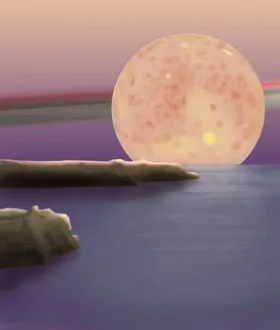
- Illustration of the Primitive Cold Earth, 4,400 million years ago. Graphic: Andrée Valley and Mary Diman
- Earth and Moon. NASA