New data on the object Quaoar challenge the current knowledge about objects in the Kuiper Belt.
Between October 4 and 9, 2009, the 41st Annual Meeting of the Division for Planetary Sciences of the American Astronomical Society was held. This time the meeting took place in Fajardo, Puerto Rico.
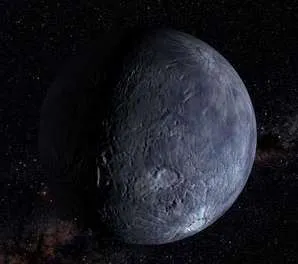
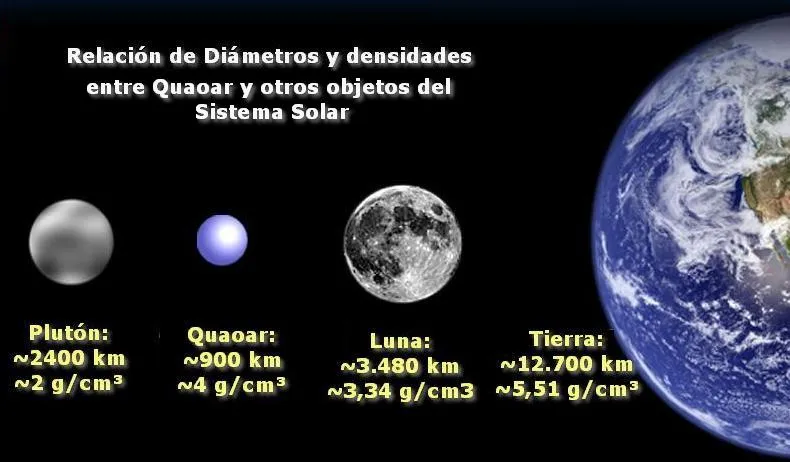
If Wesley C. Fraser, from Caltech, is right, planetary scientists should rethink the Kuiper Belt, that vast band of asteroids orbiting beyond Neptune. Using the Hubble Space Telescope, Fraser and Mike Brown observed one of the largest objects, Quaoar and its small moon Weywot, to refine estimates of its size and mass. Brown was one of the original discoverers of the object in 2002, along with Chad Trujillo. They found that Quaoar is smaller than previously thought, only 900 kilometers in diameter. (Previous measurements indicated about 1200/1300 km).
Consequently, it is denser, around four grams per cubic centimeter. This makes it the densest Kuiper Belt Object (KBO) of all. And by far.
Planetary scientists usually explain the density of belt objects as rocks that were once large and less dense and that, upon colliding with other objects, lost light material, like ice, leaving mainly rock. But the plutoid Quaoar would be so dense that this process would not be sufficient. Furthermore, astronomers detect ice on its surface. It makes no sense. "It's confusing, to say the least," Fraser noted.
But this is only half of it. Most moons of Kuiper Belt objects have circular orbits. It is thought that this is a consequence of the incorporation of debris from collisions that form the moons, and those debris rings naturally settle into a circular shape. However, Weywot has an oblong orbit.
A radical idea is that Quaoar is a refugee from the asteroid belt between Mars and Jupiter. Asteroids tend to be denser than KBOs, so perhaps Jupiter sent one of the asteroids to the farthest reaches of the solar system. But the unfortunate exile would have tended toward a highly elliptical orbit, whereas Quaoar has an almost circular orbit.
Erik Asphaug from the University of California offered another explanation. Perhaps Quaoar collided with a much larger body, some body the size of Mars. Something like the crash of a Mini Cooper into a Hummer, but on a planetary scale, could have given Quaoar the right density.
Fraser has already requested more telescope time, because clearly this is one of the topics that will necessarily have to be further investigated. After all, the icy Kuiper Belt objects hide rocks larger than Pluto, like frozen and small Earths in exile.
Sources and related links
- Quaoar: A Rock in the Kuiper Belt
Wesley Fraser, M. E. Brown - What do we really know about the Kuiper Belt? Fifth dispatch from the annual planets meeting
Scientific American, by George Musser, October 13 - Science@NASA:A Cold New World
- A Search for the Brightest Kuiper Belt Objects
Trujillo, C. A.; Brown, M. E.; Margot, J.-L.; Bertoldi, F.
American Astronomical Society, DPS Meeting #34, #09.04;
Bulletin of the American Astronomical Society, 09/2002, Vol. 34, p.849
About the images
- Size comparison. Credit: NASA and A. Feild (STSci)
http://www2.warwick.ac.uk - Illustration of Quaoar. Credit: NASA