A day like today, the life of Carl Sagan ended. I hope that one day pseudosciences and magical thinking will come to an end.
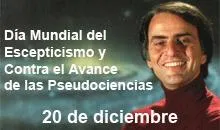
From Proyecto Sandía, they invite us to continue the fight of the famous American astronomer.
Other blogs joined this day to remember Sagan's thought and his work. Eugenio (Ciencia en el XXI) is clear in quickly indicating that being skeptical does not mean not believing in anything.
From here we want to express that we bet on critical thinking, which proposes to analyze or evaluate the structure and consistency of reasonings.
Ultimately, we must consider how we make our decisions.
When I leave my house, for example yesterday, to go to a friend's house to eat a barbecue, I don't know if upon leaving I will find, behind the door, a murderer, a thief, or a hungry extraterrestrial being craving human flesh.
I really don't know. I do not have absolute certainty of any of these options.
But I do have to make a decision. If yesterday I left and nothing happened, and the same on previous days, then, perhaps today nothing will happen either. I will look through the peephole of the door, I will observe through the window, I will take into account different variables and, finally, I will weigh which is the most probable and I will make a decision.
But I know it is a probability, not a certainty. This implies that I am not 100% sure, I am therefore skeptical, but I can make a decision.
The same when we face a statement, particularly those about which we do not have sufficient elements to know if it is correct or false.
Someone tells me: "I just spoke with ....". Let's fill the ellipsis with something strange to our daily life, be it a mystical figure, an alien, or a common element in an action very different from the normal one.
Is that statement true or false? We will know when we gather proofs, evidence, that is, knowledge.
But before that, we still lean towards one of the two options (true-false). How? By indications that can reaffirm our belief system. But, whether we choose to believe that a statement is true or false, we can be wrong.
Carl Sagan used to say that in the face of extraordinary claims we must demand extraordinary evidence.
We wrote about it in The Null Hypothesis and the Logic of Skepticism. That note is a translation of an article in English, in which the author, faced with a situation like the one cited before, prefers to be skeptical rather than naive.
I also prefer to doubt an extraordinary claim and even those about which I do not possess sufficient knowledge, instead of quickly believing only based on very subjective indications.
A very common example is the supposed Moon conspiracy. Is what NASA says true or should I distrust that? Is what they write out there about a supposed staged television studio true?
The internet has popularized this type of belief based on pseudosciences that "explain" why the Moon landing would have been fake. What to do about this?
Let's doubt. Let's doubt in the same way both claims. And then let's look for rational explanations. If we do that we can say: "The Moon conspiracy, what a scam!". Eugenio's book is an excellent example of critical thinking.
For some years now, a community of people has been forming, to which I belong, who call ourselves "Brights". Not because we are enlightened. Far from it. It is because we believe in the light of knowledge.

What is a Bright?
A bright is a person with a naturalistic worldview.
A bright's worldview is free of mystical or supernatural elements.
The ethics and actions of a bright are based on a naturalistic worldview.
Being a Bright, or simply being a skeptic, does not in any way imply having a single way of thinking. It means using logic, reasoning, to try to understand the world, nature, through observation and the gathering of evidence.
But there are many things we do not know. Very many. Could some of them be explained through mystical, supernatural elements? I prefer to believe not, that there are logical and natural explanations, even if we do not yet know them. Could I be wrong? Of course. As much as when I had to go to the barbecue and didn't know what awaited me behind the door.
Carl Sagan died on December 20, 1996. His work did not.
Sources and related links
About the images
- World Skepticism Day banner. Credit: Proyecto Sandía
- The Brights logo