The Sábato Institute offers an undergraduate degree in Materials Engineering with a very high level and very good job opportunities. It also offers full scholarships to its students. But this year, only eight students enrolled.

The Sábato Institute, operates at the Constituyentes Atomic Center, was created in 1993, through an agreement between the National University of General San Martín (UNSAM) and the National Atomic Energy Commission (CNEA), and is dedicated to teaching science and technology.
Its name comes from Jorge Alberto Sábato, who in the 1950s pushed to build, in a country lacking experience, a metallurgy hub based at the National Atomic Energy Commission.
The academic offerings include the undergraduate degree, Materials Engineering, as well as a Master's in Science and Technology of Materials, a Doctorate in Science and Technology (with a focus on materials or a focus on physics) and a specialization in Non-Destructive Testing.
Video: Instituto de Tecnologia Prof. Jorge Sabato
http://www.youtube.com/watch?v=jISt3o6yv0o
The institute is located at Av. Gral. Paz 1499, in the San Martín district, bordering the Federal Capital. Several buses reach the institute and can be found on its website (See location).
Scholarships
All students who enter the Materials Engineering degree are offered a monthly scholarship for the 4 years the degree lasts, which at this time is $1500.
The scholarships aim to guarantee exclusive dedication to study. The Sábato Institute inverts the logic of private education, as it is the students who receive financial aid to study from the State, through the National University of San Martín and the National Atomic Energy Commission; as well as through some companies in the country that invest in education to be able to meet the demand for engineers.
To learn more, see the institute's scholarship page.
Dissemination: Is this true?
Since late July, early August, there has been an email circulating signed by Claudio Arenas and, of course, forwarded dozens of times. The email alerts about the existence of the aforementioned scholarships.
The content of the email is correct, as can be quickly checked on the Sábato Institute website.
Furthermore, the signatory Claudio Arenas, was included in a note in the Clarín newspaper on June 21 (see in Clarín: "Sin apoyo no lo hacía").
However, this dissemination method -which we can call viral- ends up generating suspicions about the authenticity of the content.
It didn't help at all that on a very popular forum in Argentina, where a user echoed the topic, a comment labeled the information as false, when it is not.
A graduate, proud and concerned
I know the topic moved many. That a high-ranking institute offers such a scholarship does not seem usual. And it sounds like a waste that they are not taken advantage of. Why does this happen? We consulted Claudio Daniel Arenas, the signatory of that email that originated this note, to get his opinion.
UNC: -The institute's website explains that the degree is for those who have already completed two years of engineering or physics at a university. What incentives does a current student of one of those degrees who is studying at UBA, for example, have to switch to Sábato? I can think of reasons, of course, but I would like to know your opinion.
CDA: -It has incentives such as being a new degree (approx. 15 years) and it is in high demand both by industry and in research (despite needing more dissemination). Furthermore, by its nature, if the student has to work while studying at UBA, here they have a scholarship for exclusive dedication, which increases the hours of concentration on study and with this the possibility of improving their experience in the laboratories, as they are in permanent contact with the researchers at the Constituyentes Atomic Center, something that is hard to find in National Universities.
(Note: To learn more, see the graduate profile.)
UNC: -What is the job market like? Besides being able to work in industry, is it possible for materials engineers to pursue a research career at CONICET?
CDA: -The job market is immediate, as the Institute is recognized both Nationally and Internationally (although, again, it needs more dissemination, of course); of course they can aspire to a research career at CONICET.
The nuclear issue is something that still persists as a taboo in the community and we have to strive for this to disappear.
Lack of interest on the part of the population to attend University because this requires effort and that is not the model of "success" sold in the media.
UNC: -What are the most important research and development topics or subjects in materials engineering?
CDA: -The topics with the most weight now and in the future are several, among which are: polymers, alternative forms for energy production that favor sustainable development of it to appease the excessive consumption of our natural resources, alloys for nuclear use, high-tech ceramics, composite materials in the aero-naval industry; and everything related to basic research will also have its evident place.
UNC: -Do you have any idea how long the scholarship system has existed at the Sábato Inst.?
CDA: -The scholarship system has existed for 14 years.
UNC: -To remove any kind of superstition about it, are we talking about real, hard cash that students who get the spot and want the scholarship receive, month by month, during the 4 years of the undergraduate degree? Is there any other requirement, such as a certain purchasing power, socioeconomic level, etc., to access the scholarships?
CDA: -There is no other requirement of those you mention, the scholarships are updated (as much as possible) according to the country's inflation, that is something very important to maintain the student's exclusive dedication to study and so they don't have to worry about rent, food, services, etc.
UNC: -Did very few students really enroll this past year?
CDA: -YES ; really very few students enrolled this year, after the 3 who had entered (which was when I wrote my email) a second call was made to take the admission exam and another 5 entered, so currently there are 8 students taking the 1st year (they will start the 2nd semester in 2010, which is still few, because there is capacity for 20 !!).
UNC: -What happened?
CDA: -That question deserves a multifactorial analysis from me because things in a community that calls itself "society..." do not occur in isolation and everything is more related than we imagine, but broadly speaking, what happens is that "prejudices" exist.
- This type of career is conceived as suitable only for "brains.." (pathetic)
- Less than 10% of the Argentine population is in universities, and the rigorous scientific ones are always the ones with the smallest numbers, so the Institute has no reason to deviate from the line.
- Lack of interest on the part of the population to attend university because this requires effort and that is not the model of "success" sold in the media.
- Outdated methods of dissemination that do not work are still maintained in practice, and yet they keep repeating them, that is...
- There is also little dissemination to companies and therefore no one will demand professionals whose existence is unknown, in this the media have a lot to do with it.
- The nuclear issue is something that still persists as a taboo in the community and we have to strive for this to disappear.
As you can see "what happened" is quite broad, and there is no single reason, I hope I have guided you a little, at least from my opinion.
UNC: -Last one. Have you already graduated? Are you going to do a postgraduate degree? What do you see yourself doing in the future?
CDA: -That's right, I have already graduated, very happy about that!! now I have a professional scholarship and I want to do a doctorate in Materials, teach classes and awaken patriotic spirits and open minds, we need to work hard so that there are very thoughtful people in our country, and that they do not leave our land !!, it is the only way for us not to disappear.
Sources and related links
About the images
- Logo of the Sábato Institute
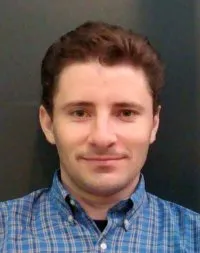
- Photograph of Claudio Daniel Arenas