For a few days now, the news has been circulating the web that an IT administrator at an educational institution was fired for the alleged use of BOINC and SETI@home to search for extraterrestrial intelligence. The truth, as always, is more complex.

"Man loses his job after searching too much for aliens" is the title of an article by Chris Matyszczyk on Cnet. There he takes an article from Arizona Republic about the firing of Brad Niesluchowski who managed the network for the technology department of Higley Unified School District.
The charges appear to be several, but can be summarized as abuse of authority, in purchasing equipment, inappropriate use of the internet, 18 pieces of equipment he allegedly stole (since they were found at his home), never having installed a firewall on the network, not having trained the technical staff. And having downloaded and run BOINC on every computer in the institution. The employee's nickname on SETI@home is NEZ.
Therefore, the dismissal occurred due to violations of the terms and responsibilities of his contract and the ethical policy of a network administrator.
However, some media have emphasized that the cause of the dismissal was the use of BOINC, having generated a loss of up to 1.5 million dollars due to the extra use of electricity in the computers.
Do you need to ask permission to install BOINC in a company or other organization?
Does the use of BOINC involve a monstrous extra expense like the one alleged?

Today, Eric Korpela, a scientist for the SETI@home project, commented on the matter on the site's forum, with the aim of setting the record straight.
To the first question, Korpela answers yes, of course. They have said so for a decade. And, despite what is said, Niesluchowski was not the first to lose his job over this.
Regarding the cost of using SETI@home, Eric indicates that it is clearly not zero. When a computer performs calculations, it uses more energy than when it is idle. A desktop computer spends about 60 watts more when it is active than when it is idle, which is similar to an incandescent light bulb. If we use the machine 24/7, it will consume 525 kilowatt-hours in a year. The economic cost will depend on the rates in each country or region, but it should not exceed 100 dollars per year. It's different when we use 25,000 computers for a year, or 5,000 for five years. In those cases we would indeed spend about 1.5 million dollars.
How BOINC can be used
BOINC is a platform through which different projects can be run, including SETI@home, but also many others.
The application allows different configurations, among which we can run the programs at all times or only when the computer is not in use (but is turned on). But also, it is not necessary, it is not a requirement, for running BOINC that it must be running 24/7, that is, 24 hours a day.
Of course, to run any program, the computer must be running, but there is no problem, for operating with BOINC, that it runs at all times.
Korpela takes advantage of the SETI@home forum to comment on processor damage, uninstallation, slowing down of a PC's work, etc.
The key points are:
SETI@home and the use of BOINC will not damage our processors by using them when we are not. The use of the PC will not slow down if the configuration allows the application to be used only when we are not using the computer. It is possible that we notice a slowdown if the configuration allows the use of the processor at all times.
In more modern computers, which have several processors or several cores, it is possible to indicate how many of them the application can use, as well as determine how much RAM and disk space BOINC has available.
About the "credits"
When running each project in BOINC, the data to be processed will be downloaded via the web. The application will process that data according to the configuration we have set and finally send the data to the project in question. Upon finishing the jobs, users receive "credits". No, they are not bank loans. In fact, let me say it without beating around the bush, they are useless. The accumulated credits have no useful application. Just a "matter of personal pride."
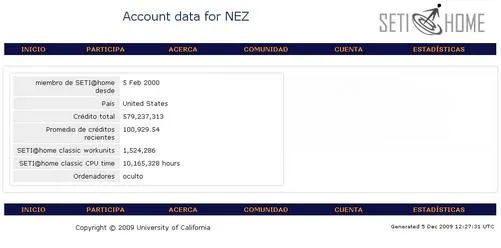
NEZ accumulated more than 570 million credits. It's an impressive number compared to my little over 51 thousand! But it means nothing. I mean, so what? It's not a competition. The only goal is to process data with the aim of finding intelligent life on other planets. Don't go crazy over credits. We are not more important, nor anything else, for contributing more by having more processors at hand.
About NEZ
Niesluchowski is not guilty. He is not, of course, until proven otherwise. They found equipment at his home. Did he steal it or take it to repair it?
Is there internal politics in that institution? There are many questions and few answers. The truth about the fulfillment of the administrator's responsibilities we will know with time.
NEZ, as a SETI@home user, contributed notably to the project. Whether he did it inappropriately or not, it's impossible to say without knowing all the facts. But he generated two things: very bad publicity (for which those who misinform are responsible) and a warning for those who have the possibility of accessing other people's computers, when managing them: the end does not justify the means.
Let's keep participating in BOINC
In short, the use of BOINC with SETI@home and other projects not only does not harm our computers, but allows us to give them a useful and scientific use during the computers' idle time. The extra electricity consumption from using a personal computer, when the computer would otherwise be idle, exists, but it is small. On the other hand, if we have access to many computers that do not belong to us, it is necessary to request the appropriate permissions and, in any case, take the necessary precautions.
Sources and related links
About the images
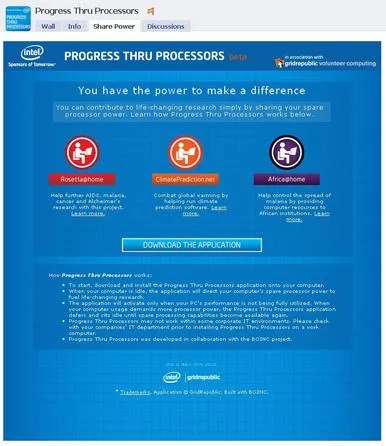
- Logos of SETI@home and BOINC
- Image of the NEZ account on SETI@home