The inauguration of the scientific and technological hub, headquarters of the Ministry of Science, Technology and Productive Innovation, the National Agency for Scientific and Technological Promotion and three research institutes, is one of the main challenges for the national government in the year of the Bicentennial. Furthermore, UBA developed a commemorative Bicentennial website. The City also has its agenda of projects.

Inaugurating the scientific and technological hub in the former railway warehouses of the Giol wineries is one of the greatest Bicentennial challenges for the government, which this year allocated a total budget to the scientific portfolio of $2,114 million 490,407, of which Conicet absorbs almost 1,260 million.
This will not be just another set of buildings in Palermo Viejo to house a ministry and related technical offices; instead, two main halls will converge an Institute in Biomedical and Biotechnological Sciences, which will join others, such as: an Institute of Social Sciences and Humanities, and another of Exact and Technological Sciences, which will include a Center for Multi-Physics Problem Simulation for Technological Applications and Bioinformatics.
There will also be the Auditorium; the Museum of Sciences and a support area sector for the latter.
And a not minor detail that guarantees international solvency and the quality of the venture: the Max Planck Society, a European leader, will install its first institute in South America in the Scientific and Technological Hub.
Although for now only curtains covering excavation and demolition tasks are visible, which around mid-year will give rise to the projected structure, as seen in the model, futuristic details for its operation are already on the drawing board, such as electricity generation through photovoltaic cells, a water recycling system and water heating through solar panels.
We can access an animated presentation at: http://www.mincyt.gov.ar/giol.htm
Video: Animation of the Scientific and Technological Hub
http://www.youtube.com/watch?v=NOEW6Z4EdwM
UBA in the Bicentennial
The site http://www.uba.ar/bicentenario/ will gather information on various activities, such as EXPO UBA 2010. It also contains images and videos and users can upload their photos.

Bicentenaries Program
The Bicentenaries Program, created in 2006, aims to collaborate from FADU, UBA, with the construction of the commemorations of the national bicentenaries in Argentina and Latin America.
Aimed at the academic community and civil society, the 2nd International Call for Essays and Audiovisuals "Bicentenaries in Action: Commemoration, Economic Crisis and Political Mobilization in Latin America", focuses on the construction of knowledge about the commemorations of Latin American bicentenaries.
The Bicentennial Group is a multilateral instance created with the objective of promoting and organizing the joint commemoration of the independence processes developed in the American continent 200 years ago.
Argentina 2.0
Argentina Bicentennial has its YouTube, Facebook, Twitter and Flickr accounts. To join, visit the sky-blue and white community.
What was done in science in 2009, at the national level
Among the many initiatives, the following stand out:
VII Science Week, 72,000 people participated in the activities: it was held from June 15 to 26, 2009 and 220 Science and Technology Institutions proposed the 2,000 activities.
Scientists go to school: signing of agreements with 4 universities that joined the program. Furthermore, training workshops were held in the province of La Rioja and at the Luis F. Leloir Institute on the topic "The importance of experimentation and modeling in the teaching of Natural Sciences".
Portal Experimentar, 9,000 monthly visits: From the National Program of Science Technology and Education, permanent updating is carried out, inquiries are attended, and participation in the XP Club is promoted, which currently has 800 members from Argentina and other Latin American countries.
Publications 2009
Among the publications made, the White Paper on ICT Foresight stands out. Project 2020 and the National Strategic Plan for Science, Technology and Innovation "Bicentennial" (2006-2010).
SAC-D/Aquarius
Collaboration was established with the National Commission for Space Activities for the Ministry's participation in financing the call for project proposals for the use of the equipment. Evaluators were appointed who, together with their counterparts from CONAE and NASA, selected 15 projects. The Ministry will contribute an approximate amount of US$1,300,000.
National High-Performance Computing System (SiNCAD).
It seeks to integrate computer "clusters" into a distributed computing facility that allows their optimal use. Likewise, the Grid infrastructure will serve as the basis for an e-Science Program, currently under development in the Secretariat for Scientific and Technological Articulation.
We commented on it in: A digital bridge between Latin America and Europe
Consolidation of the Argentina Gemini Office.
Throughout 2009, the consolidation of the Argentina Gemini Office within the Ministry's orbit continued, guaranteeing the necessary resources and support for the Argentine community of astronomers to access the use of the facilities within the established limits.
What's coming
Several projects and presentations are planned for the course of the year, with the country's participation in international fairs and congresses, competitions and more. Among the initiatives linked to science, the construction of the technological hub, mentioned before, stands out, and:
Distinction Researcher of the Argentine Nation
The first call for the Distinction Researcher of the Argentine Nation award was made, which took place from June 16 to September 4, 2009. The evaluation committees met from September 14 to October 14, their result being the elaboration of proposals for shortlists with order of merit for each area of knowledge and each category. Among the winners of the Houssay Career Awards, the Researcher of the Argentine Nation is chosen.
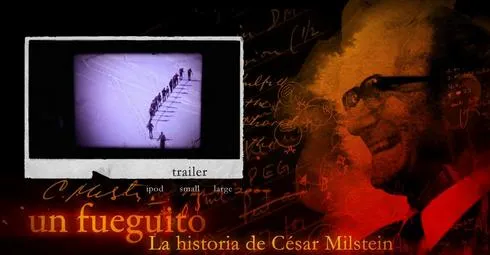
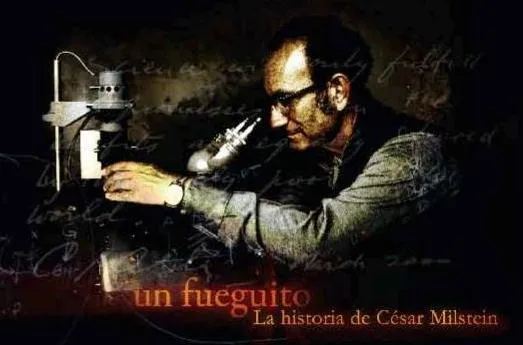
Dissemination of the documentary "A little fire. The story of César Milstein"
The documentary A Little Fire narrates the life of the last Argentine Nobel Prize winner, César Milstein, and travels to the heart of a key moment in the history of molecular biology. The documentary has had the economic-financial support of the Ministry of Science, Technology and Productive Innovation of the Argentine Nation with the backing of the Leloir Institute Foundation and FUDETEC (Foundation for Technological Development) in Argentina, Celia Milstein, the Laboratory of Molecular Biology (MRC-LMB) and Dunn School of Pathology of the University of Oxford in England, and Genzyme Corporation in the United States.
http://historiamilstein.com/
The documentary will premiere on March 11.
Tunnel of science
The exhibition El túnel de la ciencia will take place from March 4 to April 19, 2010. As part of the Bicentennial celebrations and its policy of promoting scientific culture, the Ministry of Science, Technology and Productive Innovation is organizing the Tunnel of Science, a multimedia exhibition by the Max Planck Society that allows the general public to come into contact with the latest ideas in modern research.
Buenos Aires in the Bicentennial
The meeting point of the City of Buenos Aires brings together the proposed projects, which are varied and cover different aspects of the life of the city's inhabitants.
In relation to Science and technology, the City's projects include:
Planetarium: 200 years after the May Revolution, today presents the opportunity to carry out a major technological modernization at the Galileo Galilei Planetarium, which for more than four decades has not received contributions allowing it to update its projections.
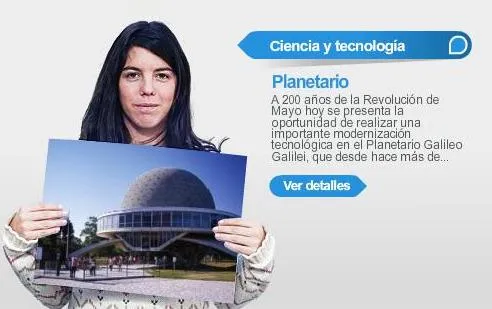
Thanks to the scheduled digitization, the Planetarium will receive the latest and most innovative tools to bring the world of astronomy closer to the citizens and visitors of Buenos Aires.
The inauguration of the renovations is scheduled for April 2010.
The time capsule
In the Bicentennial, the City looks to the future with the Time Capsule. The people of Buenos Aires will have the opportunity to leave their testimony and message so that future generations know what the Bicentennial residents were like, what they thought and dreamed.
A web 2.0 platform will allow citizens of Buenos Aires and the world to upload their images, texts and videos, to tell the generation that will live in 2210 who we were and how we lived in this era.
Sources and related links
About the images
- Video: Animation of the Scientific Technological Pole.
Credit: Secretaría de Medios/Prensa Argentina - Image from the documentary "Un fueguito". Credit: Ana Fraile.