Social scientists integrated into CERN to study the great scientific collaboration.
Among the topics of this article, originally published in Nature, are the role of peer review in scientific publication, the stress of scientists, and the role of blogs.
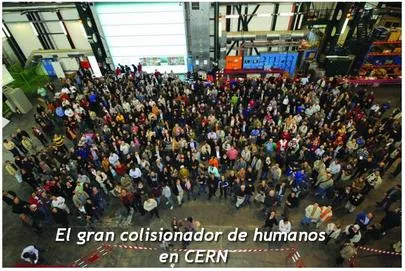
"I am here to observe you," anthropologist Arpita Roy introduced herself when she presented herself in 2007 in a room full of particle physicists from the Large Hadron Collider (LHC).
The powerful accelerator gathers the hopes of generations of physicists who designed it to achieve energies never before reached in a collider and, perhaps, produce a zoo of new particles for science. But the LHC is also a huge human experiment, bringing together a large number of scientists. That is why, in recent years, sociologists, anthropologists, historians, and philosophers have visited CERN to observe how this dense mass of beings collide, bounce, and sometimes explode.
"The LHC allows a unique sociological study of how an experiment develops in real time: how scientists form opinions, make technical decisions, and circulate knowledge in such a large project," said Arianna Borrelli, a particle physicist and philosopher at the University of Wuppertal in Germany.
Sergio Bertolucci, director of research at CERN, is fully aware of the importance of a cohesive collaboration. "This is an incredible social experiment," he noted, pointing out that nearly 10,000 physicists from around the world take part in the experiments and 2,250 of them are employees of the European Organization for Nuclear Research. To reflect the size of the collaboration he manages, and the headache it entails, Bertolucci invites us to imagine "the organization's needs when three thousand people want to know in advance if they can go home for Christmas."
And the headaches started soon after September 2008. Shortly after the first week of being online, an electrical fault caused an explosion that halted the project for 14 months. That demoralized the scientists, particularly the graduate students worried about the fate of their degrees, noted Arpita Roy. She is also a graduate student at the University of California, Berkeley, and went back and forth to CERN for three years to observe the "language, taboos, and rituals of this exotic community."
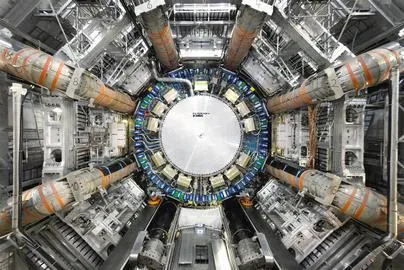
The collider resumed operations in November 2009 and will collect two years of data before stopping for scheduled upgrades in 2012. Next month, the LHC could reach record energies of 7 TeV by accelerating two beams of protons to nearly the speed of light and sending them in opposite directions around the 27-kilometer track. On their journey they pass through four detectors where the great science happens. Two of the largest detectors are ATLAS and CMS each with nearly three thousand people on their teams.
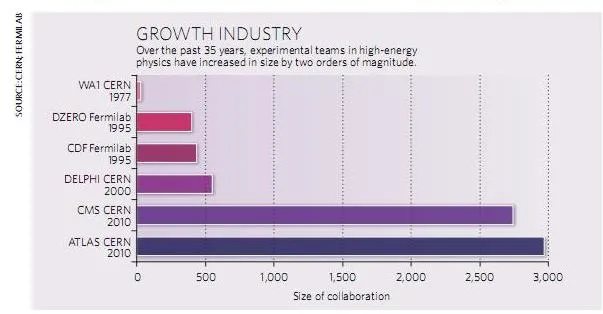
Population explosion
Each generation of colliders has seen a leap in the size of collaborations, as illustrated in the graph above, a trend that provides great opportunities for researchers concerned with human interactions. Karin Knorr Cetina, a sociologist at the University of Constance in Germany, is one of the few social scientists who witnessed this growth directly over several generations. She has studied CERN collaborations for nearly thirty years.
We talked about Karin Knorr Cetina when we commented on the book "The Scientist Is Also a Human Being," in the article "The Scientist in His Labyrinth".
When Cetina arrived, physicists were working on a smaller collider and the detector teams were less than 10% of their current size. "In those days, 100 people on a team was considered huge," she recalls. She also noted that they received her with a kind of bemused confusion, helped her, but that physicists thought of a sociologist as "a poor cousin of real scientists."
That attitude continues today, said Roy. "What can you say? Physicists are professionally dismissive," she quipped.
Social scientists say they gain the trust of physicists by becoming part of the culture themselves. Cetina uses this approach to unravel the "peacekeeping" politics among the hundreds of scientists in the laboratory.
When Cetina arrived, she commented, "I expected the same command lines we know from other complex organizations—industry or government." But she did not find the same hierarchy at CERN. Although there are spokespersons who hold positions of authority in the collaboration, there is no top-down decision-making (verticalism) because there are many specialized teams working on different parts of the detector. Cetina says that at CERN "the industrial model does not work. A human simply cannot make technical decisions on such a large scale."
CERN's unconventional structure stems in part from its history and philosophy. The laboratory was established on the Franco-Swiss border in 1954 to unite a Europe that had been fractured by war. "It is a place for global collaboration, where science exists beyond the politics of nationality," said Bertolucci. But within the laboratory, idealism meets the tensions of conducting research. "The paradox is that science is not democratic; we do not determine who is right by majority vote."
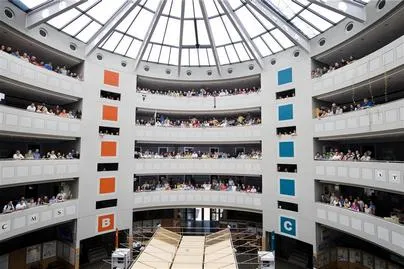
If it is not that of an industry or a democracy, what is CERN's structure? Knorr Cetina says the institution functions as a community, where physicists leave their homes and their individualism to work for a greater good. The lifestyle is driven by the fact that the laboratory is located in its own territory. (My note: A scientific "Vatican"?)
CERN has its own restaurants, post office, bank, and other facilities. "You can live forever at CERN, with no need to visit nearby Geneva. It is a cognitive bubble you cannot escape... that you do not want to escape," commented the sociologist.
Bertolucci says that immersion is essential for success as a global enterprise. "People who come from all over the world do not feel they are visiting another country, they feel they are coming home."
Sacrificing identity
Around the campus, the atmosphere is welcoming and its two restaurants live up to their reputation for offering the best food of any physics canteen in the world. But more than comfort and the promise of discovering new particles is needed to persuade hundreds of scientists to join the community. Cetina points to the organizational structure as a factor that leads physicists to sacrifice their identity to the LHC.
As a window into that structure, it describes the evolution of the ATLAS team, which it studied from its formation in the late 1980s. ATLAS will be searching for the elusive Higgs boson, a hypothetical particle that would give the others their mass.
During the initial stage of ATLAS, the LHC directorate had to choose between several design proposals offered by rival groups from different institutions. It might seem that the most obvious and efficient strategy would be a committee of experts. However, the ATLAS group did not choose that path, according to Cetina, but rather underwent a laborious process until everyone agreed. "It's an interesting strategy for getting groups to accept losing, but remain committed to the collaboration."
This prolonged process delayed construction. Physicists laugh that there are still brochures indicating "the start of the LHC in 2000," a completion date off by almost a decade. Those delays were frustrating, but a necessary cost to maintain the collaboration, noted the social researcher.
Albert de Roeck, spokesperson for the CMS experiment, notes other practical reasons behind the strategy. "The spokespersons are considered the 'bosses' of the experiment, but we really have no way to force decisions," he said. In industry, if people don't agree and refuse to perform their tasks they can be fired, but in CERN experiments the physicists are primarily employed by the universities.
John Krige, a historian at the Georgia Institute of Technology in Atlanta, who studied the collaboration structure at CERN before the formation of ATLAS, agrees with this view. However, he notes that the word "commune" implies there is little rivalry among the collaboration members. In contrast, he points out, there is a healthy "organized competition" among the subgroups working to build the various detector components quickly and efficiently.
Now that the collider is running, there are other policies in the collaborations that reinforce the communal over the individual. All papers containing experimental results must list the name of each member of the hundreds that make up the teams, ordered alphabetically by country, giving little clue to the actual "originators" of the work.
"This could never happen in biology, where the most intense disputes are about publication and reputations are established by your publications," said Cetina, who also studied the life in the molecular biologists' laboratory.
"Much of the narrative of science is about the individual genius—even the Nobel can be shared by only three people," commented Maria Ong, a sociologist from Cambridge. "The LHC is an incredible anti-example of that."
Conclusions
Collective authorship raises new questions about the construction of knowledge in particle physics, notes Peter Galison, a historian at Harvard. In February, the CMS collaboration published its first paper based on an analysis of data that showed a greater than expected number of particles, known as mesons, were produced during the first collisions. (CMS Collaboration J. High Energy Phys. doi:10.1007/JHEP02(2010)041; 2010) The paper includes 15 pages with author names, totaling between 2,200 and 2,300 people (the collaboration itself is not sure of the exact number). "Can you say that no single person truly understands all the knowledge it contains?" asks Galison. And who can externally review the papers produced? "You reach a point where the only people qualified to review the work are within the collaboration."
De Roeck says the size of the teams affects the review of the work. The CMS article went through months of rigorous checking and revisions during its internal review process. In contrast, it passed the external review by the Journal of High Energy Physics in four days. "External review for publishing in journals is becoming less important because it is much less demanding than our internal processes."
Despite the communal nature of the teams, there is a recent element of tension. An increasing number of physicists have turned to blogs. Although most posts are not controversial, at Fermilab they had to deal with cases where physicists leaked information before it was ready for release. James Gillies, spokesperson for CERN, says the European laboratory does not wish to censor blogs, but provides strict guidelines about when it is appropriate to discuss results.
Even so, the blogging phenomenon at CERN—and its possible tension with official lines of communication—will be closely followed by Borrelli as part of a team of more than 20 historians, philosophers, and sociologists.
"It will be a real-time study of how knowledge circulates in such a project," explained Borrelli. He is particularly interested in the immediacy of publication in the physics community via arXiv, where a hundred drafts are deposited every day and are freely accessible. "How do physicists select papers and navigate this flood of information?" he wonders.
Social scientists are looking beyond the professional lives of scientists to account for how collaborations affect them on a personal level. Knorr Cetina says that many particle physicists have nightmares in which their actions cause the project to fail. "They are the nightmares of those who perceive themselves as a link in the chain, not as individuals," she explained.
Abnormal stress
Cetina argues that the anxiety shown by physicists is greater because they strongly identify with the detector. (K. Knorr Cetina Interdiscipl. Sci. Rev. 32, 361–375; 2007). "It's an object they build with their hands, but they describe it like a friend." When reporting their nightmares, physicists describe themselves as agitated by the imaginary loss as if it were family members, something not routinely seen in other scientists.
De Roeck agrees that physicists at the LHC are under extreme pressure. Each experiment is composed of subgroups and none wants to be the weak link.
Physicists are making plans for the new generation of particle accelerators. But that might provide little new territory for sociologists to explore. "There won't be a further step in collaboration size to 25,000 physicists," says Galison. "We are touching the limits of people in high-energy physics."
Sources and related links
Physics: The Large Human Collider, by Zeeya Merali
Nature 464, 482-484 (2010) | doi:10.1038/464482a
About the images
Image credit: CERN/ATLAS/CMS