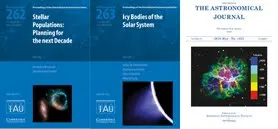
The proceedings of two IAU Symposia (262 and 263) with significant participation from researchers in our country have been published.
Since last year, we have wanted to provide from here a notion of the research produced by Argentine astronomers. Additionally, the links to the researchers' CVs and the institutions' pages allow us to learn a bit more about the professionals in our country.
From August 3 to 14, 2009, the XXVII General Assembly of the International Astronomical Union (IAU) was held in Brazil. Of the many symposia held on that occasion, several "proceedings" or "Proceedings" have already been published, and recently, two new publications from Symposia 262 and 263 were added. We also collected other scientific articles from local researchers.
Proceedings of the International Astronomical Union, Volume 5, Symposium S262
S262 Stellar Populations - Planning for the Next Decade.
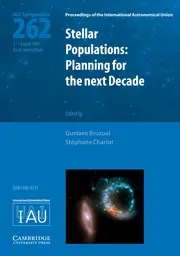
- Evolution of Stellar Population: Environments vs galaxy interactions
Josefa Perez (IAFE/CONICET), Patricia Tissera (IAFE/CONICET), Nelson Padilla (Pontificia Universidad Católica de Chile), Sol Alonso (UNLP/CASLEO) and Diego G. Lambas (Observatorio Astronómico de la Universidad Nacional de Córdoba)
pp 408-409
DOI: 10.1017/S1743921310003455
Several authors studied the dependence of galaxy properties on the environment to understand what mechanisms operate in galactic evolution. Among the proposed scenarios is that intermediate densities are sites where the environment influences the transition of galaxies. Based on this, the researchers used SDSS-DR4 data to analyze the role of close interactions and compared them with isolated galaxies from a control sample. - Control sample for galaxy pairs: Simulations and Observations
Josefa Perez and Patricia Tissera
pp 410-411
DOI: 10.1017/S1743921310003467 - The Tully-Fisher Relation in Numerical Simulations of Structure Formation
María E. De Rossi (IAFE/CONICET), Patricia B. Tissera and Susana E. Pedrosa
pp 327-328
DOI: 10.1017/S1743921310003078
The Tully-Fisher Relation is of fundamental importance for galaxy formation as it provides information about the relationship between the baryonic content and the depth of their dark halos. In recent years it has been possible to study this relation at different redshifts. However, there are still controversies about its origin and evolution. In this work, the authors attempt to determine the origin of the relation by employing cosmological simulations. - The Effects of Galactic Winds on the Chemical Evolution of Baryons
María E. De Rossi and Patricia B. Tissera
pp 325-326
DOI: 10.1017/S1743921310003066
The same researchers from the previous work study the influence of supernova winds on the chemical evolution of galaxies and the intergalactic medium by employing numerical simulations in a hierarchical universe. - Baryons and Dark Matter halo distributions in ΛCDM Cosmology
Susana Pedrosa, Patricia Tissera and Cecilia Scannapieco
pp 404-405
DOI: 10.1017/S1743921310003431
They analyze the distribution of dark matter in a halo of approximately one trillion solar masses, from a cosmological simulation. - Thousands of Milky Ways: galaxy satellites and building blocks
Nelson Padilla, Claudia Lagos (Universidad Católica de Chile) and Sofía Cora (CONICET, UNLP)
pp 240-243
DOI: 10.1017/S174392131000284X
A semi-analytical model of galaxy formation with and without active nucleus feedback was used to study the nature of possible galaxy building blocks (z=0). - Current status of galaxy formation modelling
Patricia B. Tissera
pp 231-239
DOI: 10.1017/S1743921310002838
The researcher summarizes the main characteristics of galaxy formation models and discusses some of the main results obtained in recent years.
Proceedings of the International Astronomical Union, Volume 5, Symposium S263
IAU Symposium 263: Icy Bodies In The Solar System
Rio de Janeiro, Brazil -- August 3-7, 2009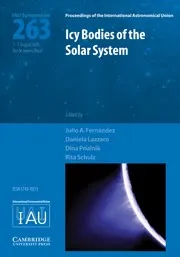
- The contribution of plutinos to the Centaur population
Romina P. Di Sisto, Adrián Brunini and Gonzalo C. de Elía (all three: UNLP, IALP - CONICET)
pp 89-92
DOI : 10.1017/S1743921310001559
A study of the dynamic evolution of plutinos recently escaped from resonance, through numerical simulations. - Impactor Flux on the Pluto-Charon System
Gonzalo C. de Elía, Romina P. Di Sisto and Adrián Brunini
pp 98-101
DOI: 10.1017/S1743921310001572
They study the impact flux on Pluto and Charon due to collisions with Plutinos, for which they developed a statistical code. - Numerical simulations of Jupiter Family Comets; physical and dynamical effects
Romina P. Di Sisto, Julio A. Fernández (UNLP, IALP - CONICET) and Adrián Brunini
pp 102-105
DOI: 10.1017/S1743921310001584
They present results of numerical simulations of a comet transferred to the Jupiter zone by gravitational interactions and present maps of the densest zones of Jupiter Family Comets (JFC, members of the group of periodic comets whose orbits were modified by passing near the gas giant).
Other articles - Integrated spectroscopic study of 7 star clusters in the Small Magellanic Cloud
Talavera, M. L. (Observatorio Astronómico Centroamericano de Suyapa); Ahumada, A. V. (ESO, Observatorio Astronómico, UNC, CONICET); Santos, J. F. C., Jr. (UFMG); Clariá, J. J. (Observatorio Astronómico, UNC); Bica, E. (UFRGS); Parisi, M. C. (Observatorio Astronómico, UNC); Torres, M. C. (Observatorio Astronómico, UNC)
in: Astronomische Nachrichten, Vol.331, Issue 3, p.323
DOI: 10.1002/asna.200911299
2010AN....331..323T
DOI: 10.1002/asna.200911299
They present data on seven star clusters in the Small Magellanic Cloud, obtained at CASLEO.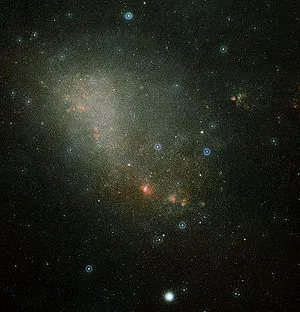
- High-energy emission from jet-cloud interactions in AGNs
Araudo, Anabella T. (Instituto Argentino de Radioastronomía (CCT La Plata - UNLP -CONICET); Bosch-Ramon, Valenti (Max Planck Institut); Romero, Gustavo E. ((Instituto Argentino de Radioastronomía (CCT La Plata - UNLP - CONICET)
In the Proceedings of "High Energy Phenomena in Relativistic Outflows (HEPRO) II", Buenos Aires, Argentina, October 26-30, 2009.
arXiv:1003.4676v1
Active galactic nuclei present continuum and emission lines. The emission lines originate from gas located near the central supermassive black hole. Some of these lines are broad and produced in a small region (broad-line region). That region could be formed by clouds around the central black hole. In this work they study the interaction of those clouds. - Simultaneous k- and l-band spectroscopy of be stars: circumstellar envelope properties from hydrogen emission lines
A. Granada, M. L. Arias and L. S. Cidale
The Astronomical Journal, Volume 139, Number 5
DOI: 10.1088/0004-6256/139/5/1983
Researchers from the Facultad de Ciencias Astronómicas y Geofísicas, Universidad Nacional de La Plata and the Instituto de Astrofísica de La Plata.
They present spectra of a sample of Be stars obtained with Gemini/NIRI. - Dynamics of two planets in co-orbital motion
C.A. Giuppone and C. Beaugé (Observatorio Astronómico, Universidad Nacional de Córdoba), T.A. Michtchenko (USP Brazil), S. Ferraz-Mello (USP Brazil)
arXiv:1004.0726v1
They study the stability regions and families of periodic orbits of two planets trapped in a co-orbital configuration. - The interstellar medium surrounding the Scorpius-Centaurus association revisited
Pöppel, W. G. L. (Argentine Institute of Radio Astronomy – CONICET); Bajaja, E. (IAR-CONICET); Arnal, E. M. (IAR -CONICET-UNLP); Morras, R.(IAR -CONICET-UNLP)
2010A&A...512A..83P
in: Astronomy and Astrophysics, Volume 512, id.A83
DOI: 10.1051/0004-6361/200811290
A large-scale study of the morphology, kinematics and origin of the H1 region surrounding the Scorpius-Centaurus stellar association - Planet Formation: Statistics of spin rates and obliquities of extrasolar planets
Yamila Miguel, Adrián Brunini (both: IALP, UNLP, CONICET)
arXiv:1004.1406v1
They developed a simple model of planet formation, focusing on those planets with masses less than 10 Earths. - Science and Detectors of the Pierre Auger Observatory
A. Etchegoyen for the Pierre Auger Collaboration
arXiv:1004.2635v1
In the Bulletin of the Asoc.Arg. de Astrononomía BAAA, Vol. 52, 2009
Sources and related links
What do Argentine astronomers study?
Argentine articles in A&A 2009
Argentine articles in APJ and AJ 2009
About the images
Small Magellanic Cloud. Credit: NASA/ESA/HST