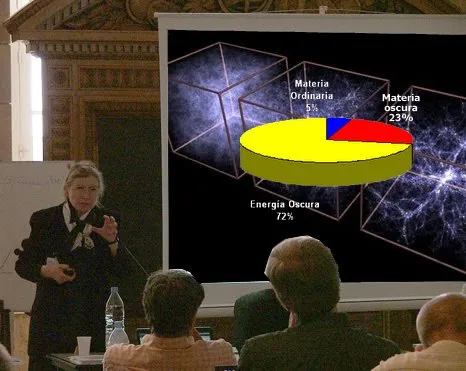
Two Argentine and one Italian researchers mathematically developed the cosmological spectrum of dark matter. Sterile neutrinos, tremble...
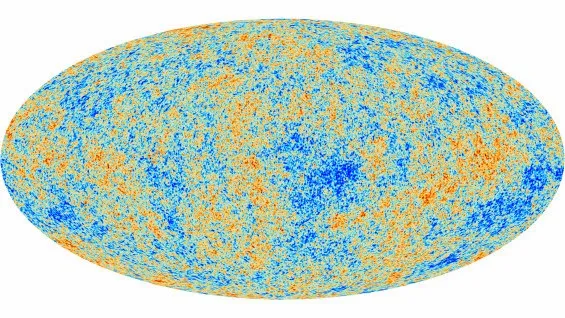
A team of researchers from the Observatoire de Paris, the Université Pierre et Marie Curie (UPMC) and the Università Milano-Bicocca, calculated for the first time the spectrum of cosmological fluctuations for different types of dark matter and obtained the mathematical explicit expression in terms of particle mass and other parameters.
These spectra provide the initial data for the formation of structures in the universe and allow the identification of physical parameters in the different schemes and evolution (linear or non-linear) of cosmic structures and galaxies. These theoretical results are relevant for comparison with observations of distant galaxies (with high redshift, z) and have implications for star formation.
Context
81% of the matter in the universe is composed of dark matter [#1]. It is different from ordinary visible matter formed by atoms since it is not perceived (because it has no electroweak interaction) and manifests itself through gravitational action. For current models this matter is essential for the composition of galaxies. As a result, dark matter and gravity play a decisive role in the formation and structure of galaxies.
Dark matter appears as a thesis when observations of galaxy rotation were made that did not match gravitational theory (Newton's). That discrepancy deserved different hypotheses: That Newton's theory requires a correction; or that there is something in and between galaxies that cannot be observed with instruments that detect radiation.
There are researchers working on the former. Regarding the second hypothesis, several alternatives opened up: massive "dark" bodies like black holes or planets or a type of matter not known until then. This division is known as baryonic dark matter (composed of baryons, like the matter we know) and non-baryonic, respectively. The baryonic one seems to be ruled out.
For cosmologists the three possible types of non-baryonic dark matter are:
1-Cold (CDM), consisting of very heavy particles, very slow (velocity almost zero), so they are almost frozen. (m ∼ 1 − 1000 GeV). They are WIMPs.
2-Hot, consisting of very low mass particles and high velocities, close to that of light. However, observations of large-scale structures and galaxies have shown that hot dark matter is incapable of forming galaxies, so it is no longer considered.
3-Warm (WDM): formed by particles with mass in intermediate energy scales (m ∼ 1 keV) with their corresponding velocities. For large scales, the warm dark matter model yields the same results as cold dark matter and is consistent with observations of CMB (Cosmic Microwave Background) anisotropies. They would be sterile neutrinos.
The work
The evolution of primordial fluctuations during the different periods of expansion of the universe led to the formation of the structures observed today. The team mathematically solved that evolution from the big bang to the present and obtained the spectrum of warm dark matter, its properties and its comparison with cold dark matter. These spectra provide the initial data for structure formation and allow the identification of physical parameters in the different models of cosmic formations: the linear model (when fluctuations are low), and the non-linear one (when structures are formed) and yield these results:
1-Non-linear structures of warm dark matter began to form later than in the case of cold dark matter.
2-In that regime, structure formation began earlier for small objects than for larger ones, so there is a hierarchical scheme.
3-The effect of removing small-scale substructures in warm dark matter compared to cold increases with redshift and the structures formed with WDM reproduce observations on all scales.
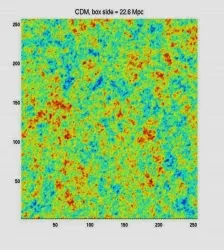
Fig.1: Primordial fluctuations of cold dark matter: They produce the large-scale cosmic structures, but result in many small unobserved formations. That is the problem of CDM, the overabundance of "satellites".
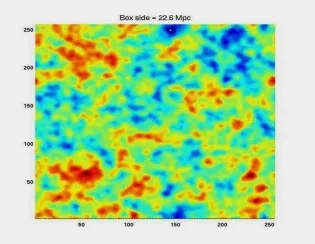
Fig.2: Primordial fluctuations of warm dark matter: They produce the observed large structures and also the correct number of small ones, in smaller quantity. The reason for this small structure removal effect is the mass and velocity of the particles.
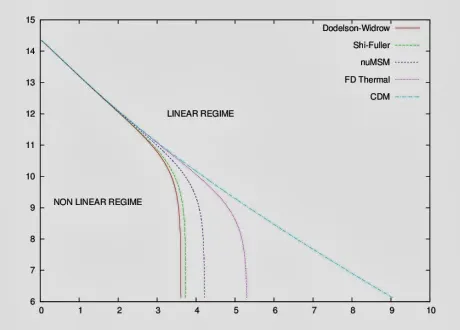
Fig.3: Linear and non-linear regimes for different types of WDM. CDM is indicated by the light blue line. (The rest of the lines are WDM models like the Dodelson-Widrow one).
The diagram shows vertically the logarithm of [0.7M/Sol] where M is the mass of galaxies, versus the redshifts z on the horizontal line. For large masses, cold and warm dark matter yield similar results. They differ mainly for small structures and for z>4, hence the importance of observations on that scale.
Implications
The theoretical predictions allow comparison with observations of distant structures (high z, between 4 and 12). It has implications in the formation of young stars: the action of WDM on ordinary matter produces the formation of filaments with stellar or protostellar cores through the fragmentation process. Precisely the results of recent observations with Herschel point to star formation through filaments with those characteristics. Furthermore, through decay, WDM can also stimulate the production of molecular hydrogen and accelerate star formation at a high z.
The researchers
Claudio Destri is a researcher at the Università Milano-Bicocca and INFN.
Norma G. Sánchez and Héctor J. de Vega are two Argentine researchers based in France, at CNRS, LERMA, Observatoire de Paris. Dr. Sánchez is the director of the "Daniel Chalonge" school.
Sources and related links
- C. Destri, H. J. de Vega, N. G. Sanchez
Warm dark matter primordial spectra and the onset of structure formation at redshift z
Phys. Rev. D88, 083512 (2013)
DOI:10.1103/PhysRevD.88.083512
arXiv:1308.1109v2 [astro-ph.CO] - Chalonge Scientific News (pdf): Dark Matter cosmological spectra and the beginnings of Structure Formation
- [#1]According to the Planck mission, the distribution would be 26.8% dark matter; 4.9% ordinary matter; 68.3% dark energy.
About the images
- Credits for Figs.1-3: C. Destri , H.J. de Vega and N.G. Sanchez.
- Initial image, Credit: ESA / Planck Collaboration.