Skyalert.org is a web application that collects observations of astronomical events and adds annotations, disseminating the information among subscribers.
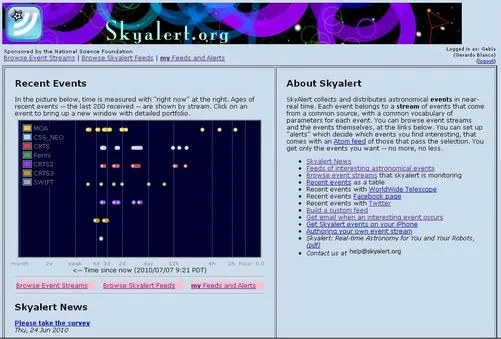
From here we have been reviewing some quantitative and qualitative changes in the information collected by astronomical observatories. That flood of data, besides requiring a lot of storage space, can be shared thanks to new computing tools and the web.
The idea of Skyalert arises from these possibilities with the goal of knowing, almost in real time, events discovered by sky surveys and space missions.
The web application is a prototype system that attempts to collect the information and disseminate it automatically and is aimed at professionals, amateurs, and students alike.
The information comes from different sources (streams) and is designed to be able to work with events in general and not a specific solution for certain sources, so that they can be easily added.
To receive the information you must register and subscribe to the information you want, being able to filter it according to each person's interest. For example, it is possible to have a feed of events from the Catalina Real-time Transient Survey (CRTS) stream that are brighter than magnitude 16, or all Swift events that are probably GRBs.
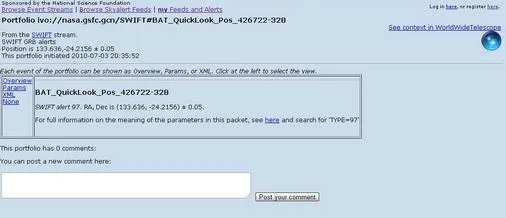
Each event has a web page with data and comments. For example, one source is SWIFT:
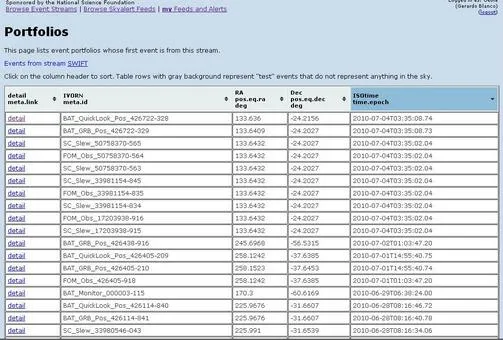
Here we see a series of SWIFT events. If we click the first one, we get specific information and it is possible to leave comments there:
Among the available sources are AAVSO, CRTS, Fermi, GALEX, SDSS and more.
The feeds for each source are already created by the system, although it is possible to create new ones, customized for particular needs.
Among the system feeds are: bright CRTS (magnitude less than 17), Swift BAT GRB (the GRB monitor), etc.
To create an alert, we must go to the creation page and:
1-Choose the stream
On the next page we must:
2a-give the alert a name
2b-Change the event trigger expression, that is, what criterion a phenomenon from the previously indicated stream must meet for it to be of interest to us. By default, that box only says "True". For this, below this second page we will have clickable parameters that, when clicked, will insert the correct code into the expression box.
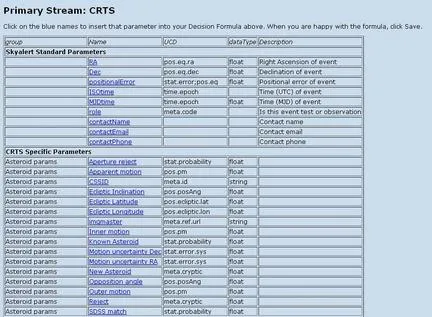
The code that is inserted when clicking the parameters is not complete since it only inserts the name of the parameter to be verified, but we must indicate a value above or below which the event becomes interesting to us.
For example:
I choose as stream CRTS and as secondary SDSS, name the alert Test and in the parameters I click on "Magnitude" and it will insert:
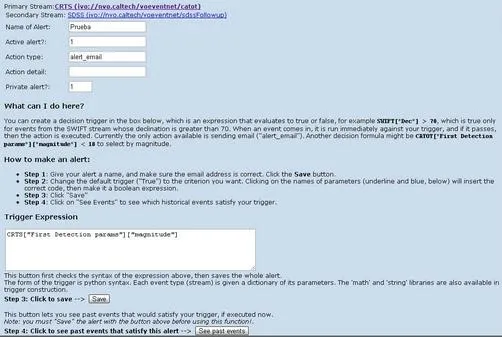
2c-To complete the code I must indicate whether the magnitude of the events that interest me must be greater than, less than, or equal to a certain value. For example: > 15, so that the code finally becomes:
CRTS["First Detection params"]["magnitude"] > 15
3-Then I must save and I will be able to see past events with the newly created alert. I will also be able to edit the alert and subscribe to the feed to be informed of events through a feed reader, like Google Reader.
The trigger expression form, as indicated on the Skyalert page, uses Python syntax. Each parameter has its data type and a description indicated (all in English).
They point out that the string and math libraries are available for building the triggers.
Skyalert has a Twitter account and a Facebook page.
And it allows viewing recent events as a table, on the iPhone, or in Worldwide Telescope.
It is, in short, one more example of the uses of new tools in the service of astronomy, which will surely expand in the future with more data sources and greater possibilities.
The authors of the idea are Roy Williams, George Djorgovski, Ciro Donalek, Andrew Drake, Sarah Emery Bunn, Matthew Graham, Ashish Mahabal and Rob Seaman.
Sources and related links
- Astrotwitter: a star to be born
- Skyalert: Real-time Astronomy for You and Your Robots
R. D. Williams, S. G. Djorgovski, A. J. Drake, M. J. Graham, A. Mahabal (California Institute of Technology)
arXiv:0906.2186v1 - Skyalert: a Platform for Event Understanding and Dissemination
Williams, Roy; Drake, A. J.; Djorgovski, S. G.; Donalek, C.; Graham, M. J.; Mahabal, A.
2010AAS...21547701W - Skyalert: A Web Application to Manage Astronomical Transients
Graham, Matthew; Williams, R. D.; Djorgovski, S. D.; Drake, A. J.; Mahabal, A.
2009AAS...21440703G
About the images
- Skyalert screenshots. Credit: Skyalert.