I am translating a note that appeared on Skepchic, a blog run by a skeptical group of women who write, in this case, about the value of critical thinking, through a particular case linked to health.
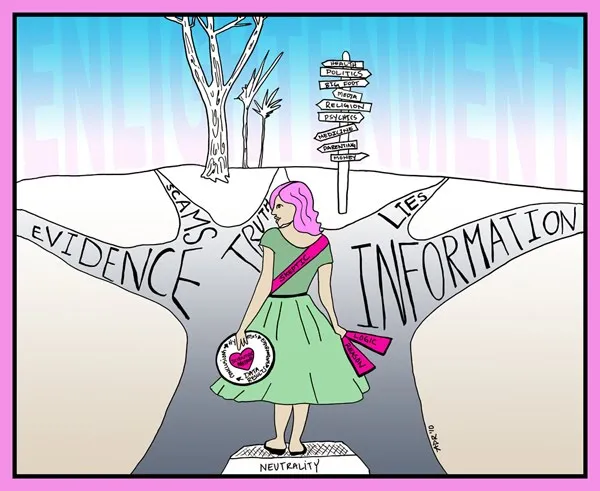
Amy, from Skepchic, writes a note addressed to other critical thinkers to point out the value of what they do, in the article "What You’re Doing Is Important".
Here I translate the note:
As skeptics we spend a lot of our time telling people they are wrong, that their beliefs are false. We do that not because we think we are better than others, but because we want to help people understand science and know how things really work so that, in turn, they are not taken advantage of financially, put in health dangers, or something worse.
Skeptics are not "contrarians" (#1), we try to make the world safer and foster advances in technology and medicine. We strive to achieve intellectual enlightenment not only for ourselves but for everyone.
We are, on the one hand, science communicators and on the other, consumer protection advocates. But even with these idealistic good intentions, we are usually the odd man or woman out at parties, the ones left in a corner. We are seen as pessimistic and argumentative, faithless, grumps who will ruin the fun and hope of others.
We are labeled "know-it-alls" or incorrectly considered closed-minded. We are, after all, the ones who stand up and speak when the majority wants to believe in homeopathy or angels or some kind of magical thinking. We are the ones who pop the bubbles, dispel the myths and sometimes end the fun of irrational fantasies. We explain how things are really. This loud bravery in the name of rationality often puts us in the minority and that can be a very lonely and difficult place to be.
It is important to remember that while we are rarely (if ever) thanked or have our hand shaken for our efforts, what we do is important and it makes a difference. So the next time your friend or coworker gives you a dirty look when you explain how homeopathy doesn't work or how a chiropractic neck adjustment can give you a stroke, or the fact that the real secret to "The Secret" (#2) is that it's pure nonsense, think about the following letter that was sent to us here at Skepchick.
The author asked to remain anonymous, but mentioned that he hopes we share the story with other skeptics, activists and educators. This letter was not just sent to the Skepchick writers, it was sent as a reminder to all of us.
What skeptics do is important
I have a story -a very personal one- about how critical thinking can be a matter of life or death.My wife has been pregnant with twins. Yesterday was week number 29. She went to the hospital after having had nausea for a few days. They were worried about dehydration, so they took her for an IV drip. Since my wife's doctor is incredible, she ordered a whole set of tests, just to be sure there was no damage.
What they found was HELLP syndrome (#3), a form of severe preeclampsia. If it had been noticed 24 hours later, it is very likely my wife would have died at home, taking the twins with her. They prepared her for an emergency C-section. As a result of the doctor's thoroughness, the quick and competent action of the medical team and the incredible technology, the result of decades of scientific research in medicine, both the mother and the twins are well.
What worries me is this: scientific medicine and our own critical thinking were key to saving my family. If we had gone to a naturopath instead of a hospital, they would all be dead. If we had sought the services of a "natural birth" with a midwife, instead of a team of doctors, *they would all be dead*.
And not ten years ago, before having learned to strengthen our critical thinking skills thanks to the skeptical community, we would have made one of those fatal decisions.
I tell you this because it is important to understand that *what you do is important*. Science saves lives. Critical thinking *saves lives*. Helping people understand these things...*saves lives*.
Thank you, and the skeptical community, for saving my family.
My notes
I would like to make some comments on the above, clarifying from the start that, as I am not a certified public translator of English, it is possible that some term or phrase is not the most appropriate. If you let me know, I will correct it, as appropriate. I also clarify that, except for the three notes indicated with the numeral symbol, the rest attempted to reflect exactly the original note (bolds and italics).
It is possible that part of this blog's audience wonders why I write about this on a supposed astronomy blog.
There are several reasons, namely:
a-Yes, I write primarily about astronomy, but for some time now, I have been trying to push the blog's boundaries a little further. My concerns include stimulating and fostering critical thinking in all areas, as well as other topics such as those related to the environment.
b-Soon I will write something related to climate change and critical thinking and I believe this note will be useful in that context.
c-I feel very identified with the first part, which describes people who try to have critical thinking as pessimistic and the social isolation that this can produce, in certain contexts.
d-Recently I had a health problem, popularly known as "shingles", although doctors call it Herpes Zoster.
I must admit that I find it somewhat embarrassing to talk about it publicly. Until now I had tried to tell only a few people, but I recognize that feeling is silly.
I mention it here because many of the people who quickly found out what happened to me, the first thing they told me was to go to a folk healer.
It is clear that I did not do it and I am recovering. The Wikipedia entry describes very well what happened to me and the treatment indicated there was exactly the one indicated by the doctors I consulted.
This note talks about a particular case. I must say that I don't think natural childbirth is incorrect to perform (many of our mothers or grandmothers did it that way), but logically with medical control. Otherwise, the person who wrote that letter could have lost the most valuable thing a human being can have.
It goes without saying, although it would warrant a separate note, that exercising critical thinking does not mean not making mistakes, or "being smarter". It's not a genetic issue: we can learn, that's what it's about. It's not that by trying to have critical thinking we are always going to be right over others.
But it is essential to be able to separate the wheat from the chaff (belief from knowledge), especially in important matters, those where our lives are at stake.
Sources and related links
- #1 Contrarians: term used in the sense of "Against", a person who systematically opposes what others think. It can also be understood as "denier" or "opponent".
- #2 I suppose it refers to the movie The Secret.
- #3 See HELLP Syndrome.
- What You’re Doing Is Important
About the images
- Image from Skepchick.org.