The International Union of Pure and Applied Physics (IUPAP) announced the awarding of the Young Scientist Prize in Particle Physics to an Argentine physicist and a Spaniard.
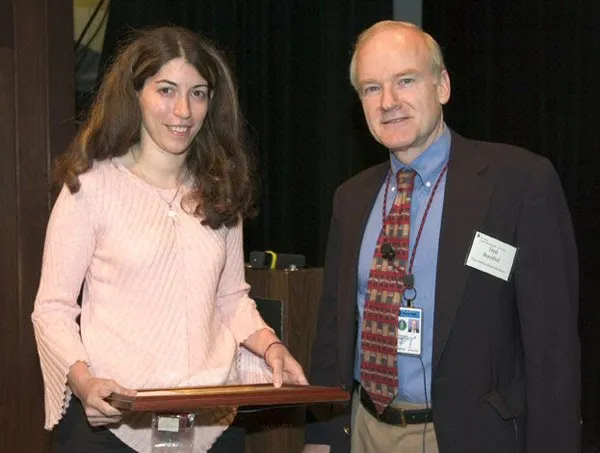
The prize was awarded to: Florencia Canelli, of the Enrico Fermi Institute, University of Chicago and Fermilab and José Santiago of the Department of Theoretical Physics and the Cosmos and CAFPE, University of Granada.
Canelli was recognized for her pioneering contribution to the identification and precise measurement of rare phenomena through the use of advanced analysis techniques to separate very small signals from large background processes at the Tevatron collider.
Santiago is congratulated for his contributions to a number of areas of particle physics including Quantum Chromodynamics, electroweak physics, theories of gravity and extra-dimensional models.
"We are very excited about the opportunity to recognize the achievements of these two scientists who have demonstrated leadership and creativity in their particle physics research," said Patricia McBride, of Fermilab, head of the Commission on Particles and Fields of IUPAP (Commission 11).
At each International Conference on High Energy Physics (ICHEP), which takes place every two years, IUPAP plans to honor two young scientists, one experimental and one theoretical, in recognition of excellence in the field.
The awardees will receive their prizes and give presentations at the plenary session on July 26 at the 35th ICHEP Meeting in Paris. Each will receive a medal, a certificate and a small monetary award.
Canelli, who worked for ATLAS, CDF and D0, studied at the University of Rochester, at the University of Asunción, Paraguay and at the University of Buenos Aires. She is one of the founding members of the Young Particle Physicists (YPP) organization and received the Frederick Lobkowicz Thesis Prize from Rochester (along with Ben Kilminster) as well as the New Talents award. In 2004 she received the URA prize awarded by Fermilab and Universities Research Association for the best doctoral theses. And the same year, together with Juan Estrada and Gastón Gutiérrez they made a new measurement of the Top quark mass. In 2005 she received the Mitsuyoshi Tanaka Prize from the APS and last year she was recognized by the Sloan Foundation as a fellow.
Canelli holds Italian citizenship and is married to another researcher (from Ohio State University) who also works at D0, according to Adrian Cho in a 2008 article published in Science about the future of Fermilab.
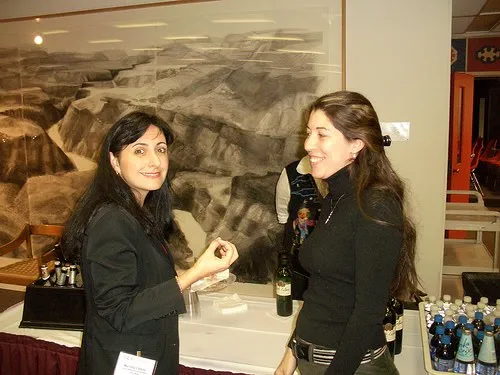
She is not the only physics researcher from our country who triumphs in the world. Nor the only one at Fermilab. We already commented here about Marcela Carena and her participation in the fabulous documentary The Atom Smashers in The Atom Smashers: The Documentary.
Some of Florencia Canelli's articles on arXiv and on SPIRES.
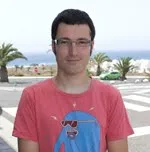
José Santiago Pérez was born on July 30, 1975 in Jaén. He studied at the University of Granada and obtained his Master of Science in Theoretical Physics in 1998 and his doctorate in 2002.
He conducted postdoctoral research at the Institute for Particle Physics in Durham, Fermilab, ETH Zurich and since last year he has been a Ramón y Cajal contract researcher in the Theoretical Physics department of the University of Granada. He has also been an editor and referee for several prestigious scientific publications.
Works by José Santiago on SPIRES-HEP and on arXiv.
Sources and related links
- IUPAP Awards Young Scientist Prize in Particle Physics
- A Spanish researcher, international prize for best young theoretical physicist in particle physics
- Does Fermilab Have a Future?
Adrian Cho
Science 30 May 2008:
Vol. 320. no. 5880, pp. 1148 - 1151
DOI: 10.1126/science.320.5880.1148
About the images
- Fred Bernthal presenting the URA prize to Florencia Canelli. Credit: Fermilab Today.
- Image of Marcela Carena and Florencia Canelli by Gordon Watts (2005) on Flickr.
- Photo of José Santiago from CPAN.