On how critical and objective science communication is or should be, following a journalistic article.
I write here some articles related to critical thinking, which tries to promote criticism, mainly in the face of extraordinary claims, typical of pseudoscience.
But our thinking would not be truly critical if we do not also apply it to ourselves. We have to look at our own navel.
Matías Alinovi writes in the Futuro supplement of Página/12 an article about what a science journalist is and what, in his opinion, one should be. The note "Divulgación científica, fascinación y crítica" is not to be missed and I recommend reading it in full. What follows is not an objection to his thinking, but rather an extension.
Basically, Alinovi -who studied Physics at UBA and is the author of several books, including Historia universal de la infamia científica- invites us to reflect on the need for the science journalist to be critical.
If criticism is not exercised, one falls into being only a translator of technical and hermetic concepts into simpler ideas to digest. Certainly that task is part of the communication activity, but it is not the only one. Opinion and, therefore, subjectivity also count, and a lot.
Says Alinovi:
What we propose is a step forward of subjectivity. That the science journalist sheds the cloak of invisibility, that he stops obeying those transcendent mandates, that he abandons his essence, and becomes, existing subjectively, in what we could perhaps identify as a communicator: a cultural critic of science.
Let's say right now that if there is no explicit opinion, there is one anyway, albeit veiled. By choosing a topic, by choosing how, what, when to tell something, we are choosing over other possible forms. We are being subjective, even if we do not admit it publicly. As a version of Watzlawick's first axiom we could say: "Non-subjectivity does not exist".
Journalistic work is often linked to objectivity, despite this. Both ideas are not opposed, they complement each other, at least as long as there is information and explanation of the facts. Once the implication, the context of a fact is known, then we can offer our particular point of view.
But it happens that many times the two (or more) sides of the coin are not shown. Why?
The problems of the critical attitude
As Alinovi points out, the science journalist's fascination with science can lead him to see nothing but feats in discoveries. Or the opposite. For example: recently, on the occasion of the 60th anniversary of CNEA, when writing an article here about it, I told of certain achievements of the National Atomic Energy Commission, but I also pointed out the pantomime of the Proyecto Huemul, as well as some disadvantages of that kind of energy.
However, it is possible that a journalist who admires nuclear scientists would have hidden such circumstances, or, that someone who is frightened by the consequences of atomic manipulation, would have focused exclusively on Chernobyl.
The dichotomy
Within the problem of fascination with science that clouds critical thinking, we have a particular case: adherence to a position for ideological reasons.
How many criticisms of the Theory of Evolution did Thomas Huxley point out? It is enough to point out that they called him "Darwin's bulldog" for how he defended the author of "The Origin of Species".
Paradigm shifts, within science, originate this type of positions. In order not to leave a gap for those who think the opposite, the failures or incompleteness of certain theories are not warned or pointed out -publicly-. Because, by doing so, a front would be opened that perhaps cannot be closed. And thus a quasi-warlike scenario is configured between scientific positions. Here there is subjectivity, in my view, misunderstood.
Another example: To say that perhaps it is possible that a supernatural being created the universe would be to open the door to a horde of charlatans, so it is better to defend the opposite to the extreme, to seal the borders.
Let it be clear: I believe that the Theory of evolution already has enough evidence to contradict it, but that there is still a long way to go to understand the mechanisms. And I disbelieve in the possibility of a supreme being existing, but it is a possibility that I do not rule out as false or accept as true, for lack of evidence in one case or the other.
We could put other examples (Teoría MOND vs. other theories about dark matter, etc) in which it is possible to find "fanatics". I talked about this in Júpiter y la caja de pandora.
Therefore, it is very healthy to give our opinion, but with extremisms as a border that we must try not to reach, because the end does not justify the means.
Another problem arises, in my opinion, in a difference in training (and deformation) among science journalists. It is not the same, from the start, a journalist with some scientific training, than a scientist with some journalistic training.
From reading a paper to analyzing science policies, the position will be different. I am not saying that one will be better than the other, but they are different. It is also possible that there is a good balance between journalistic judgment and knowledge, whether in a press worker or in a scientist.
To complicate the picture, journalistic judgment will vary according to the audience to which the message is directed. Alvin Toffler ventured the segmentation of the media in his "Third Wave". Nowadays, more than ever, we have magazines, radio and TV programs and blogs, increasingly specialized, aimed at a certain audience that is presumed to have some knowledge. The discourse will be different in each case. For a medium specialized in astrobiology, a text like the one recently published in Clarín (main section), titled:
"Para la ciencia, la vida extraterrestre dejó de ser una posibilidad insólita".
In media that try to reach a broader audience, specialized opinion can be given equally, with differences in language, in a simpler or smoothed way, but it is also possible. In fact, the opinion is there, even if it is not made explicit, as I pointed out before.
Ideological subjectivity
Scientists are also human beings. And there will be some fans of River or Real, like others who get excited at the Bombonera or at Camp Nou.
In the same way, they will have their political stance. A large number of researchers live off the State: they work in public institutions, receive grants to devote themselves exclusively to their work, and because of that or due to ideology, they may feel pleased with the current policy.
Or the opposite: a researcher may not get the funding they expect, an instrument they requested may be delayed, etc.
In both cases, apart from strictly scientific matters, there may be a predisposition for or against the State. And, again, this can lead to radicalized positions: if one is in favor of a certain government, then we must be against another. And this can happen within the same period, since in countries there are different political forces governing the various jurisdictions (National, Provincial, Municipal).
Again here lies the risk of fanaticism, of not wanting to see what is inconvenient, taking positions to the extreme.
Therefore, subjectivity in itself is not a guarantee of critical thinking. What I mean is that this subjectivity must not be blind; it must have that other element, of objectivity, which allows it to know (and not ignore) other ideas, other facts, and, finally, to know how to weigh them.
Alinovi says:
What the science journalist must do, then, is take all the elements that are presented to them, and which they do not produce, and through personal tools –knowledge of the history of science, knowledge of the recent vicissitudes of scientific development, some notions about the strategic importance of certain research, their own ideology–, craft their own narrative that can critically assess a given piece of scientific news.
And other journalisms?
There is not a single way to do journalism, regardless of whether covering political, police, or scientific events. We will find media that emphasize the police's ease in pulling the trigger, as well as others that emphasize the opposite. Reality, as in almost everything -though there are exceptions- is intertwined with multiple nuances. The other journalistic specializations are not exempt from what was said before, but it becomes relevant to emphasize the dissemination of scientific news due to a certain increasing interest in that field in recent years. And because scientists, in the world and in our country, are slowly coming out of their laboratories (and observatories).
This phenomenon, which can be thought of as intrinsically positive, will soon cease to be so if there is no critical attitude, even if it is not welcome or expected.
I remember that at a meeting with astronomers last year, I started chatting with an eminent astrophysicist who primarily studies the Sun, with data from American observatories. On one hand, I felt (and still feel) a great fascination for this man who, besides knowing a great deal about astronomy and physics, must be fluent in English and, as if that weren't enough, must be able to program his own applications to evaluate and/or visualize the data. A Renaissance man of these times, like the vast majority of professionals in the field.
But, at one point -and when a certain number of people had gathered around us- it occurred to me to ask him why he studied that and not something else, how he chose his research topics. And, perhaps it was just my feeling, but it seemed like a bucket of cold water, like a question in bad taste or out of place.
I don't remember his exact words, but it seemed to me 'canned,' like those answers football players give at the end of a match.
Since then, I thought about telling or, at least, listing, what astronomers in our country research. Clearly, astronomy is not the same as biochemistry, at least in its social aspect. In our territory we have Chagas disease, dengue, swine flu. There one can point out that, beyond the pleasure of discovery itself, there are also social needs to attend to.
Can the same be said about astronomy? Evidently, they are very different contexts, but one can think of a greater integration of educational initiatives linked to astronomy -both locally and regionally-, as I pointed out in Lula received a Galileoscope. Regionally there are some projects of that type, for example the Llama Project.
However, to be critical, in several aspects something more than one's own rationality is necessary, despite what Alinovi points out in the last paragraph of his article. That there are no 'sources of authority mounted on reason' is partially true. It is true as an ad hominem fallacy, but it is false in relation to knowledge. One cannot exercise logic without adequate knowledge. However, sticking with that can cause, in the absence of a certain level of knowledge, us to only disseminate news, without a critical attitude, which would be implicitly subjective.
The path is not easy to travel. Besides the minimum capabilities, it demands a non-complacent vision, a lot of experience (trial and error) and, fundamentally, an attitude not always well recognized. I usually say that, in the Market of Qualities, I found self-esteem very expensive and bought a used one, but self-criticism was on sale and I took two. That's why, and because I have my feet on the ground, I think I lack everything. But the attempt is worth it.
Sources and related links
- Página/12: Scientific dissemination, fascination and criticism
- Ámbito Financiero: Matías Alinovi: 'Lo doloso siempre resulta atractivo'
About the images
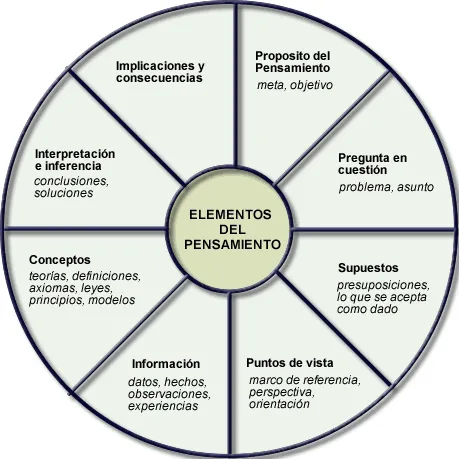
- Elements of thought. Credit: Eduteka.