A study on the 1000 most cited papers in astronomy and astrophysics during the first decade of the 21st century (2000-2009).
Jay A. Frogel, from AURA, conducts an analysis (submitted to PASP) based on the 100 most cited papers in astronomy and astrophysics for each year 2000-2009 and supplementary data from 1995 and 1990. The main findings are:
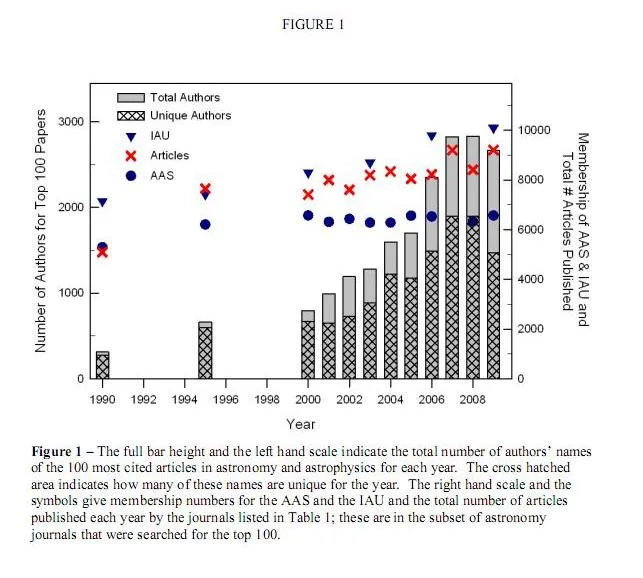
During the period the total number of authors in the top 100 per year tripled. The annual number of papers with 5 authors or fewer declined, while the number of authors per paper increased: the most cited papers tend to have the largest number of authors and vice versa.
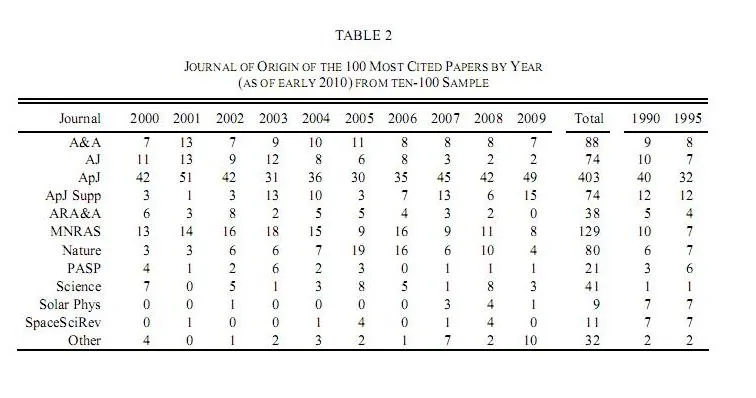
For each year 2000-2008 the same 5 journals accounted for between 80 and 85% of the total citations each year in the category, which excludes Nature and Science. The same journals, A&A, AJ, ApJ, ApJS, MNRAS, take 77% of the 1000 most cited articles.
Several indicators of web access to astronomy sites such as data archives and journal repositories show an increase by factors of three to ten or more.
The author, after pointing out these main conclusions, provides an introduction on how astronomy has changed in the decade and aims to answer what effects the new facilities have had. The article is presented as the first in a series on the topic.
For that, he takes into consideration several parameters such as the number of authors, citations and even the length of the article (in page numbers). The interpretation of his "findings" he says he leaves for the next paper, while in this one he addresses the scientific context of the most cited papers, how he acquired the data and the role of archives.
Data sources and analysis procedure
The number of citations is often used as a parameter to measure the impact of a publication, as well as the h-index (Hirsch 2005). The quantitative analysis performed in this case is based on two samples of the most cited papers in astronomy and astrophysics, in peer-reviewed journals. The first sample was compiled in mid-2007 and consists of the 100 most cited articles for 2001-2006 (for short, 6-100). The second and main sample used was made in early 2010 and consists of the 100 most cited papers for each year 2000-2009 (for short, the 10-100 sample).
As an alternative to the absolute number of citations and the h-index, the author chose to use the citation ranking. A paper with ranking 1 in the sample for its year implies it was the most cited relative to other papers published the same year (at least at the time of compilation).
Self-citation
Trimble (1986) found that about 15% of all citations in astronomy papers published during January 1983 were self-citations, in the sense that the citer and the cited papers have at least one author in common. And that would vary little by country, topic, journal, etc. Then Abt (2000) concluded that although these self-citations are not negligible in quantity, they do not represent a significant distortion.
But as this author tries to show, the average number of authors per paper for the top 100 increased by a factor greater than three during the past decade. Thus, the incidence has grown considerably and the objectives of this work are outside the correction of that effect.
Journal selection
To identify the relevant journals, Journal Citation Reports (JCR) from ISI was used to determine which journals accounted for more than 95% of all citations each year: there were 34 journals in 2000, 43 in 2008. The five that consistently take up to 85% of the citations are ApJ, ApJS, A&A, AJ and MNRAS.
For Nature and Science, being considered by ISI as "multidisciplinary," a general search was performed filtering with Boolean operators and the result was manually corrected to remove book or database reviews, letters, etc.
The Top 100
The next step was to identify the "great hits." Since ApJ takes most of the citations, he used the cited reference search in ISI to select the 100 most cited papers each year from ApJ, which was used as a lower limit. Then for each year from the other journals, papers that had at least as many citations as those ranked 100 in the previous list were selected.
With this procedure, however, there is a possibility that some journals not searched have articles with enough citations to be in the top 100 of a given year. To investigate that possibility, searches were made in Acta Astronomica, Astronomy Reports, Astronomy Letters, Astronomische Nachrichten, Journal of Astrophysics, Revista Mexicana Astronomy & Astrophysics, Observatory, and Baltic Astronomy.
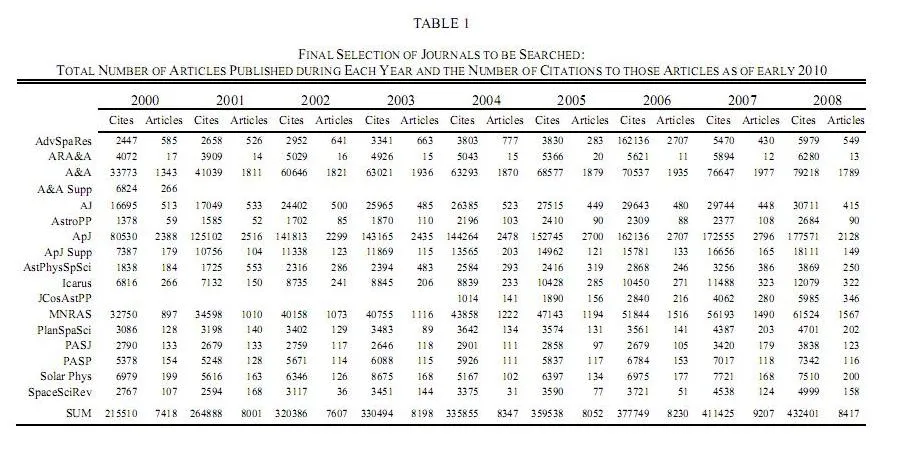
Very few of these journals had any article with sufficient citations, except 4 papers found over the 10 years that had more citations than the 100th place for each year of the selection. Two in Acta Astronomica in 2002 (210 and 192 citations). They presented the results of a large survey of variable stars and the second the results of the 2001 OGLE campaign. The other two articles are from Astronomische Nachrichten on technical aspects of SDSS. These four articles were found after the analysis presented in this paper. As they would constitute only 0.4% of the 1000 articles, the analysis was not redone to include them.
The prevalence of the increase in teams in astronomy
Wuchty et al (2007), based on an analysis of almost 20 million papers (that's an analysis!) over 5 decades, showed that teams increasingly dominate over single authors in the production of knowledge. And that papers produced by teams are frequently more cited than individual ones.
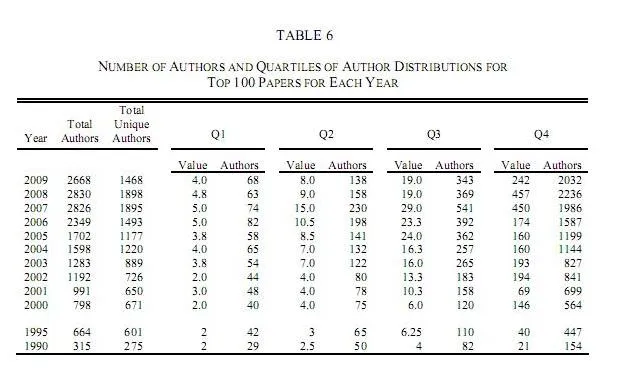
Table 6 of the paper, in the second column, lists the total number of authors for the top 100 papers for each year. The third column gives the number of unique authors in those papers for each year. It is also accompanied by graphs, for example Figure 1 illustrates, according to the author, one of the main "findings" of this work: the total number of authors for the top 100 has tripled between 2000 and 2009.
Another point to highlight is that, having two overlapping samples two years apart (6-100 and 10-100), it is possible to note that between 13% and 42% of the papers in the first sample do not appear in the second. This exclusion varies strongly and systematically with age: the most recent year (2006) has the highest number of dropouts, 42/100, while the oldest years (2001-2002) have fewer, 13/100. The author notes that this bias would be produced by an initial increase in the accumulation of citations for papers on extragalactic topics, although later the dropout or exclusion rate seems to be comparable.
Another note is the number of pages per article. The average length of the 1000 papers studied is 18.7. This length would be one and a half times greater than typical for refereed astronomical articles. Furthermore, even within this sample of the top 100 per year, the best-placed articles have a length 2.9 times greater, on average, than the worst-placed articles.
It is also indicated that the number of published articles has increased by 3% per year.
Finally, there is an appendix comparing ISI and ADS.
Table A2 lists for each year the 1st, 50th, and 100th papers.
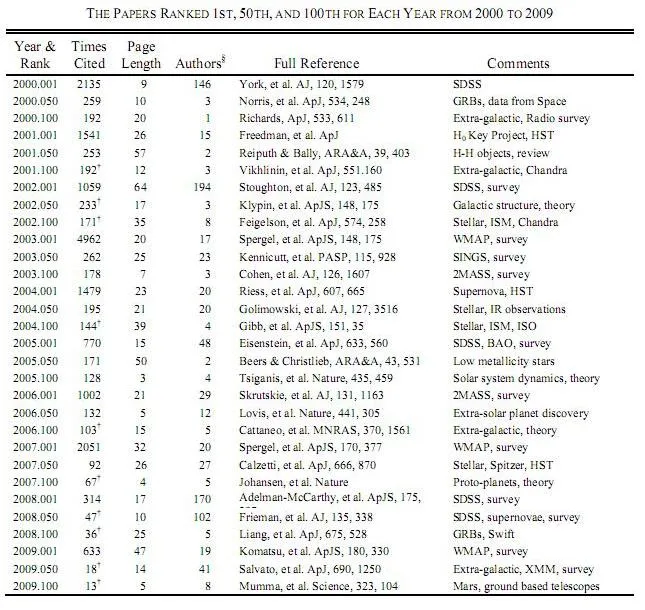
If we take this table, the articles with the most authors correspond to SDSS (one of which is also the longest) and the most cited one is about WMAP.
Sources and related links
- Astronomy's Greatest Hits: The 100 most Cited Papers in Each Year of the First Decade of the 21st Century (2000 - 2009)
Jay A. Frogel
arXiv:1005.5377v1
About the images
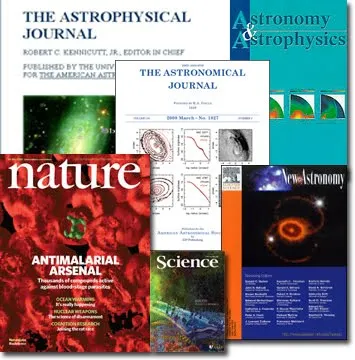
- Image composed of several covers of astronomy journals, Nature and Science.