In the United States they have just published their decadal plan for astronomy and astrophysics. What challenges do they identify and how does that affect the rest of the world's astronomers?
Thanks to discoveries and technological advances, along with the work and imagination of researchers, our understanding of the universe has changed dramatically over the course of the last few decades. Astronomy and astrophysics have begun to establish new connections with physics, chemistry, biology and computer science.
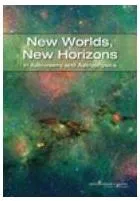
Based on a broad and detailed survey of scientific opportunities, infrastructure and national and international organization, the document called "New Worlds, New Horizons in Astronomy and Astrophysics" (NMNHAA) details a plan for ground-based and orbital astronomy and for astrophysics in the next decade.
In broad terms, the document proposes carrying out innovative, moderate-cost programs, both on the surface and in orbit. It recommends the construction of survey telescopes to investigate the nature of dark energy, as well as the next generation of large optical telescopes and a new class of gravitational space observatory to observe the merger of distant black holes and to precisely test theories of gravity.
The NMNHAA book was produced by the Committee on the Decadal Survey of Astronomy and Astrophysics of the U.S. National Research Council and has just been published by The National Academies Press.
For the completion of the work, scientific panels were formed with researchers specialized in areas such as Galaxies, the galactic neighborhood, stars and stellar evolution, planetary systems, optical and infrared astronomy, and many more.
Preparations for the work began in 2008 under the name Project Astro2010 and after consulting more than 200 experts, they publish their conclusions that point to prioritizing space mission projects and large telescopes, as well as the study of dark energy.
What implications does the report have for the rest of the world?
Telescopes like Hubble, Spitzer, Chandra or the upcoming James Webb are instruments built and operated by researchers in the U.S. and Europe, but their discoveries affect us all.
On the other hand, many Latin American and Spanish researchers work on some of the research that those instruments enable.
To give one example among many possible ones:
Dr. Alberto Vasquez and Dr. Cristina Mandrini, who work at IAFE and whom we met at the last Open House Day of that institute, develop research on solar physics. And for that they work with data provided by STEREO.
In the same way we can say that the Auger Observatory in Mendoza has international support, as is noted in this decadal report.
Something similar happens with the Gemini telescopes, internationally operated from Chile and the United States, to which Argentina contributes its grain of sand.
Looking for partners
Science in general, and in particular astronomy and astrophysics, require the contribution of the scientific community around the world. This is not only beneficial economically, but in some cases it is indispensable.
Let's think about the installation of large telescopes. There aren't many areas where an instrument, whose cost is precisely astronomical, can provide optical observations. The quality of the sky and the climatic characteristics of the place decisively influence it.
For these reasons, the U.S. Decadal Plan will have consequences for researchers beyond that country's borders.
An astronomical fortune
Among the aspects to highlight of the recent report are:
The recommendation that research programs be balanced, that is, that they maximize scientific contribution with a lower budget.
If we talk about money, let's put numbers:
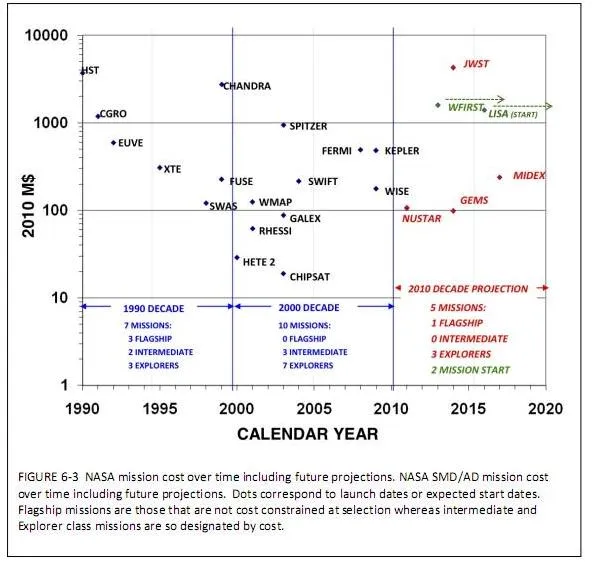
The committee recommends programs in terms of space-based opportunities and surface projects. In space, the large activities are those whose cost exceeds one billion dollars, while medium activities have an estimated cost between 300 million and the previous floor.
In ground projects, the major activities are those whose cost has a floor of 135 million dollars and the medium ones are those that cost between 4 million and the aforementioned floor.
Large space projects
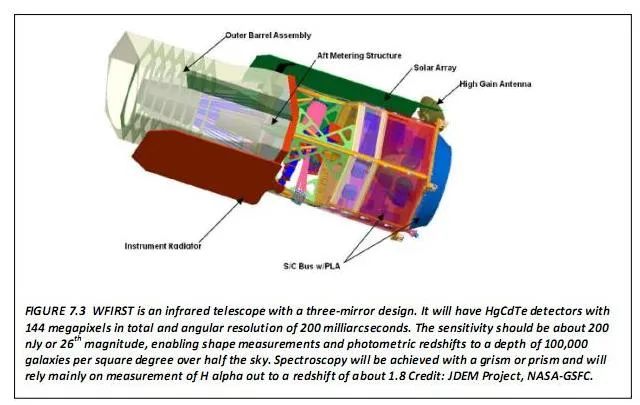
Wide Field Infrared Survey Telescope (WFIRST)
It will be a 1.5-meter wide-field near-infrared telescope that will attempt to answer fundamental questions about the nature of dark energy.
The Explorer Program
This program supports small and medium missions to respond quickly to new discoveries. The three medium missions launched to date, Swift, WISE and WMAP have had an enormous impact on science for a cost they consider appropriate. According to NASA, the development cost for those three missions was 590 million, 50% of the cost of a single mission of the Great Observatories.
The report recommends that the annual astrophysics budget for this program be increased (from 40 million to 100 million) by 2015.
Laser Interferometer Space Antenna (LISA)
LISA uses three separate spacecraft to detect ripples in spacetime which will allow the study of the merger of black holes with masses between 10 thousand and 10 million solar masses and will conduct a census of binary systems in the Milky Way.
International X-ray Observatory (IXO)
It is an X-ray telescope that will allow great advances on broad fronts such as the characterization of black holes to understand the life cycle of matter and energy in the cosmos. IXO is a project of NASA, ESA and JAXA, the space agencies of the U.S., Europe and Japan.
Medium space projects
Technology development program to find other worlds: this field is one of the fastest growing and the goal seems to be to find one or several rocky planets that are in the habitable zone - at a distance from their star that allows liquid water - and characterize their atmosphere. The chimera is to find "another Earth".
The committee recommends that NASA dedicate 4 million dollars per year to develop technology for this field.
The "Inflationary" program
A cosmological advance has been the detection of the cosmic microwave background radiation. The committee proposes a technology program to advance detection techniques. If the polarization pattern imprinted by gravitational waves from the inflation epoch is detected during this decade, a technology selection is recommended to develop a mission to study the signal.
Large surface projects
Large Synoptic Survey Telescope (LSST) is a multipurpose observatory to study the nature of dark energy and the behavior of dark matter. An 8.4-meter, optical telescope, to be installed in Chile, will observe the entire sky every three nights.
Giant Segmented Mirror Telescope (GSMT): Advances in optical and infrared astronomy are possible by building adaptive optics telescopes with nearly 10 times the collecting area and about 80 times the near-infrared sensitivity of current facilities. An investment is recommended to provide U.S. astronomers access to a 30-meter optical-infrared telescope.
Two projects underway, the GMT (Giant Magellan Telescope) and the TMT (Thirty Meter Telescope) are being developed and it is recommended that a choice be made on one of them to partner with a 25% share.
Atmospheric Cerenkov Telescope Array (ACTA)
The past decade has seen the beginning of the era of high-energy (TeV, Tera electron volt) gamma-ray astronomy. Two facilities have been proposed: The Cherenkov Telescope Array (CTA) and the Advanced Gamma-ray Imaging System (AGIS). The committee recommends that the U.S. AGIS team collaborate as a junior partner in CTA.
Medium ground projects
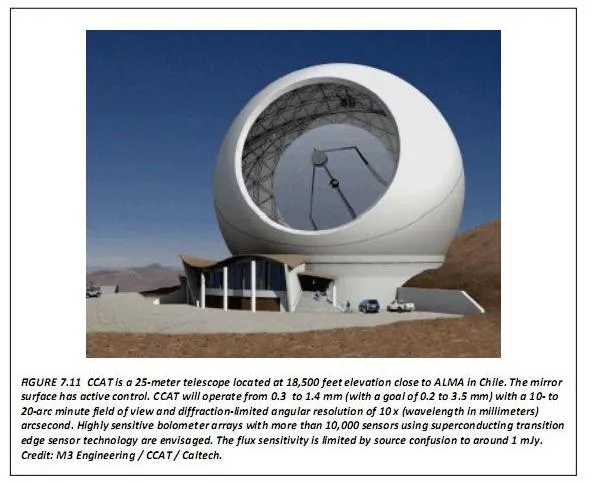
Cerro Chajnantor Atacama Telescope (CCAT) is a powerful 25-meter telescope to be built in Chile, just below ALMA. It will conduct millimeter and submillimeter observations to study galaxies, stars, planets, interstellar gas, and objects outside the solar system.
The document also notes that the imminent withdrawal of the United Kingdom from Gemini will require additional support from the remaining partners. It is necessary, it says, to operate the telescopes more efficiently and they consider it possible to reduce costs.
The gender issue
U.S. minorities are seriously underrepresented among professional astronomers and women have not yet reached parity. For many reasons they consider improving the representation of minorities and women a matter of the highest priority.
The document, which in its electronic form is 225 pages long, develops many other topics, such as the importance of astronomy in society, the value of technical-scientific education, the demographic statistics of researchers, support for individual researchers, etc.
The document can be downloaded in PDF format from National Academies Press and can be read online.
Sources and related links
- New Worlds, New Horizons in Astronomy and Astrophysics
Committee for a Decadal Survey of Astronomy and Astrophysics;
National Research Council
ISBN: 0-309-15800-1, 270 pages, 7 x 10, (2010)
http://www.nap.edu/catalog.php?record_id=12951 - US astronomers unveil 10-year plan
About the images
- The images used belong to National Academies Press.