The International Astronomical Union's Newsletter 106 has just appeared with an article about the high percentage of women in astronomy that our country possesses.
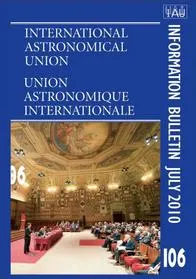
Newsletter 106 (IB106) contains a summary of the International Year of Astronomy 2009 in its first chapter, followed by the initiative to establish an Office of Astronomy for Development (OAD) as a first step for implementing the decade's strategic plan called Astronomy for the Developing World. We talked about this at the time in: The future of astronomy: beyond 2009.
From the 40 expressions of interest received, South Africa was chosen to host this office and an agreement was made with the South African Astronomical Observatory (SAAO). They are now looking for someone to fill the position of Director of the OAD.
But I stop at what was published in the third chapter of IB106. Statistics of women in astronomy, written by Catherine Jeanne Cesarsky.
She says that when they proposed she write about it, she wondered how to do it. Despite the IYA2009 project "She is an Astronomer", she knew there isn't much statistics on the matter. She wrote some letters and got her numbers and curves, which, although they are heterogeneous data, allowed her to make some interesting comments and perhaps, encourage a more rigorous study in the future.
The IAU is an organization that includes 68 member countries, so its membership and variation over time is a good collection of data to use for comparison with individual countries. In many countries, to be an IAU astronomer, the person must obtain a certain level of recognition.
Thus, to begin, she assumed that if in a country women have difficulties in having their work recognized, in retention or promotion, the relative proportion with women IAU astronomers is an indicator of discrimination.
The local organization of the last General Assembly in Rio de Janeiro, in August of last year, counted 667 women among the 2109 people who attended, that is 31.6%. But few sessions had that percentage of their talks given by women and only one of the ten plenary talks and invited speeches were given by a woman (10%).
Every three years, the IAU elects new members and in 2009 the total number of members exceeded 10 thousand. The number of women is increasing:
in 2009 it was 12.1%; in 2006 it rose to 12.9%; and now it climbed to 13.6%, an increase of 0.7% per triennium.
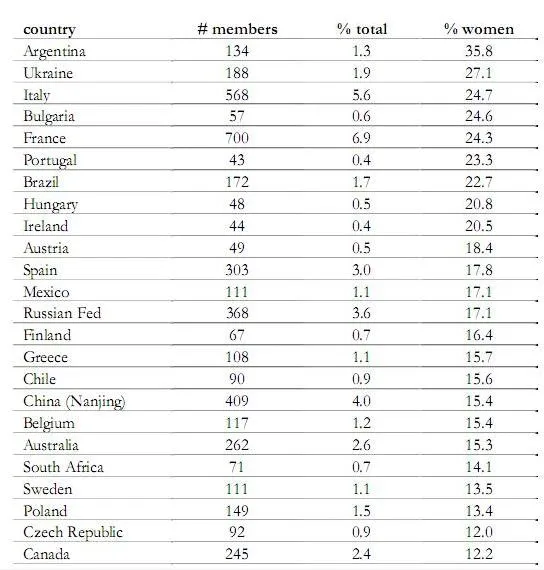
The interesting part comes in the Table 1 published in IB106. It shows the percentage of women IAU members by country, data from the IAU Working Group on Women. Only countries with more than 40 members were selected.
Argentina, with 35.8%, has the highest percentage by far.
Cesarsky mentions that this makes her happy and proud because this is where she did her first studies.

Let's say that Catherine Cesarsky is a French astronomer who presided over the IAU and was educated at the University of Buenos Aires and Harvard. She was director of ESO and served on the committees of several of the most important astronomical institutes in the world (Paris Observatory, Max Planck in Germany, SRON in the Netherlands). She was also editor of Astronomy and Astrophysics.
Her time in Buenos Aires saw her study at the Faculty of Exact and Natural Sciences of UBA between 1959 and 1965 to obtain her degree in physical sciences. Her doctorate, at Harvard, she obtained in 1971.
This fact is not minor. Only eight countries (in IB106 it says 6) have more than 20% of women IAU members (Ukraine, Italy, Bulgaria, France, Portugal, Brazil, Hungary and Ireland). The United States only reaches 12%. Spain and Mexico (with 17.8% and 17.1% respectively) are not badly placed, in 12th place for the European country and 13th for the American one.
Table 1 indicates the total number of members, the percentage of the total and the percentage of women.
It is noteworthy that although the U.S. only has 12% women, the total number of members is 2594, by far the country with the most members, 25.5% of the total!
Note that Argentina, with 134 members (1.3% of the total) has 35.8% women, that is, 48.
But Spain, with 303 members in total (3% of the total), has 17.8% women, that is, 53.
I point this out because one might think that, based on what was said before, Argentina would have more women in the IAU than Spain, and yet, as shown, it is the opposite. But it is true that of the total members, in this part of the world there is a higher percentage of women astronomers in the IAU than in other member countries.
Next, Cesarsky opens a separate paragraph for Asia, the continent with the lowest percentage of women. It is noted that in Japan the growth in the number of women in astronomy has been accelerating since the 1960s, but even more so in the last decade. China, which had 12.4% in 2006, now has 15.4%, also a notable increase.
The paragraph on Latin America emphasizes first these southern lands. It is noted that Argentina's indicated percentage compares well with the percentage of the 175 women researchers and professors (34.9%).
The male-female ratio of graduate students and young researchers is 50-50. At the highest level, 2 out of 14 are women (14.2%). Gloria Dubner, Cesarsky notes, sent her that data, who was recently elected Director of her institute -IAFE- "a very important institute in Buenos Aires, in which the percentage of women is 50%", comments Cesarsky.
Marta Rovira is also highlighted as an example, being the president of CONICET and Vice President of the IAU.
It is also indicated that recently there has been an important advance in CONICET: the maximum age to access scholarships and permanent positions has been made more flexible for women whose careers have been put on pause by maternity (of course, based on the quality of the applicants).
It is highlighted that Venezuela, despite having a small number of members in the IAU (19 in 2009, reason why it does not appear in Table 1) has 26% women. In Mexico, in 2006, there were 17.5% women in the IAU, which compares with 20% women researchers and 20% women postdocs. There is a much higher percentage of women among students (doctorates, masters) of 39%, which shows that the field is expanding. When everything is included, the percentage of women in astronomy in Mexico is 28.3%.
For Brazil the numbers were hard to get, says the researcher, but 22.3% of IAU members are women (as of 2009) and the members of the Sociedade Astronomica Brasileira (with 479 members) is 25% female.
Incidentally, Europe is also alluded to and it is pointed out, finally, that a glance does not provide enough information. Almost no country has equal percentages of women and men in the IAU and in its astronomer population, so a gender advantage in favor of the male sex continues to exist.
But, as those of us interested in the topic already knew, in our country, not only is the number of women in astronomy and astrophysics very important, but many of them hold good positions and possess an excellent level of research, as can be seen in the works they publish continuously.
We can cite at least a few examples, although we will be unfair to those researchers not mentioned:
In the same IB106 it is indicated that Symposium 273, Physics of the Sun and Sunspots, August 23-26, 2010 in Los Angeles, will be held. As part of the members of the Scientific Organizing Committee (SOC) is Dr. Cristina Mandrini (IAFE).
Symposium 286, on comparative magnetic minima, to characterize quiet times on the Sun and stars, to be held in Mendoza, Argentina, October 3-7, 2011, will have Hebe Cremades as Head of the SOC.
Symposium 275, Jet at All Scales, to be held soon, September 13-17 in Buenos Aires, (with Gustavo E. Romero as SOC head), will have as members of the local organizing committee Deborah Aguilera, Ileana Andruchow, Sofía A. Cora and Mariana Orellana.
In IB106, the members of each IAU division are also reviewed, among whom is Beatriz Elena García (Div. XII/Comm.46, Education and development of astronomy.
On the page of the Asociación Argentina de Astronomía it is possible to obtain a listing of IAU members.
According to the list I just obtained, there would be 136 members today, of which 49 are women, that is 36.03%.
The 49 Argentine women astronomers in the IAU are:
Estela L. Aguero, Andrea V. Ahumada, Maria Sol Alonso, Maria V. Alonso, Maria Laura Arias, Diana E. Azcarate, Liria G. Bagala, Lilia P. Bassino, Paula Benaglia, Elisande Estela Brandi, Andrea Paola Buccino, Cristina Cappa de Nicolau, Gabriela Castelletti, Silvina Cichowolski, Lydia Sonia Cidale, Sofia A. Cora, Andrea Costa, Alicia Cruzado, Maria S. De Biasi, Romina P. Di Sisto, Gloria M. Dubner, Laura I. Fernandez, Silvia M. Fernandez, Lia G. Garcia, Beatriz Elena Garcia, Elsa B. Giacani, Mercedes Gomez, Monica Gladys Grosso, Stella M. Malaroda, Cristina H. Mandrini, Maria C. Martin, Rosa B. Orellana, Mariana Orellana, Ana María Orsatti, Susana Pedrosa, Maria Josefa Perez, Olga I. Pintado, Monica Rabolli, Estela M. Reynoso, Adela E. Ringuelet, Marta G. Rovira, Gladys R. Solivella, Garcia Zulema. Lopez, Patricia B. Tissera, María Marcela Vergne, E. Irene. Vega, Mariela Cristina Vieytes, Monica Maria Villada, Claudia M. Giordano.
It is worth saying that there are many more researchers in the country who are not yet part of the international organization, but who contribute day by day to knowledge through their work.
Here is a listing with all the IAU members from Argentina, distinguishing between female and male.
Note: Although it is not relevant, I must say that IB106 also refers to the event Teaching Astronomy for Development (TAD Bolivia) of June-July 2009, with the presence of the Instituto Copérnico led by Jaime García, who runs El Mensajero de los Astros. His contribution to the popularization of astronomy and his encouragement to those of us who are starting out is always appreciated and I am glad for his recognition in the IAU IB106.
Sources and related links
- Informative Bulletin 106 of the IAU.
About the images
- Photo of Catherine Jeanne Cesarsky. ESO.
- Cover of IB106 and Table 1. Credit: IAU.