Today, September 18, a worldwide event to observe our closest neighbor is taking place.
The event is called International Observe the Moon Night (InOMN). It is organized by the outreach and education team of LRO, NASA's Lunar Reconnaissance Orbiter, and other organizations, such as Astronomers Without Borders and the Gemini Observatory, among others.
There is an InOMN website (in English) with a lot of material, which includes a wheel for observing the Moon. It is a pdf file to print and cut out. Although it is in English, the wheel is easy to make. Some explanations in Spanish for those interested:
The pdf contains different parts to print on its pages. Then you will have to cut out the parts. Ideally, you would glue them onto cardboard so they are more rigid.
The parts called Back cover and front cover are, respectively, the back cover and the front cover. The front cover has an ellipse drawn on it that says "cut this window out" and "cut on this line" which indicates that this line must be removed; you need to cut out that ellipse to create a "window" there.
Where it says "fold line" it indicates that along those lines we must fold the paper.
Then we have the wheel itself, "star wheel".
After cutting, we must assemble the pieces as follows: (from top to bottom)
The front cover (cut with the window), the wheel, the back cover. We can assemble it all with a brad.
It should be noted that this wheel or star chart was made specifically for the Southern Hemisphere, for September 18, 2010, and not for other dates.
What can be done tonight?
We can observe the Moon on our own and then share what we have seen or send photos to the InOMN Facebook and Twitter accounts.
But we can also go to an astronomy association and share the experience with others. At the Buenos Aires Planetarium, they plan to set up the telescopes (from 19 to 21 h).
On the InOMN page we can see a map with events around the world.
In Argentina, the following are listed:
Observatorio Astronómico de Córdoba-Instituto de Astonomía Teórica y Experimental
Laguna Don Tomás-La Pampa
Cocade-Casilda, Santa Fe
Planetario Malargüe,Mendoza
Observatorio San José, Buenos Aires
GOCO, Olavarría
Achernar- Difusión de la Astronomía, Mar del Plata
Planetario de Buenos Aires.
Moonmeter
The people from Galaxy Zoo, to celebrate this day, launched the Moonmeter which allows us to classify a large part of the Moon: 40 thousand images. It runs until September 19.
Sources and related links
- Observe the Moon Night Goes Global
- InOMN
About the images
- Logo of InOMN. Credit: InOMN.
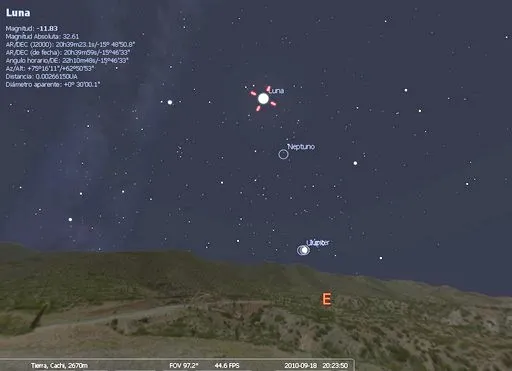
- Screenshot of Stellarium, 09/18/2010, 20:30 h, Buenos Aires, East.