If we had to throw an object a great distance, using only the force of our body, what would we have to consider? The shot put and discus throw will give us some ideas. But what about the optimal angle?
I must say, first of all, that sports are not my strong suit. However, they are for a great many people. That is why I think it is appropriate to address these topics that may be of interest, even to those not particularly interested in physics.
We already talked here a bit about Athletic Physics in a previous edition of the Carnival. The idea is not to be extremely detailed, but to give some idea of how the study of physics can help to understand and improve the performance of sports. High-level athletic athletes do not discard these theoretical contributions at all.
In this case we will talk about throwing. Especially shot put, but it can be applied to other sports disciplines, even to tennis (in which you also throw, when serving).
Here there is a series of movements to consider, but we will deal with the movement of the arm. We know that to throw an object or move it from its place, we must apply force. This concept was developed by Isaac Newton.
Inclined launch
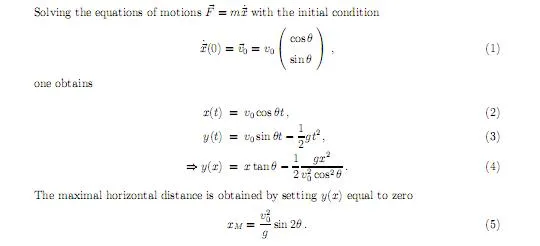
If we imagine a body or a particle that is launched with an initial velocity V0 (a vector should be drawn above), forming an angle a with the horizontal, the position of that body will change due to gravitational attraction (unless it is launched at more than 11 km/s!).
Therefore, it is not a uniform rectilinear motion with constant speed and the trajectory will be a parabola.
To understand the basic physics of this motion we can consult, for example, the page of RENA on Inclined Launch.
Also highly recommended is the website of physics with computer by Ángel Franco García. And on this particular topic an interesting site is http://www.sportsscientists.com/.
The launch angle
We must then consider that we will have to move our body, which has a certain mass, so that it acquires a certain speed and allows us to throw the object as far as possible.
But, what about the angle? That is, our arm, when performing the throw, will be at how many degrees in relation to the horizontal?
What would happen if we throw a ball with the arm at 90º? It could go very far, but only upwards, although what we want is for it to go far, but forward. It then emerges that the angle of 45º could be a good solution.
However, a recent study reveals that a slightly smaller angle, between 37º and 38º would be better. I want to stop at this point for two main reasons:
The entire movement of the athlete has considerations related to physics and biomechanics, but the topic of the angle (less than 45º) seems particularly interesting to me.
Furthermore, that and other topics can be addressed, together with physics and biomechanics, with computational models. Just as there will be readers interested in sports, there are surely also those interested in computer science. And the field of computer models or simulations allows combining everything: physics, sports and computers.
The research on the optimal angle was developed by Alexander Lenz and Florian Rappl, both from German universities. According to the authors of the paper "The optimal angle of Release in Shot Put" they determined the optimal angle in the throw taking into account that although textbooks indicate a value of 45º, measurements in top athletes indicate that they do it at 37-38º. If the height of the athlete is included, the theory predicts that the ideal angle would be 42º for the typical parameters of a great athlete. But according to them, considering the initial velocity, the release angle and the height, the measurements of the great athletes and their non-coincidence with the textbook value are understood.
In addition to that study, many others have addressed the topic from various angles, precisely. The biomechanical analysis of high-level sports and athletes produces very interesting results.
There is a software tool to simulate events, such as the one used by Ariel Gideon, from the California Biomechanics Institute. In his article "Biomechanical Analysis of the Shot-Put Event at the 2004 Athens Olympic Games" an analysis of shot put at the 2004 Athens Games is made using the statistics provided by several cameras and the Ariel Performance Analysis System (APAS) software.
That and other related articles can be found at http://sportsci.com/start/apas/studies/
The current records put Randy Barnes at the top of the list with 23.12 meters, although in 2004 Yuriy Bilonog stood out.
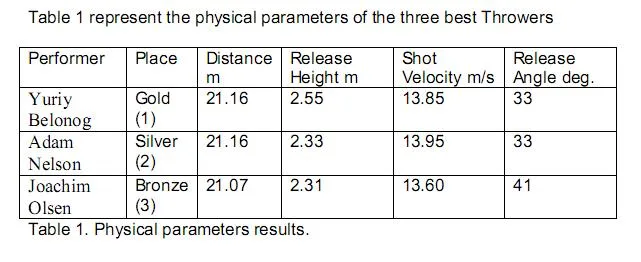
Here we see Table 1 from Gideon's work in which the physical parameters of the top three throws are represented. The last column indicates the release angle of the throw, all of them less than 45º.
Videos of biomechanical analysis of those games can be found at http://www.macrosport.com/media/?video=1160.
In the work of the German researchers, a 1976 investigation by Lichtenberg and Wills is alluded to, which was used as a basis, and they investigated the effects of air resistance. They found that in the case of the throw, resistance contributes negligibly.
If the initial velocity (v), the release height (h) and the angle (a) are known, the results obtained are almost exact. They used a computer to graphically determine the trajectory of the throw for a set of v, h and a.
Three correlations were included:
The angle depends on the height of the shot
The angle depends on the strength of the athlete
The angle depends on the initial velocity (due to the effect of gravity during the release period).
The three correlations were discussed by previous researchers.
In their conclusions the researchers say:
The dependence between the release height and the angle is a geometric relationship. This effect favors higher values for the optimal angle.
The energy that the athlete can transmit to the throw is divided into a kinetic part and a potential energy part. This effect favors lower values for the optimal angle.
The force that the athlete can exert on the throw also depends on the release angle. This effect favors lower values for the angle.
The third effect depends on each individual athlete.
This means there is no universal optimal angle, but rather the physical conditions of each athlete must be taken into account. And that is precisely what happens, if we consider what really happens in international competitions with the highest-level throwers.
The Argentine Thrower
Since I am writing these lines at 34.5º South Latitude, I found it interesting to know how we are doing at home.
Germán Lauro, Argentine athlete, born in Trenque Lauquen in 1984, achieved this year at the Ibero-American Championship in San Fernando, a mark of 20.43 m (second place), behind the Portuguese Marco Fortes (20.69).
On 9/6 at 11:00, thanks to the management of a friend from Trenque Lauquen, I was able to contact Germán Lauro.
According to Germán, the three variables that athletes in this discipline consider are speed, height (at which the implement is released) and the throwing angle.
But he indicated that, in addition, each athlete has their own technique, adapted to their physique, in relation to their strength (body mass) and height.
He told me about the two most used techniques (one linear and one rotational), indicating that those who are not so tall (Germán is 1.84 m) usually opt for the second.
I would like to add that Lauro is among the most outstanding Argentine athletes and, yet, he attended to me with great kindness, even considering that he was being bothered by someone from a blog and not from a major national media outlet. We spoke for long minutes during which he demonstrated knowledge about the impact of physics on his specialty, although he emphasized that, in the end, the athlete's own characteristics (and a lot, a lot of practice) are the differentiating elements.
I thank Lauro for his kindness and for making us look so good at the international sports level.
And the Spaniard
We cannot fail to mention the Spaniard Manuel Martínez, whose complete personal site notes his extensive list of achievements. There it says:
The shot put is a track and field event that consists of throwing a steel ball of 7.260kg (4kg for women) as far as possible. It is a test of explosive speed. It is a deceptive event, where a very strong, but not very fast, athlete has nothing to do. I like to think that this seven-kilo piece is a cannonball, as those who studied the origin of the specialty say.
Conclusion
Although the physical characteristics of each athlete and, of course, the practice of specific movements through different techniques, decisively influence athletic performance, we cannot minimize the importance of physics.
Ultimately, it is about living physical bodies, throwing other objects in a world governed by laws of nature that are fairly well known.
Understanding the details of physics allows coaches to give better advice to their trainees, so they can optimize their resources.
It is also an Olympic specialty that has been documented in videos that can be used to perform biomechanical analyses through specialized software. This allows for some "reverse engineering," that is, understanding why the best athletes move as they do, aside from what is theoretically predicted.
I hope this post generates greater interest in physics for those interested in sports, or sparks the curiosity of computer scientists in developing biomechanical analysis applications.
Ultimately, I am launching into cyberspace a ball with an optimal angle? to generate interest.
Note written for the XI Carnival of Physics, in this edition hosted by El Neutrino. To join and read the posts there is a social network on Ning.
Sources and related links
- The optimal angle of Release in Shot Put
Alexander Lenz, Florian Rappl
http://arxiv.org/abs/1007.3689 - Biomechanical Analysis of the Shot-Put Event at the 2004 Athens Olympic Games
Gideon Ariel, Ph.D.
http://www.arielnet.com/start/apas/studies/ - The importance of speed in throwing events
- Why Physics and Not Biomechanics Determines Human Throwing Accuracy
- Biomechanical Problem of Shot Putting Finally Solved
- How to throw a shot
- Video: Biomechanical Analysis of best shotputers
About the images
- Image of Germán Lauro from Deportarg.
- Opening image with graphic by runningromans