The Planetary Society and the forum UnmannedSpaceflight.com joined forces to give a boost to images of the cosmos processed by amateurs.
This alliance will translate into the forum becoming part of the Planetary Society, so the Society will take charge of that space. That will bring changes in its administration and will ensure its economic continuity.
Furthermore, the Society announced the creation of AmateurSpaceImages.com
The page does not exist yet and redirects to http://www.planetary.org/amateur/
Emily Lakdawalla proudly tells us about the new initiative that will try to host images of space from original missions processed by members of the public.
By the way, it needs financial help for this new site, so if anyone can, there is a way to help.
But what is this about processing images by amateurs?
The astronomical images we see on sites like those of Chandra, Spitzer, NASA, etc., are "non-raw" images, meaning they are not exactly as the data is received (sets of ones and zeros that travel from the probes to the control centers on Earth). There is a retouching. Not with an aesthetic objective, although aesthetics and visual astronomy have an important relationship.
As I have told here in several cases, the processing of original images taken by space missions or telescopes in orbit basically lies in the fact that the light these instruments collect can be different from what we can perceive with our eyes.
We know that an electromagnetic spectrum exists and that human vision only perceives a small strip of it: the so-called visible light or optical light. But we also know about ultraviolet light, infrared, etc. These instruments have the ability to detect X-rays or the infrared spectrum, but how to show that to beings who cannot see those wavelengths? To answer this, images are modified by "false coloring". This means that if an image corresponds to soft and hard X-rays or a combination of infrared and optical, it is possible, with a retouch, to show some wavelengths with one color and others with a different one.
Thus we can "see" those wavelengths which are useful for understanding different physical phenomena that occur in the objects.
In other cases, image processing can have the objective of highlighting certain features over others.
However, that processing done for dissemination or scientific purposes can also have an aesthetic side and, in the case of being done by amateurs, expand the retouching freedoms even more, let's say artistic freedoms.
On the other hand, since there is an enormous amount of data available to the public from past missions, one can "recreate" old shots or make comparisons of different moments of the same object, etc.
Examples?
On the Planetary Society site there are some beautiful examples of images processed by amateurs and also links to amateur processors and their pages.
And where does one get the data from?
The data from NASA's spacecraft belongs to the public and has been available for a long time. In 1966, the Space Science Data Center was established at Goddard and a decade later a library system was created (Regional Planetary Imaging Facilities, RPIF).
Now the data is easily found at Planetary Data System. The system has "nodes" like the one for images, rings, small bodies, and geosciences.
Many individual missions and cameras have their own site like the Rovers, Cassini, HiRISE, HRSC, VMC and MGD.
There is a list of available sites at Planetary Society: Image Data and also software for processing images.
There is a series of tutorials (in English) made with videos and presentations.
The videos can be downloaded or viewed in our web browser (stream) and the examples can be replicated thanks to the fact that on the same site there are compressed files to download with the sample images.
It seems to me that this is a fabulous aspect of new technologies and the availability of data. For those interested in knowing how to process images of the cosmos, I have already made some tutorials here, translated from the Chandra site, which can be a good start.
Other tutorials are already underway, but they demand time that is sometimes scarce, but soon there will be more, also taking advantage of these new resources.
About astronomical images written here:
The OpenFITS Project
Astronomical Aesthetics
The DNA of Astronomical Images
The FITS Liberator
Getting real image data is not so difficult
NASA's Planetary Data System, or PDS, is the repository of images from space missions, available to the public, although it is designed for scientists.
The images from the missions, like those that can be obtained from the rover site, are "raw" images, raw (as it is said in English).
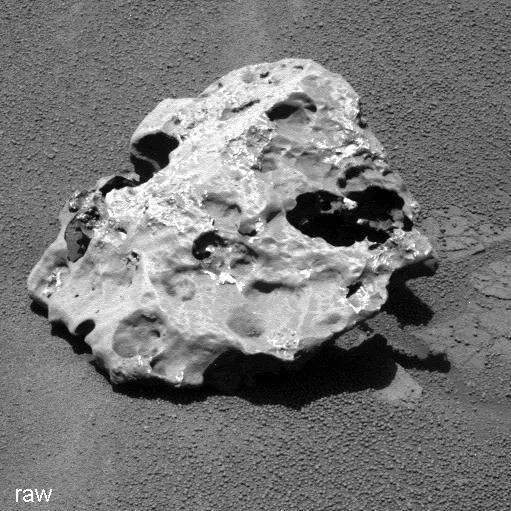
But the problem is that although they are quickly available and no process that mediated with the public (or almost) intervened in them, they are converted to JPEG which decreases the file size, but reduces the quality. Furthermore, the contrast of the images makes the lightest pixels pure white and the darkest ones, black. For science these images are not useful, but for the public to know what is being done they are useful.
Here we can see a "raw" image (above) and an "archived" one (below) to notice their difference.
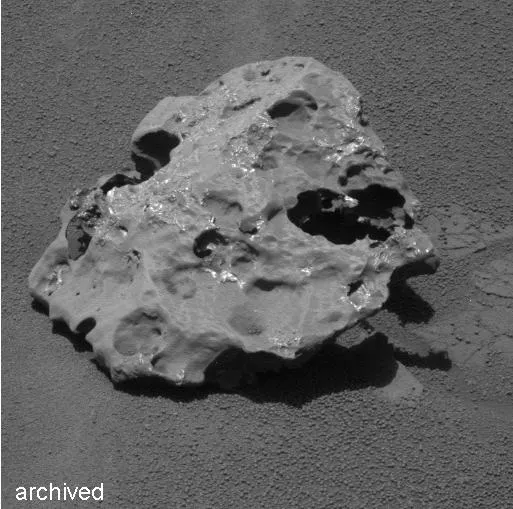
The image belongs to Opportunity of a rock on Martian day (sol) 2037. The "raw" image is the public version and the other is the one available through PDS. The first one was available very quickly (hours), while the other took six months.
Credit: NASA / JPL / Cornell / color mosaic by Emily Lakdawalla
How to use PDS?
As I indicated before, the system has nodes. Let's go to the imaging node.
PDS Imaging Node: http://img.pds.nasa.gov/
On the left we select Planetary Image Atlas.
Under "Select Mission" at the top left, we click "Mars Exploration Rover".
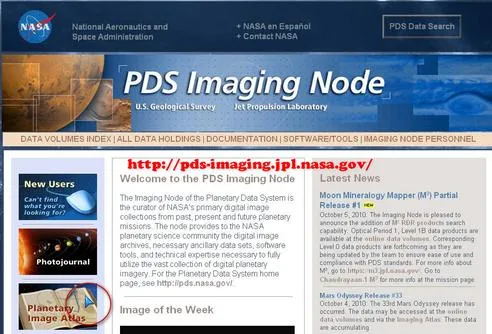
The main part of the site will take a few seconds to load. Next, in that central part we will see a series of tabs, a message with a blue background, and below a set of options.
The second row says "Image Type". We choose "Regular".
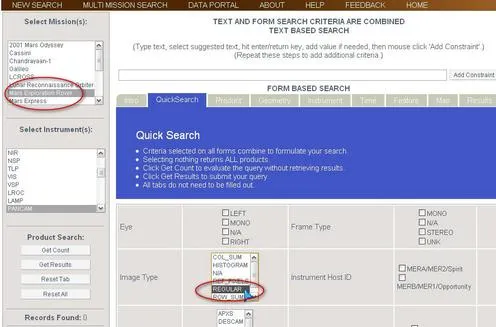
Then we can put the planet day number in the two fields of "Planet Day Number". There are two fields because one is for "from" and the other "to". If we are looking specifically for one day we indicate the same in both fields. If we put nothing we will get the thousand most recent results.
Since what we are trying to demonstrate is how to obtain an image, we use the example of the images of the previous rock, taken on Mars day or "sol" 2037.
Then, on the left we have some buttons below "Product Search". We choose "Get Results".
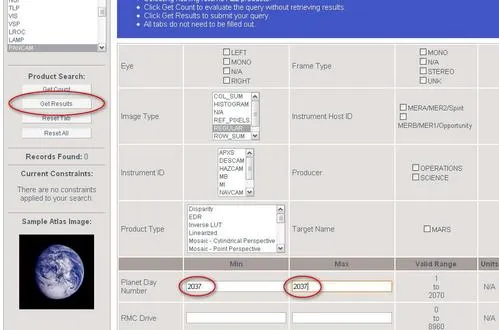
While the system searches, the screen turns a bluish tone and then shows us the results. All the images from that day.
Once we choose ours, we can download it in various formats (if we got this far it was because we didn't want a JPEG, so it's better to choose another format) and view the image's labels (the data).
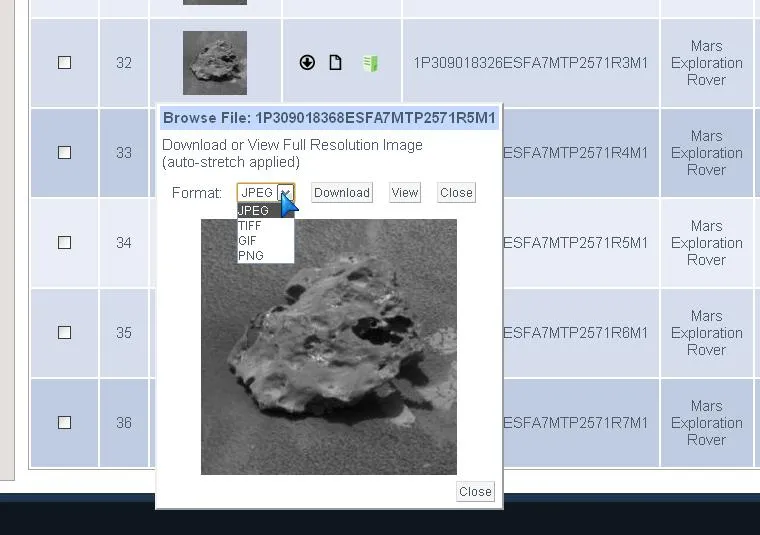
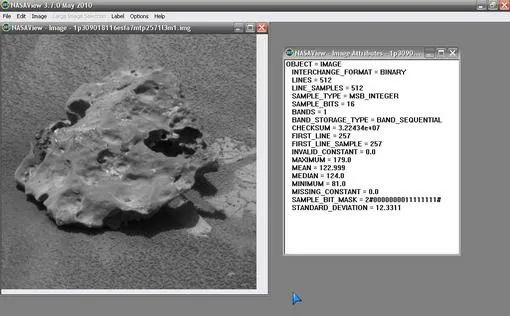
If we click on the image, a window will open with viewing and download options. If we click the circle icon with an arrow, an image with a .img extension will be downloaded. These files are heavier (not that much, about 500kb, compared to a JPEG which is about 100-200kb) and can be viewed with NASAView.
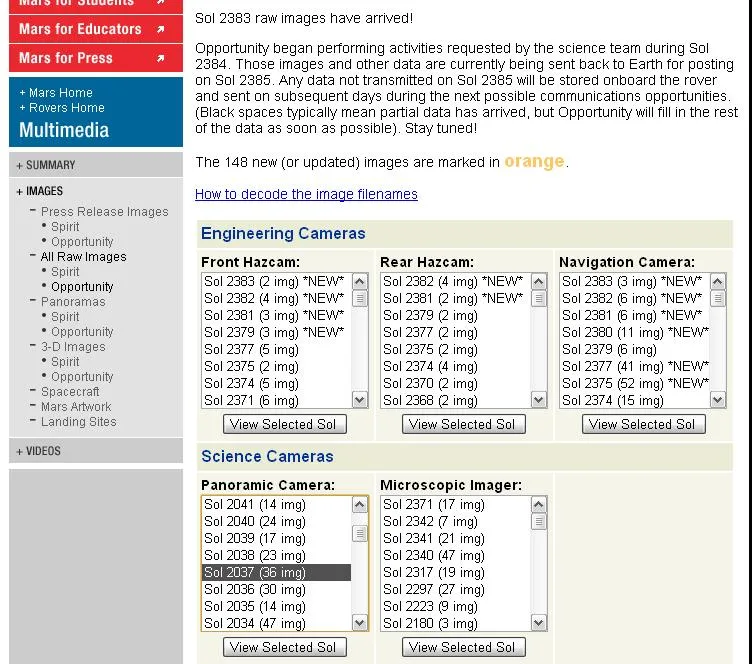
One idea is to use both rover sites. The one where images are quickly posted in "raw" format, the rover site, which is easier to navigate, and then, if we want, we can search for the same image archived in PDS.
For example, to get this same image on the rover site, we go to the site, in this case we choose Opportunity and then the PANCAM camera for sol 2037:
About UMSP and Planetary Society
UnmannedSpaceflight.com likely has its roots in the Beagle 2 mission to Mars in 2003. Doug Ellison couldn't find a place to share his enthusiasm and founded a group on Yahoo! that grew quickly. Then Spirit sent its first images to Earth and Ellison downloaded them from the web, realized he could retouch them to make color images, anaglyphs, and mosaics, and thought he might not be the only one doing that, so he started a forum in 2004 which was joined by those from the old Yahoo group.
The forum began to grow, sections were added to the point of being a meeting place for a large community that includes some experts. This year, Ellison thought about finding a permanent home for the forum and contacted Planetary Society as a form of funding, an alliance that is finally being realized as the society celebrates its thirtieth anniversary.
The Planetary Society
Founded in 1980 by Carl Sagan, Bruce Murray, and Louis Friedman, The Planetary Society aims to support planetary exploration and the search for extraterrestrial life (SETI@home). It has affiliations in Brazil, Chile, Spain, and various parts of the world and a network of volunteers and members who support in different ways, including financially, as the Society does not receive money from the government of any country.
Sources and related links
- The Planetary Society and Unmanned Spaceflight Join Forces
- I'm so proud 1: UnmannedSpaceflight.com now partnered with the Planetary Society
- Space Imaging
- Getting to the real science image data: It's not that hard!
- Amateur Space Images and UnmannedSpaceFlight.com
About the images
- Planetary Society logo.
- Screenshots of MarsRovers and PDS. Credit: NASA.