It is a fictional, online galaxy in which users can buy a star and planetary system, black hole, neutron star or pulsar. Or edit those systems available to the community.

Galaxiki is, more than anything, a site for fans of science fiction, astronomy and space. It is a social network where we can add friends and share content, but the fascinating thing is that we can edit the stellar systems and other objects within this galaxy.
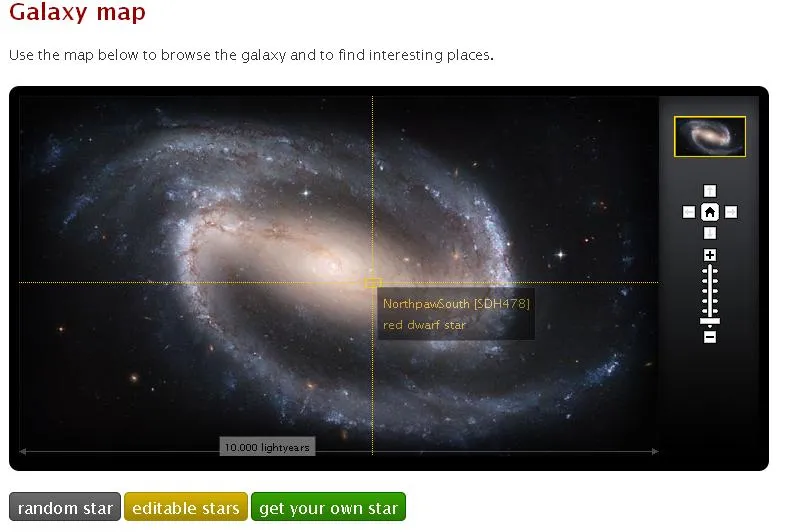
It is easy to navigate this galaxy.
With the buttons below we can view stars randomly, editable ones and search for one we can "own".
What can we do?
It's about giving free rein to our imagination. Science fiction allows us to cross the borders of the known. It is said that good science fiction (like any story) must be plausible to the right degree. This can be hard to estimate, because if we get too close to a "realistic" story we can lose that creative possibility that imagination gives us. But any story can be followed if it has a certain internal consistency and plausibility with some real variables.
In Galaxiki we can then create stories of these systems: tell what the planets orbiting a star are like, change their physical parameters, describe if there is life and of what type, etc.
That is, a galaxy tailored to our imagination.
Let's look at a system in Galaxiki, for example the JodCentral system (QKE452):
We will see what the star is like, how many planets it has and if any could harbor life.
We see that two of the 15 planets were renamed and if we look at the planet Basia we will notice that it has 26 moons with no data yet.
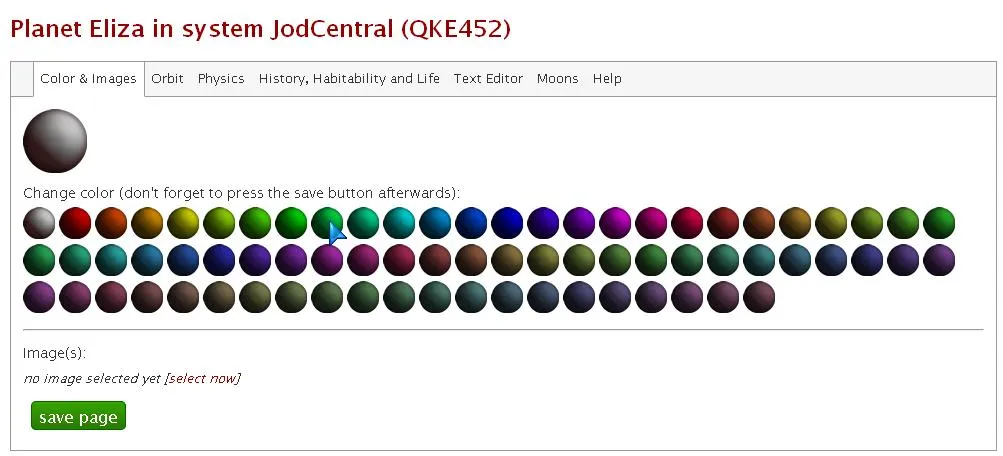
There users will be able to edit the names and characteristics of these objects, for example Eliza:
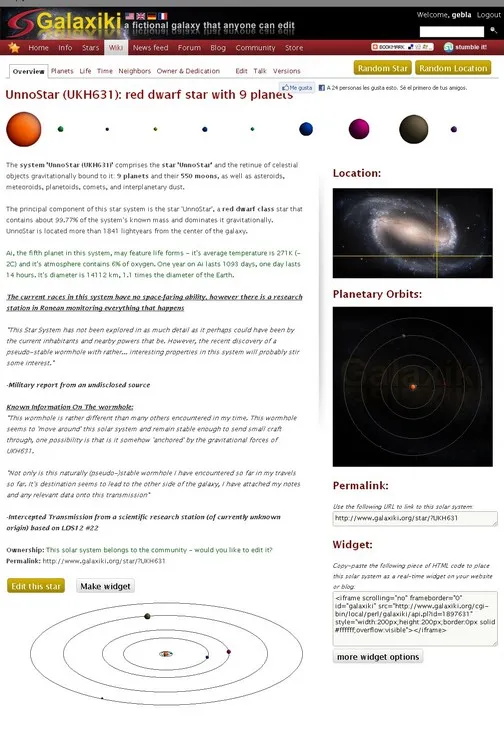
The data for each system is presented in a very complete way. Let's look for example at the UnnoStar system (UKH631):
The general data:
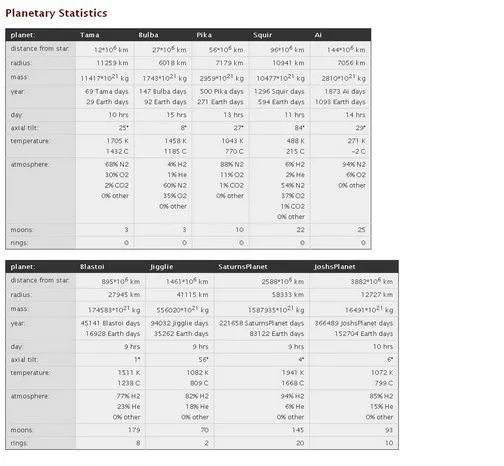
Planet statistics:
There are indeed some rules:
Faster-than-light travel (like on Telecinco!), mental powers and other extraordinary things are allowed. Artificial intelligence is optional.
Continuity, historical consistency is necessary.
Keep copyright in mind: do not use names, characters or stories already created in Galaxiki. We must create the stories ourselves. And do not use obscene, racist, violent language, etc.
Some content rules
The age of the universe is 13.7 billion years. Galaxiki is a galaxy about 5 billion years old and its planetary systems, therefore, cannot be older.
Time travel is not allowed (except relativistic acceleration).
In some cases it is possible not to respect the physical properties of the real world.
The galaxy is a little smaller than real ones (a diameter of 10 thousand light-years) and contains just over a million stars. It is clearly smaller than NGC 1300, whose NASA photograph is used as part of the logo.
Galaxiki basically ignores relativistic effects to make things easier, meaning it works with an absolute time scale and faster-than-light travel (FTL travel, for "faster than light") is allowed. FTL travel was inspired by Star Trek's Warp travel and there are nine speeds from 1 (speed of light) to 9 (9^3 = 729x the speed of light). The energy required to go from one speed to another increases exponentially and FTL 10 is impossible to reach.
In science fiction novels, the possibility also appears that some creatures have mental powers. This generates very broad imaginary sequences like telepathy, extra-sensory perception and psychokinesis. There are no rules about life after death (spirits, ghosts), yet.
Galaxiki is not the Milky Way and is so, so far away, that humans cannot reach it. But there can be similar planets, harboring intelligent life. But they will not be "humans" nor will they live on Earth.
Proper names are not used to name stars and planets. There are also other content rules.
The site
The new version of Galaxiki was launched in 2010. I had made a comment here a few years ago, when the project was starting.
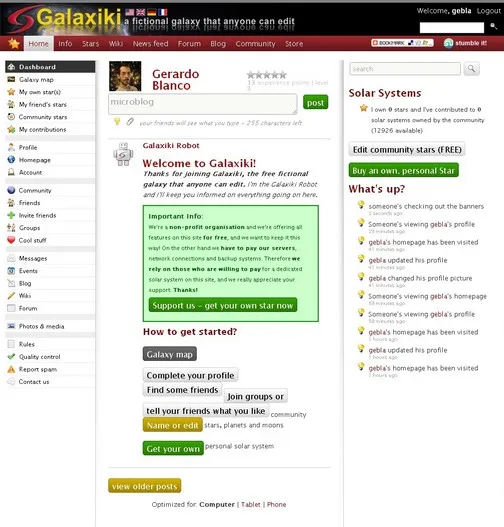
Now the site is a whole social network where we can connect with friends, post news on our microblog, make physical changes to solar systems, upload photos up to 1GB, join groups, manage our collection of books and DVDs online, participate in the forum, and more.
It is also possible to choose a system and create a widget to put on a blog or web page. The left sidebar has all the shortcuts to each of the site's functions.
I want my star!
It is possible to buy a system from among those available. We can browse the existing ones, find out what type of star it is, how many planets it has, what they are like, and choose the one we like best. By doing so we will be able to edit that system, taking into account the previous rules and others that the site has.
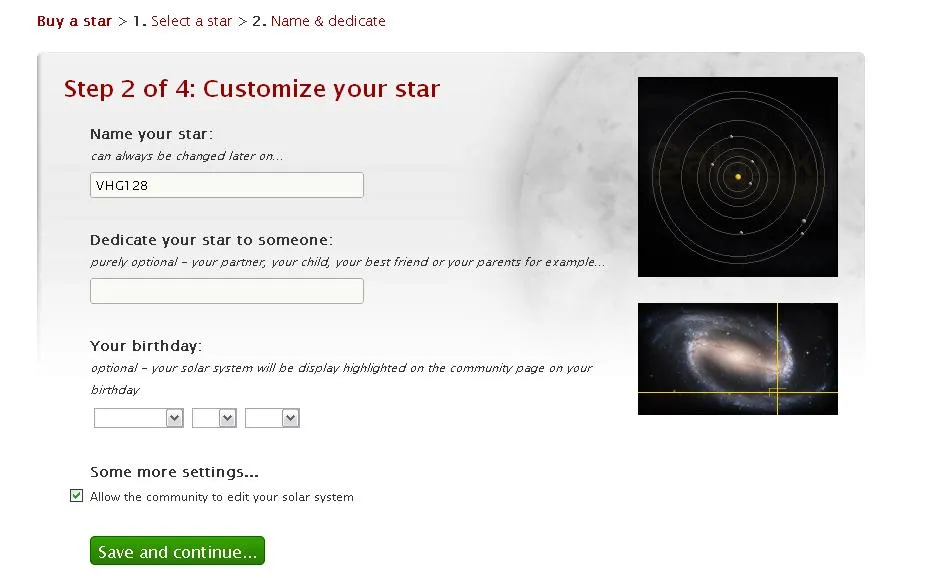
A star costs USD 12 (or 10 Euros) one time and forever. However, when buying a star we can choose another value, meaning the USD 12 is the proposed value, but if we want we can pay more.
Among the payment options we have the most important credit cards and PayPal (you do not need a PayPal account to use that payment method).
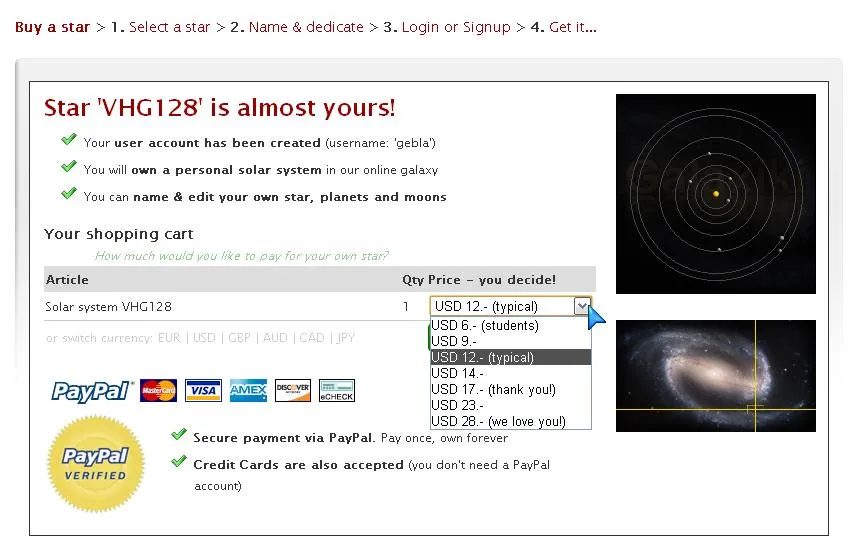
Clarification: We are NOT buying a real star, it is a fictional galaxy. What we are buying is web space and the use of an online application prepared for this. Stars cannot be bought. There are indeed sites where, for a payment, a certificate is sent to the client, but it has no legal value. Neither will the star be ours, nor will the name we have chosen be adopted by astronomers. Only the International Astronomical Union can name stellar objects.
However, when we buy a star in Galaxiki we will achieve:
Having our own solar system, binary system, black hole, neutron star or pulsar. And we will be able to edit its star and planets, to our liking. We will also be able to "dedicate" that system to some famous scientist/astronomer (with an English Wikipedia page).
From the menu, we can click on Stars and we will also see a proposed system and, below, binary systems and other available objects.
Also, we can give a star or system to another person, which is an extremely geeky, very special and unique gift.
Is it necessary to buy?
We can do the same for free on the site itself, by editing available community stars.
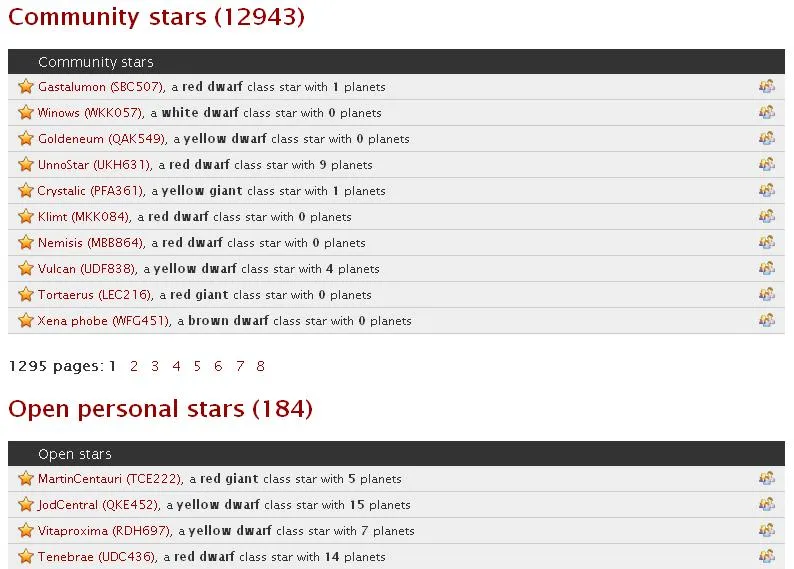
It is also possible to offer solar systems to the community or to other members. When we buy a star we have the option to allow other users to edit the system, or not.
Points
To be able to edit systems we must earn "experience points". At most we can obtain 1 million points.
By increasing points we will reach higher levels among the 100 possible levels.
The activity will be reflected in stars that appear in our profile. Each star is equivalent to 20 levels.
We can earn experience points by being active and productive, completing our profile, our homepage, inviting friends, joining groups, cool stuff or events. Also by adding movies, books, CDs to our profile or posting something on the community blog.
Regarding the latter, the idea is to share information that may be valuable, or a story (which is the most common) and not to advertise a specific website.
Who is behind the project?
Jos Kirps. The first prototype existed in 2006 and a test site was made public in March 2007, officially launched in July of that year.
It was chosen Site of the Year by Yahoo on 08/03/2007 and by RedOrbit in December of that year.
The community already has more than 5000 users, more than 13 thousand registered stars,
Languages
The weak point, for now, is that the site is not in Spanish. Even using the options for other languages like French and German (above, in the header) only the buttons or titles are translated, but not all the content.
According to what Jos told me, the idea for next year is for the content to be translatable by the users themselves. I suppose it could be a good way to earn experience points and, at the same time, expand Galaxiki's possibilities to all Spanish speakers who don't get along well with English, for example.
Conclusion
Galaxiki is not for everyone. Nothing is for everyone. Each of us has different interests. Galaxiki is a platform that will be delightful for lovers of science fiction stories, for those who wish to create their own stories. Even if we are not Larry Niven or Brian Aldiss we can let our imagination run wild and invent civilizations, wars or conflicts, etc.
It is also ideal for lovers of astronomy and astrophysics, when creating our own stellar system and playing with its physical parameters.
The option to gift a system is ideal for surprising someone in a unique way. Any geek girl (and not so geek) will "melt" if we give her a star with planets.
It is an extremely interesting development. I invite you to try it, to explore its multiple worlds. I really liked one system, but I think only I did.
Sources and related links
About the images
- Screenshots of Galaxiki