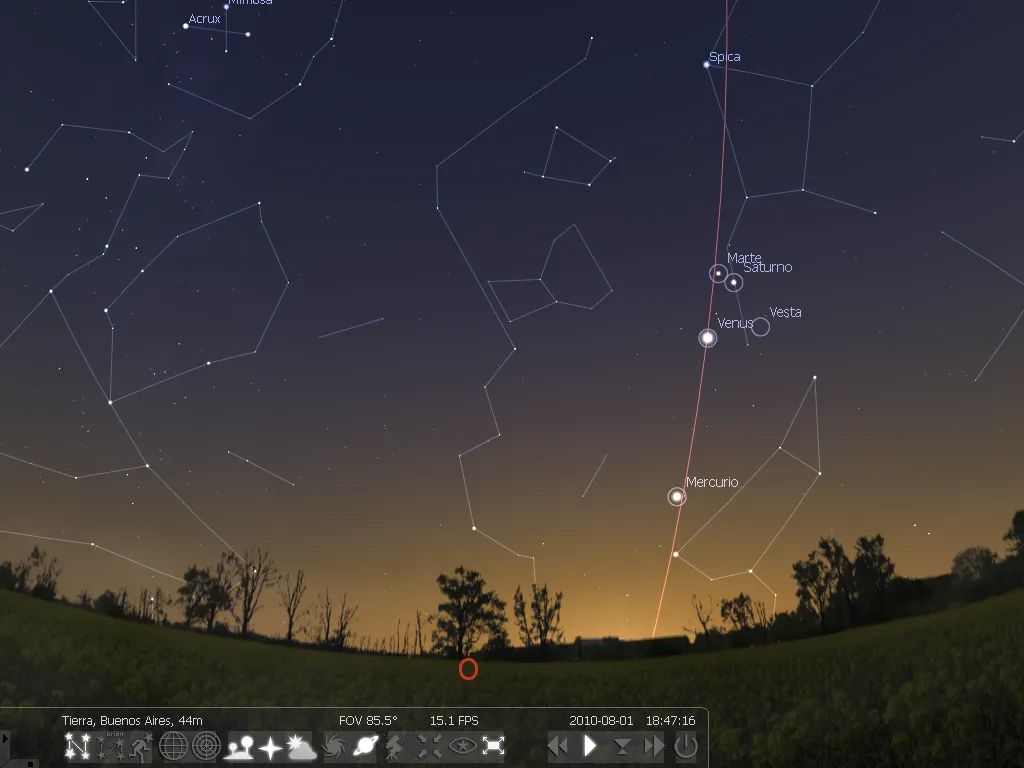
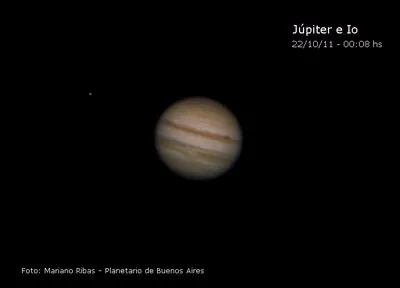
A night of observing 230 km from the Federal Capital is like being born again, like glimpsing a completely new universe, full of stars.
It all started about two months ago, when I signed up for the course at the Buenos Aires Planetarium, Discover, Observe and Enjoy the Sky.
I knew beforehand that much of what Diego Hernández, the teacher-guide, would talk about, I already knew. But I also hoped to know more (and better) about the location of celestial objects visible to the naked eye and with instruments. And that was indeed the case.
But those weekly classes (which haven't finished yet) also served as an excuse to meet new people, interested in astronomy, and, fundamentally, to go out observing.
As planned, yesterday Saturday at 14:00 hours, fifty minds eager for starlight boarded a bus (from La Nueva Estrella!) bound for Yamay. It's an ecological farm that is slowly being built, all with recyclable materials, with a sustainable mindset. As indicated on the Yamay website, the place is located in the town of Villa Pardo, Partido de Las Flores, Province of Buenos Aires, 223 km from the federal capital of Argentina to the south via Route 3.
Pardo today is a town of less than 200 inhabitants where the famous writer Adolfo Bioy Casares lived a large part of his adolescence and youth and was visited by his friend Jorge Luis Borges several times.
Once in Pardo, Yamay is 2 km from the urban center via the main access.
The Partido de Las Flores is located in the center of the Province of Buenos Aires, making it a strategic place to visit from different parts of the country.
Of course, before leaving, I prepared my backpack with everything I thought I might need: some sandwiches (salami and cheese), some cookies, a small bottle of soda, a thermos with a liter of hot water, five little packets of coffee in tea bags, a small bag of sugar, a teaspoon, a sweatshirt, a good pair of gloves, a notepad and pen, flashlight (with red cellophane), cell phone, mp3 player, a pair of binoculars (Shilba, 12x50, Powerview).
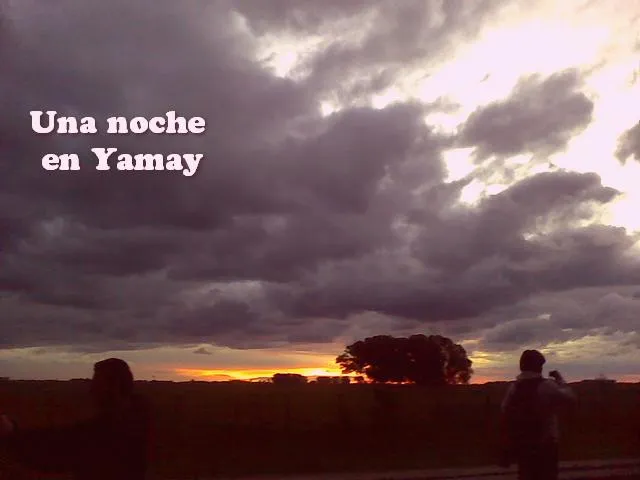
Upon arriving at the Planetarium, early as always, I realized that in that list of things I was missing...the camera. My companions, who didn't have their heads in the Moon, did bring theirs and I will have to be content with their photos as a memento, although with the cell phone I managed to capture the orange sunset, with clouds tinged pink below, upon arrival, at 19:30.
We had been stopped by a freight train that was blocking the road, but the rest of the trip there was peaceful, though with the uncertainty of how cloudy the place would be, since in the Capital and throughout the entire journey, the clouds seemed to multiply and clump together.
The forecast said "windy." And boy did it deliver. A wind for which I was not sufficiently prepared (I would have needed a little hat, next time), but which helped clear away the storm clouds.
After settling in we could already begin to perceive stars in the clearings the clouds left, but at 21 the sky closed up deeply, which was a good excuse to go to the shelter and eat something. And chat, with Sofi and Yael or with Yésica (Perhaps a future astronomer?).
Around 22 it cleared up again and from then on, the rest of the night was a constant coming and going of clouds, at high speed due to a wind that barely subsided for a little while.
In that flow of Stratocumulus and Cumulonimbus I could appreciate a sky never seen by these two restless eyes. It was a black cloth full of precious stones, but full. My eyes weren't enough to capture so much light. If from the Capital it's hard to make out the whimsical drawings of the constellations, since few stars are perceived, here it was the complete opposite. A sea of fires flooded the celestial sphere as I had never seen before.
If to the naked eye the night was literally "dazzling," it is impossible to describe the universe under binoculars. It's an ocean of twinkling lights that is out there. It's unheard of, bewildering.
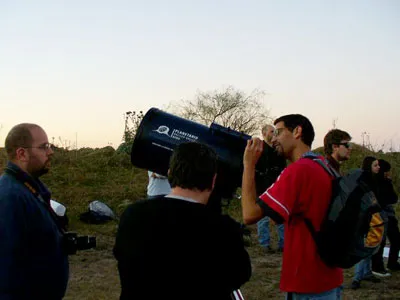
With the telescopes you had to be very careful, because they could fly away, with so much wind, but one of those brought was used a lot (I think it's a Meade LX200 of 30 cm), like the one in the photo below (which is not from this occasion, but from a previous visit to Yamay, which I did not participate in).
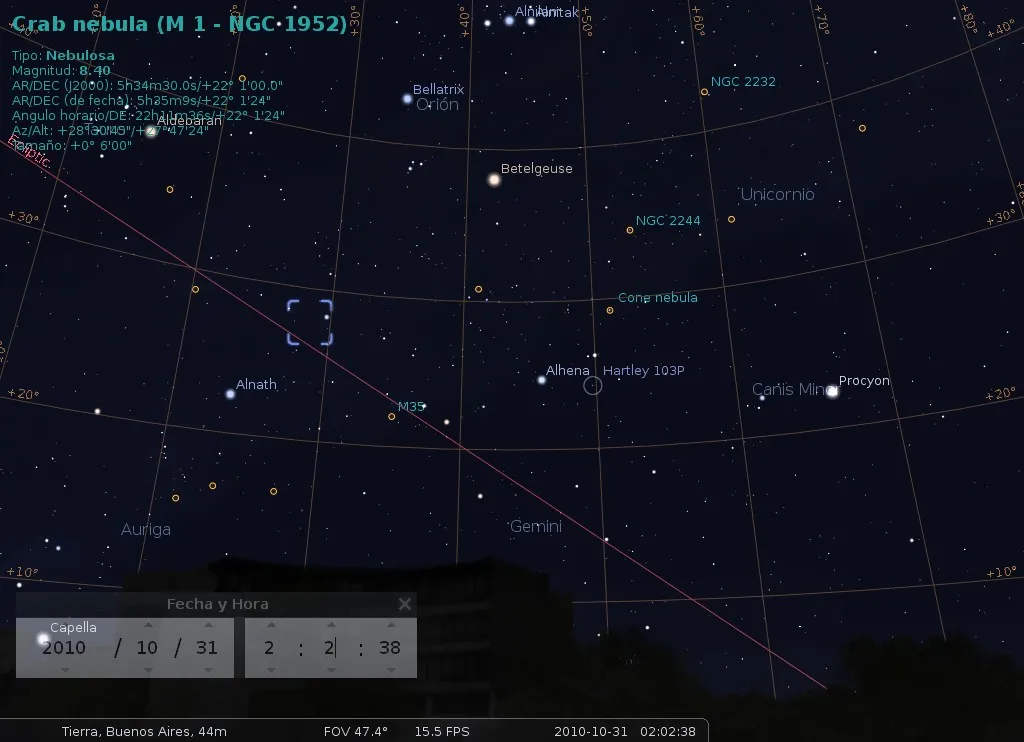
The wind was an ally that herded the clouds to let us see objects like M1 (NGC 1952, the remnant of the supernova of 1054 or the Crab Nebula), in Taurus and around there also the Pleiades (the popular seven sisters or seven little goats, which form part of the Subaru logo), and of course, in the same area, Orion, to the East. Also Sirius, of course, in Canis Major and a little further south, Canopus.
To the West, Fomalhaut and Deneb and a little further north, around 2:00 we could observe comet Hartley near the twins (Gemini), and Uranus, near Jupiter (and near what Diego called "the Snail constellation"), with the three stars (Psi Aquarii) to the left of the gas giant forming the "little antennae."
To the South, above the Cross, in Carina, Eta Car and the Southern Pleiades. The Tarantula Nebula, 47 Tucanae, and the beautiful Milky Way.
To the North, the Constellation of Andromeda (with Mirach, and Alpheratz at a vertex of the square of Pegasus) and the incredible M31 so remotely far away.
My eyes hurt and the astonishment went from my brain to the nerve endings of my body which trembled at such a spectacle (or maybe it was the cold!).
Around 3:00 someone turned on a spotlight on the roof. No, it was the waning quarter Moon, yellow-orange, in the East, appearing behind some tattered clouds. A while later we left, sleeping like tired children after playing with their new toy.
I write this, already in the comfort of my apartment, after arriving back at the Planetarium at 6-something to get home a little later. I unpacked everything, except the stellar and galactic echoes that still linger.
As if glitter had fallen from the sky, my body is full of stars...
Sources and related links
- Discover, Observe and Enjoy the Sky
- Planetario Galileo Galilei
About the images
- My own images, screenshots from Stellarium.
- Image from a previous visit to Yamay. Credit: Planetario Galileo Galilei.