Starting November 30, the Sun will be apparently traveling through the constellation Ophiuchus, despite astrologers continuing to say it travels through Scorpio. But, is that the problem? Here I propose, then, to NOT-ophiuchize.
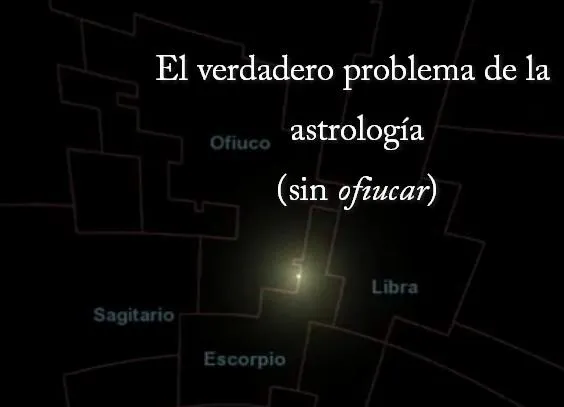
It may seem strange that, already into the 21st century, concrete information continues to be distorted. Despite scientific and technological advances, there is much we know we ignore (and that we don't know we ignore), but we do know many things.
For example, we know that the Sun, in its apparent path around the Sun, travels through 13 or 14 constellations and not 12. Since the signs used in astrology are named the same and are related to the constellations, one might then infer that the Sun only passes through a dozen constellations, and that is not the case.
The ignored constellations are Ophiuchus and Cetus. Ophiuchus was known when astrology was formulated, but it was far from the ecliptic.
The ecliptic is the Sun's apparent path in the sky. In reality, it is the Earth that rotates and revolves, but from our surface it seems the opposite.
Zodiacal Constellations
http://www.youtube.com/watch?v=2Sb4XDuG1N0
It is because of this, along with the fact that the names are somewhat similar, and fundamentally because there are quite a few charlatans around, that some still link astrology with astronomy.
For astrology, astronomical knowledge is of little importance, even if it seems otherwise. The fact that they speak of a "new Age" of Aquarius speaks to their knowledge of the precession movement, but at the same time, that movement is the cause of Ophiuchus not having "been on the Ecliptic" three thousand years ago and today it is, a fact not corrected by astrologers.
For astrologers, each constellation occupies the same amount of (apparent) space. It must be said that space is three-dimensional and that the stars in the constellations are very far apart from each other. But even in appearance, the distribution of stars is irregular. Some constellations are "small" and others "very extensive," although for astrology they all have 30º (30x12=360).
Some astrologers say that although the signs took their names from Babylonian constellations, they have nothing else in common and, therefore, it doesn't matter if there are now more constellations on the ecliptic. They refer to the "cycle of the Ecliptic," as if it were a wheel that begins in spring (the vernal point, where the ecliptic meets the line of the Equator) and denotes a cycle of life and reproduction, of the "four elements," etc.
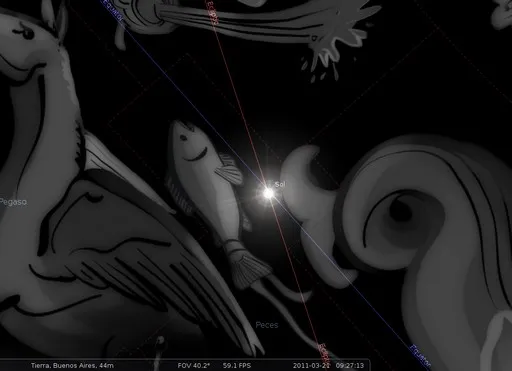
Ophiuchus and Cetus
Nowadays, thanks to the internet to some extent, many people who were unaware of the constellation Ophiuchus know of its "existence" because many "attack" astrology for ignoring the Sun's passage through this constellation.
It is also pointed out that the constellation Cetus (The Whale) should be taken into account, since the Sun also passes through there, a little bit.
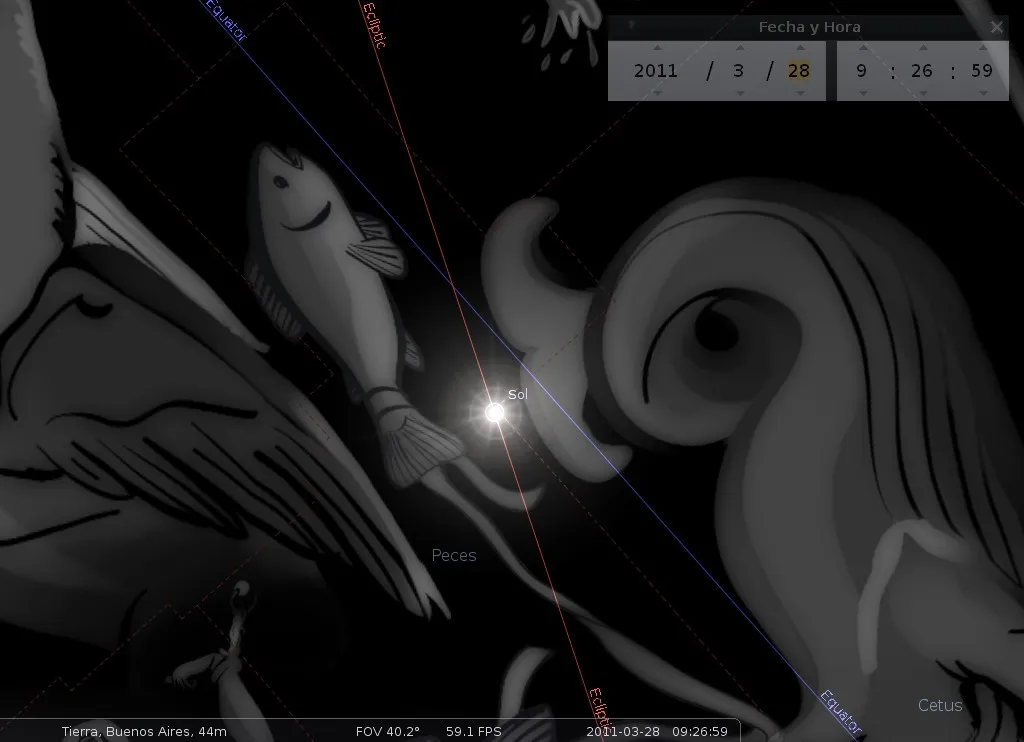
But if we talk exclusively about Ophiuchus with the attempt to prove that astrology is a false science, several things would happen. We would be emphasizing constellations as if they were something too important in astronomy. But they are not. They are sets of stars very far apart from each other, which have nothing in common from a physical point of view. Their utility in astronomy is as a frame of reference. They are not objects of study as clusters are, for example.
Furthermore, the origin and subsequent history of constellations speak to us of human whims, very subjective, and not of science. Did you know, for example, about the ignored constellations?
On the other hand, by talking about Ophiuchus or "delaying the horoscope" we would be moving away from the real problem.
I don't mean by this that the historical value as a heritage legacy or the use of constellations as reference has no value, but rather that we must not exaggerate their true worth.
Ophiuchizing
When I thought of writing about this topic a while ago, I began thinking about making some demonstrative video of the Sun's apparent transit through the constellations, to emphasize the ignored passage through Ophiuchus.
And then I started playing devil's advocate. This is something that often happens to me and deserves good psychiatric treatment :)
It's about objecting to my own ideas. If I do it, I'll have to rethink the matter. Otherwise, I'll be more sure.
This is reinforced when conversing with people who think differently from oneself, but especially with those who think similarly, and assuming the role of devil's advocate with them.
At that moment, assuming the aforementioned role, I had this "dialogue" with myself:
EADD-If the whole problem with astrology is Ophiuchus, if that constellation were incorporated as a sign, would the problem be solved?
Me-Not at all. Besides, the signs are out of phase in time.
EADD-And if we also adjusted the dates in relation to the present?
Me-Not at all, since the dates would have to be updated year by year.
EADD-And if we did it every year?
Me-Not at all...
EADD-I left you without arguments
Me-It's just that the problem is not Ophiuchus or Cetus, nor the dates. I don't want to ophiuchize. The problem is another...
EADD-Explain.
Video: Constellations
http://www.youtube.com/watch?v=XRr_OugolPs
Soft Sciences and Pseudoscience
Astrology is often compared to psychology. It's that someone who consults an astrologer perhaps does so because they need guidance or advice on how to act, how to decide their behavior in a certain situation, something comparable to psychology and sociology.
However, astrology is not a science, neither hard nor soft. Nor does it want to be. I know that some statistical study has been done on people born at a certain time. Studies like those not only do not allow establishing causal relationships, but in no way could they explain why they would occur.
If we found that all or a very high percentage of people born at a certain moment ARE similar (in their character, personality, physical constitution, interests, etc.) it would be a mystery to be solved by science, certainly. But nothing like that seems to happen.
Natal Charts
Other voices in defense of astrology say that the horoscopes published in newspapers or magazines harm astrology and that "true" astrologers do not take into account only one variable, but multiple ones. That is, not only a person's date of birth, but also the time, latitude, ruling planet, etc.
However, what would happen with two people born at the same moment, in the same place?
The criticism of the twins arises precisely because of this.
Astrology and chaos theory
Chaos theory is spoken of in reference to dynamic systems sensitive to initial variations. In some systems a small variation can give rise to a series of processes difficult to predict. That is, the "butterfly effect".
An example is the forecast of atmospheric conditions. We often hear that "it will rain on Friday" and then it doesn't happen.
If a criticism of astrology is its lack of predictability or its failures, what then to say of meteorology?
First, the results are a scientific analysis and second, its results are quantitative and falsifiable.
If I go to http://espanol.weather.com/regional and check the forecast we can see an extended forecast.
Or this other chart from the SMN:

In both cases, the forecasts are born from a scientific, quantitative study, of concrete measurements of some important variables. It's true that the projection of these variables does not always hit the mark, because although it is a science that tries to be precise, Nature is variable.
The errors of the forecast, then, are understandable, measurable, and quantifiable. One can know concretely why a forecast failed. And, fundamentally, we can easily discern whether it was fulfilled or not.
Can the same be said of astrology?
Let's look for a site about astrology on the internet. I go to the first result and in the prediction for Scorpios we find things like:
"Possible love affairs, even possible start of more transcendent relationships."
What can we say to that? If the Scorpio person who reads the horoscope finally has an affair, it will be a "hit". And if not? They will be told they were "possible". How possible, in what percentage or scale? What does it depend on?.
We can also say Forer.
The Forer effect
In 1948 the psychologist Bertram Forer gave his students a personality test. Then he gave them an analysis, supposedly based on the previous test.
We can do it ourselves now. Javi Moya has the personality test on his blog. The matter is like this:
Follow the link, answer the questions (there are few) and you will get the result.
Read the result and -this is very important- evaluate if it is good or bad on a scale of 0 to 5 (0 is very poor, 5 excellent).
After deciding how the analysis turned out for us we can return to the same link to leave a comment, indicating what we thought.
And then we can read the second part, explanatory.
Lo and behold, the analysis that Forer gave to his students was exactly the same for everyone, but when rating the analysis (from 0 to 5, from very poor to excellent), the average was 4.26. That is, the vast majority believed it was a good analysis.
Forer had written a text assembling different horoscopes. We can read more on Wikipedia about the Forer effect or Barnum effect.
That is the problem of astrology. Its ambiguity. It is impossible to falsify the vast majority of its conclusions, because they are extremely vague.
Not only does that happen but it also happens that the positive is evaluated and not the negative. For example: An astrologer predicts to someone that they will do well on an exam and will take a trip. If that person gets a good grade they will take it as "evidence" that the prediction was good, but will not take into account that they did not take the trip. This happens very often.
Derren Brown - Cold Reading (Spanish subs)
http://www.youtube.com/watch?v=QEFndH5KOD0
An experiment based on the Forer effect
Ophiuchize
In this bidirectional monologue I established with myself, I realized that sometimes, with the aim of demystifying something, of correcting an error, we can add more confusion by not getting to the point of the matter, the real problem.
It's true that sometimes explanations can be long and complex. And if we reduce them we can arrive at false conclusions.
Reducing the problem of astrology to Ophiuchus is to Ophiuchize the problem, to center it on Ophiuchus. Perhaps this concept can be extended to other topics. Dark matter and energy, black holes, quantum mechanics (especially), relativity, particle physics, etc., are topics in which we can potentially Ophiuchize. I say this after a mea culpa, clarification forced by my other self.
The term is similar to obfuscation, a concept that denotes confusion in communication and that in programming is used to "tangle the code".
Unlike this concept, that of Ophiuchizing would be more linked to tangling knowledge unintentionally, not on purpose.
With the aim of "curing" poor knowledge, sometimes, we resort to the snake's venom, which does not seem to be the best remedy. Asclepius cannot get angry over the use of the term. After all, resurrection does not exist.
Sources and related links
About the images
- The videos were made with Stellarium 0.10.5 and Celestia 1.6. In the first case Camstudio was used for the video. In both cases modified scripts were used to visualize only the zodiac constellations and they can be seen at Scripts.