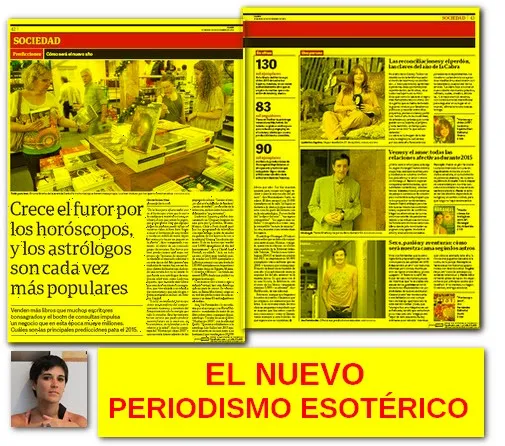
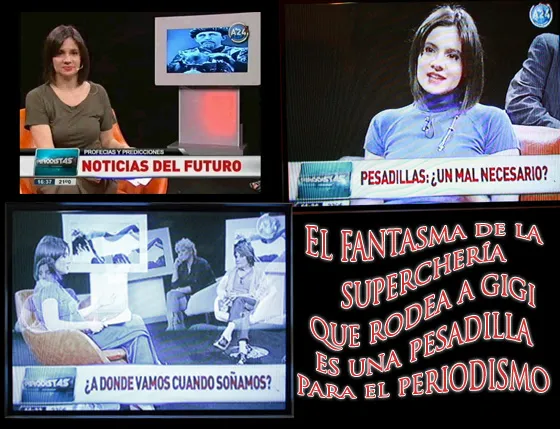
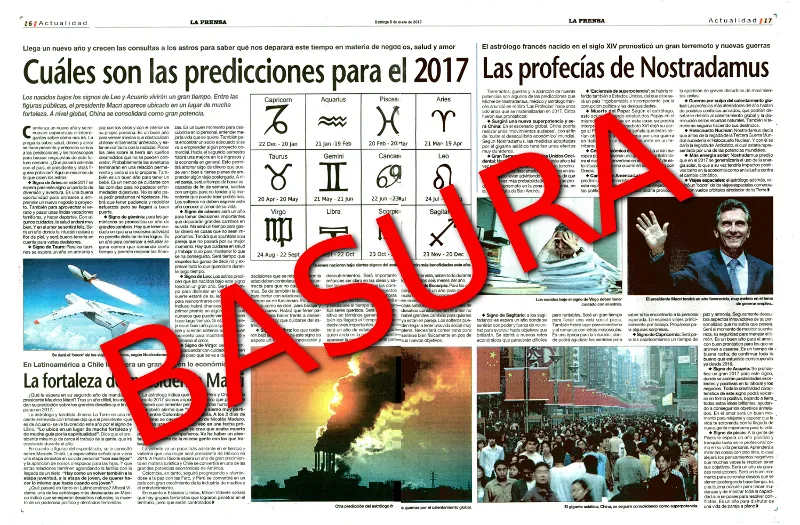
A note on Entremujeres.com allows for reflection on preconceptions, discrimination, objective-subjective reality, alienation, and image.
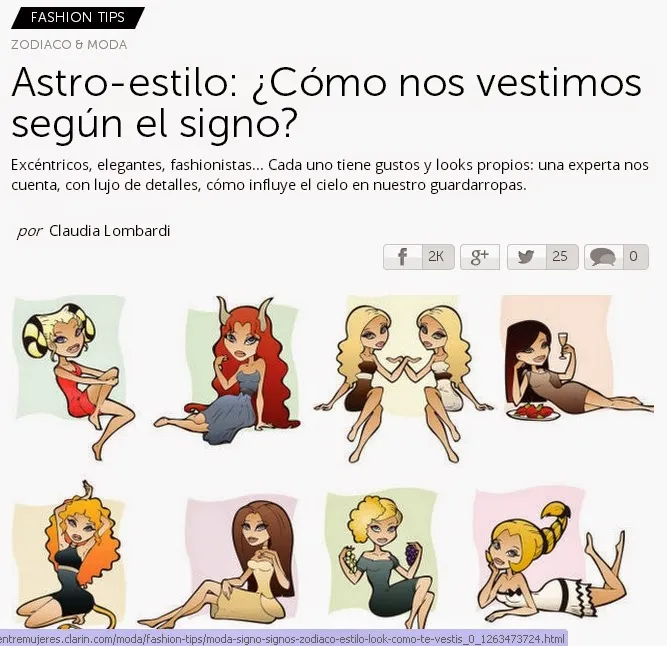
The note in question is titled: Astro-style: How do we dress according to our sign? (Entremujeres.com). It is signed by Claudia Lombardi, who says she is an "image consultant".
Before addressing the note itself, some reflections on the concept of "image".
From an idealistic conception, like the Platonic one, the image is an ontological degradation of being. There would be a superior plane of immaterial, absolute, perfect, immutable images whose imperfect and mutable copy is matter. The tree would be an imperfect copy of the idea of a tree. But that imperfect copy, which is already a degradation of the idea, then continues to degrade: the image of a tree (the representation).
Certainly, this philosophical conception is impossible to prove. What we do know is that trees exist, the shadows of trees exist, and that human beings form ideas of trees and represent them in images.
From a communication point of view, we will find some problems: when we draw a tree, what are we saying?
From a psychological point of view, by drawing the tree and the house, we are saying something we think. Since what we think cannot be taken out of our head, discourse is an indirect way of accessing those ideas.
However, if when drawing a tree I did not represent its roots in the image, would that say that I do not give importance to my "roots"? Is it possible to infer that the way I draw the tree says something I think about myself?
If this seems strange (and it is), let's think about this:
Until a short while ago, I had long hair. What does having long hair say about me? Can we perhaps postulate that when someone grows their hair long, they want to say something with that?
From a semiotic point of view, everything is a sign. Everything we perceive is a sign. A sign is something that refers to something else.
Therefore, whether I want to or not, long hair is a sign.
We give meaning (let's say "significance") to signs by relating them to other signs and discourses we have had contact with before.
For example, I know hippies, who wore long hair, and then, when I see someone with long hair I relate them to that collective. Thus, I would be giving long hair the meaning of "hippie-ness".
It happens that we can also associate long hair with other discourses: pirates, philosophers, wizards, sages, rockers. Examples: Dumbledore, Gandalf, etc.
Therefore, long hair does not have a meaning inside. Nor does it have one "outside". This is why we cannot literally think of a "contextual meaning" because it would imply that the meaning is "inside" the text (context).
However, when someone grows their hair long, they do it for some reason. And they know that others will see it. Which would lead us to some reflections on other customs like wearing earrings, dressing in certain clothes or... getting tattoos. For example, what meaning would painting one's skin have if we didn't show the tattoo?
We can also consider that the choice of clothing, for example, must be associated with what we call "taste". What is the origin of "taste"? I don't mean flavor, of course, but why we choose some things over others (which we could also apply to food).
One way to answer the question is given by what has already been said about the formation of meaning in relation to belonging to a social group.
If I associate /long hair/ with hippie-ness and hippie-ness with a certain philosophy of life that I like, then it is possible that I grow my hair long to /belong/ to that group.
But belonging to a group is, at the same time, not belonging to others. It is associating with some and dissociating from others. At this point we could include the concept of "alienation" in the reflection.
Although we can find these ways of relating to others since ancient times, modern media in a globalized society have an important "impact" or influence.
It happens that in this saying of others, through the media, we generate stereotypes. We make reductionist classifications, that is, ones that reduce a group to a few minimal characteristics, dissociated from other variables and almost as absolutes.
Let's think of some paradigmatic examples:
Assuming that black people are faster than white people, or that white people are more intelligent, or that men drive cars better than women, or that Jews are stingy, or that women read astrology, or that gay men are sensitive, are different stereotypes.
It is reducing a group to certain "abstract" characteristics, that is, dissociated from other variables, as if they were something "in themselves".
In all the previous cases we will find some "true" elements. It is possible that, statistically speaking, we can prove that in the Olympic games, the best runners are black. But that does not imply that black people "are" faster "in themselves".
We can point out the same about the dichotomy of whether men or women drive better (cars or institutions!).
The reality that effectively occurs is conditioned by what we call "culture". If for centuries a certain role was assigned to women and not others, it is logical that now, as that is changing, we find that women as a collective have less driving experience. Which does not imply that they are like that "in themselves". Cognitive abilities are similar. They will have developed more in men due to the role they assumed historically and socially.
IMAGE AND PSEUDOSCIENCE
Let's return then to the article in question. There, the aforementioned "image consultant" tells us that, according to what an astrologer told her at an airport, people who /belong/ to a certain /sign/ dress in a /determined/ way.
Well, this is nothing more than stereotypes. And they are crossed by considerations of class and social sector.
Unlike the previous examples, in this type of discourse we will not find a "negative" bias, as it is not said in any case that those of Cancer are better than those of Leo or things like that.
Perhaps that is why this type of discourse is considered "harmless".
But it is communication, it influences, it creates meanings that we then adopt to some extent. On the other hand, if those of Taurus do have a lot of patience and the same is not said of the other /signs/, it could then be inferred that the rest of the /collectives/ would not have as much patience. The negative begins to appear, indirectly.
On the other hand, we can say that the blind are different from those of us who can see. Different in some aspects. This difference is "real" and also "objective," insofar as it does not depend exclusively on what each of us thinks.
But what is the basis for saying that Geminis have good taste?
Let's recall the statistical basis we talked about earlier.
Suppose we had a statistic on the matter and it turned out to be reliable and from which we infer that most people born on a certain date have "good taste." In principle, making such a statistic is complicated because first we would have to define /good taste/.
Secondly, such a statistic could have several biases like age and culture. The first would imply that we would be surveying people of a certain age, at a certain moment in their lives. Would it be possible to infer that the same person "was" and "will be" always the same in some aspect? Are shy people always shy? Does someone with good taste have it for everything, from always?
But suppose that despite these difficulties, we had such a statistic (which, by the way, has never been done, as far as I know).
Then we would have a statistical basis indicating that 80% of a certain sample would have /good taste/. And since those people were born within a certain date range, we would establish a correlation.
CORRELATIONS AND CAUSAL RELATIONSHIPS
Before proceeding, let's think about this example.
We want to know why it rains. The cause of rain. So we go outdoors when it rains and note what we perceive: temperature, pressure, wind speed, presence of little birds, clouds.
After a year, since we only went out when it rained, we will perhaps have about 100 observations (if it rained one third of the year).
We take the 100 cases and look for some pattern, some variable that repeats.
The temperature will have varied, the same as the other variables, although we might find that the pressure varied within a certain limited range, perhaps.
But there is one variable that never changed: the presence of clouds. Therefore we will establish a correlation between clouds and rain.
But careful! we cannot say that clouds are the cause of rain.
We will discover this when we do a second study in which we go outdoors every day and find that there are days with clouds, but without rain.
Clouds may be necessary, but not sufficient to cause rain.
And more careful: it is possible that if we had noted the state of traffic we would also find a strong correlation. Perhaps in the 100 observations the traffic was /heavy/.
And that will also be a correlation. But to what extent can the state of traffic affect the weather? Can't the state of traffic be explained by other variables?
It is important then that we consider that, from what has been presented and the knowledge acquired over millennia, we can well reach the following conclusion:
Not everything is related to everything. Nor is anything related to anything.
Which implies that reality is intertwined, that relationships are established between /things/, but not everything with everything.
And this generates the need to investigate those relationships.
Astrology establishes relationships between personality and the apparent position of the planets in the sky at a given moment. On what basis?
Not even statistical. The few statistics that exist are strongly contradictory. And at most one could think of some correlation, not causal relationships.
When we do not take this into account, we fall into pre-judgments, pre-concepts. They are based in many cases on our life experiences. If we know several gay people and they are all /sensitive/, we will extrapolate that idea. It happens to us almost inevitably. What we cannot do, however, is assume that what we think is "real," but rather that it is probably biased, an appearance given by a superficial exploration of reality.
In that sense, although Claudia Lombardi does not read the horoscope every day in newspapers or magazines, although her "followers" do not, she does seem to believe in a causal relationship between /signs/ and ways of being. The horoscope is a simple discourse with the aim of entertaining, we could even say, fictional, but it ceases to be so in its relationship with astrology to which it gives /circulation/.
PRECONCEPTIONS AND CONSUMER SOCIETY
The media are part of a consumer society; they are an industry that creates products like sausages.
It is supposed (ha) that journalism should overcome that, in order not to settle for the merely superficial. But in practice, the opposite occurs.
Without going any further, let's take some phrases from the note that appeared on Entremujeres.com and search the internet.
Some results:
On the site Paranormal there is a post dated 02-13-2010 that includes the full text published on the Clarin site.
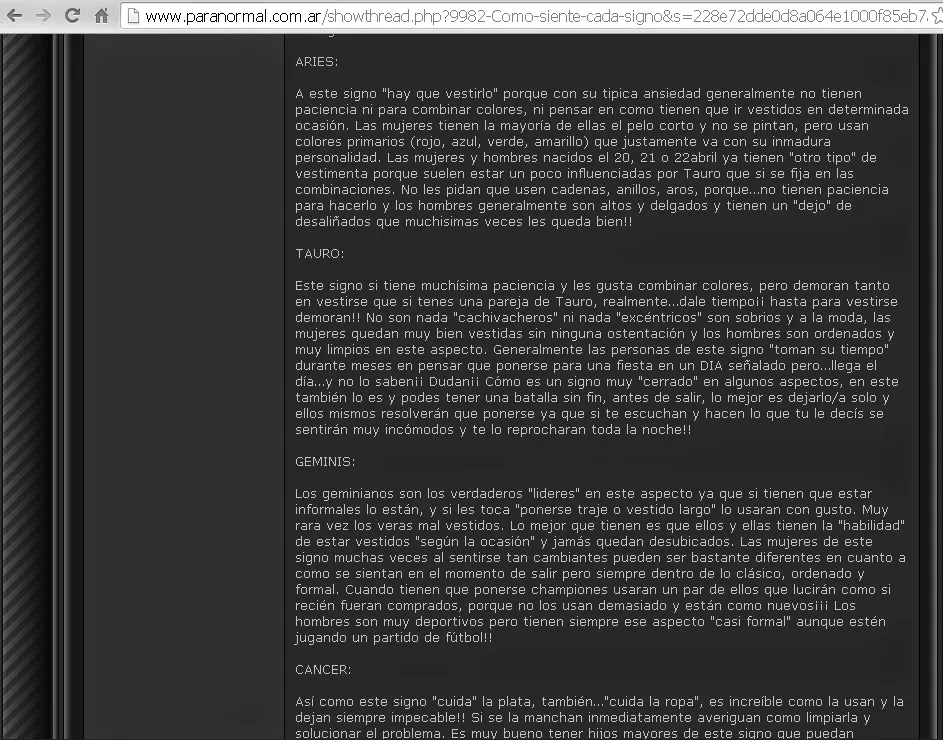
There the "source" of such discourse is indicated: the site Monografias.com. Upon accessing, we see that such discourse is signed by an astrologer who leaves her phone number, as if to be consulted (advertising).
We will also find "the same discourse," the same words in the same order, on the forum Interreclutas dated 04-08-2008.
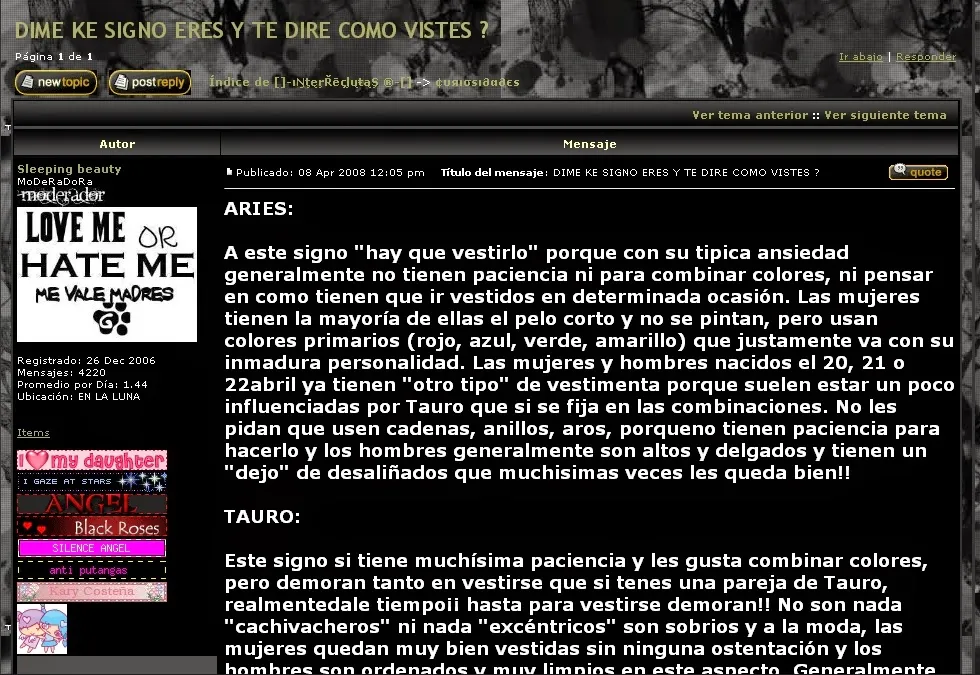
If we continue with the searches we will find again the same astrologer and the same text on Universonuevaera.com.
We will also find that on 01-09-2015 the site Peru.com published the same note, without clarifying the source or signature.
This does not mean that because the same discourse is repeated, it is false. It is unreal for the reasons given earlier, for the lack of rigor, the lack of a scientific basis, the lack of an investigation, which prevents establishing causal relationships.
But it does show that these discourses /circulate/ like water in a society in which we have lost our compass.
The responsibility will no longer be only of the senders, but also of the receivers. And it is not enough, as some postulate, to stop consuming these discourses: we must complain.
HARMLESSNESS AND TRUTH
We do not complain because, apparently, I postulate, for people these texts are "harmless."
They are as harmless as the stereotypes pointed out above. The mechanism is the same. It is to affirm that something is true, when it is not. It is to affirm that there are groups of people who are different from others without basis for such statements.
These discourses circulate false ideas, differentiating us based on something that is unreal. We should care if we cared about /truth/.
But in postmodern societies we have lost the search for /truth/.
It is true that in the past, truths were rigid, absolute, structured and that we want to get rid of that.
But one thing is to shed absolutism and another is to fall into a relativism where everything is the same. Relativism, however, has a positive factor. It is an overcoming of absolutism insofar as it is a concrete philosophy, of consequences, that takes into account intentions and different variables. But if we take it to the extreme, we arrive at the same place as in absolutism: knowing nothing.
Paradoxically, mass astrological discourse is absolutist and transmits /truths/ that are not truths.
Non-media astrological discourse, the one most people do not have access to, is not absolutist. An astrologer will draw up a birth chart taking into account not only the apparent position of the Sun, but also that of the planets and the moon. And they will also consider triangulations and other relational variables. That discourse, although less absolute, is still false insofar as it establishes causal relationships with no basis other than ancient myths; it is less widespread because it is more complex, to the point of being "individual".
Such discourses, although more complex, are not harmless, but they affect fewer people. In contrast, astrological discourse in the mass media /circulates/ strongly and reaches people of all ages and backgrounds.
To conclude, we can add two reflections. It is understandable that we people seek some kind of "refuge" in the irrational when circumstances press upon us. A mother whose child is sick and not getting better may, in her desperation, turn to an astrologer. I understand that.
It is not advisable and the consequences could be serious, but I understand it.
But that we are permanently looking for others to tell us who we are, how we should dress and act in the name of a supposed correlation between planets and personality, is a symptom of a crisis of meaning and an alienation that has not been overcome.
Modern societies brought rationality and, as a negative reaction to that rationality, a return to the irrational.
In the middle, a dialectical and overcoming conception seems to be lost, one that must be recovered. To stop thinking of ourselves as objects of change and to assume ourselves as subjects of change.