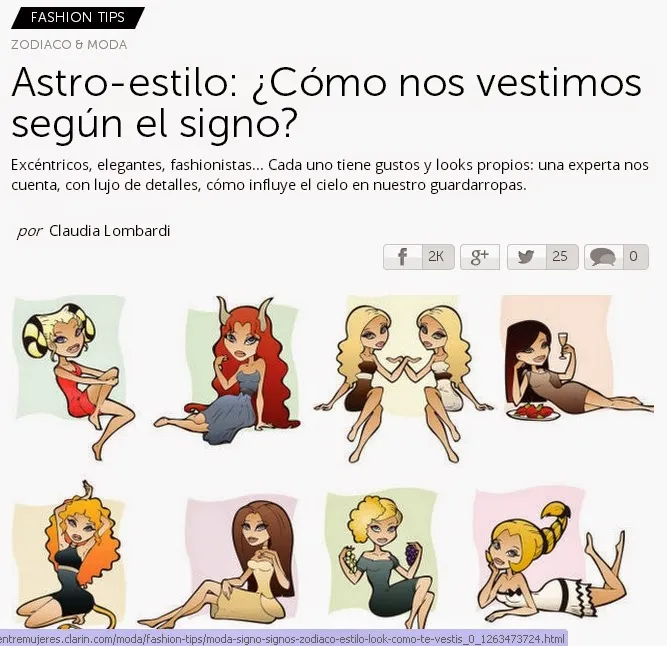
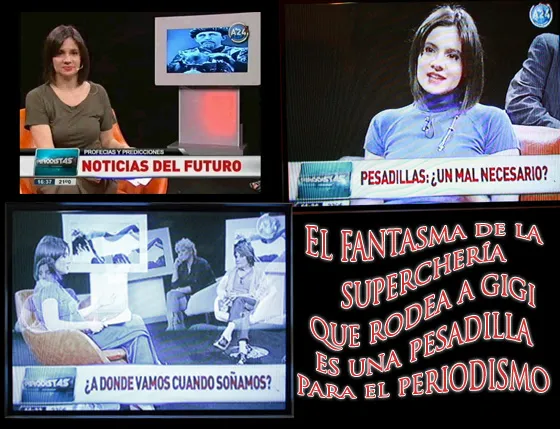
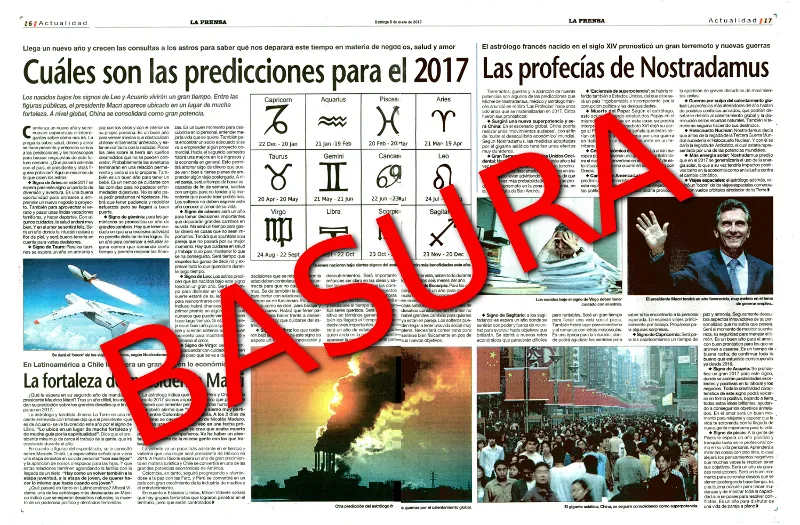
An article is published in Clarín claiming that "The frenzy for horoscopes is growing". Analysis.
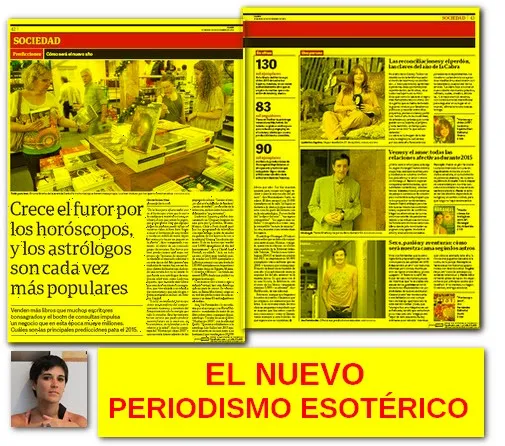
The headline of the article, which appears on the web and in the print edition (society, pages 42-43) of 12-28-2014 is "The frenzy for horoscopes is growing and astrologers are increasingly popular" (see at Clarin.com).
Reading the article, although obvious, is still surprising in some paragraphs. Perhaps it's a joke for April Fools' Day...
The article on the web appears without a byline. It is symptomatic that, while the author claims something, the web commenters seem to say the opposite.
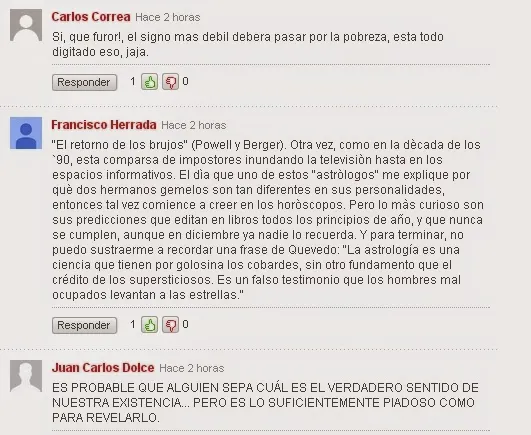
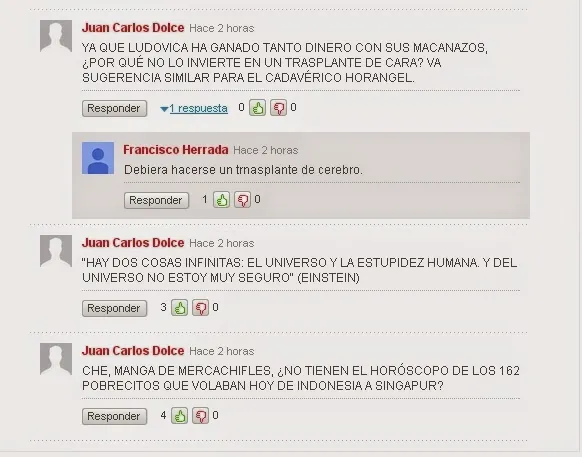
In the print version the article is signed by Gisele Sousa Dias. According to her profile on LinkedIn she has worked at Clarín since 2006. Also, since 2012 at Revista Anfibia.
Previous jobs seem more like internships: 1 month at Courrier International, 8 months at El Mundo, 1 month as a freelancer for the UN. Between 2005 and 2014 she completed the master's degree in journalism from Clarín-Universidad San Andrés. Her bachelor's degree was from UAI.
According to her profile on Blogger: "I'm Gisele, a journalist by birth, a frustrated psychologist. The low budget for vacations allowed me to discover the wonders of the lands of Córdoba. Daughter, sister, friend, girlfriend-wife and aunt, these are all my roles. Too much for being only 24...?"
This is not about "persecuting" people or ad hominem arguments. But we must make it clear that what is published is said by her.
The article begins with a saying, a supposed quote: "Out loud, nobody believes in horoscopes". And then it adds: However: if you take the horoscope out of a magazine, you get a million emails, sales drop and they picket your door," says –exaggerating and not so much– the editor of a well-known magazine group.
What Gisele says is "exaggerating and not so much". It is not clear in what the anonymous editor exaggerates and in what he does not.
But there is something else, outrageous: The journalist does not bother to ask or investigate with that editor or other sources in which cases the horoscope was removed from a magazine or newspaper and what is said would happen actually occurred. Documented cases are extraordinarily few.
The New York Times, which for some is the most prestigious newspaper in the world, does NOT have a horoscope.
It can be said that the horoscope is published, above all, in "generalist" publications. Crónica and Diario Popular, which are among the best-selling newspapers in the country, have this column.
In almost all cases it follows the same scheme composed of 12 paragraphs. This format appears in modernity in relation to newspapers, as a way to make a previously more complex discourse (the astrological discourse) into a simpler one, for the masses.
The other issue that Gisele does not care about in the slightest is whether newspapers should (I'm thinking of a "should be") publish what the public demands.
One could argue that if Crónica stopped publishing photos of women in scant clothing, its audience might switch to Popular. Would that be applicable to Clarín and the horoscope?
That is, for Gisele and for the editors of Clarín, if they stopped publishing the horoscope, would people switch newspapers? The Great Argentine newspaper stopped publishing a certain type of classified ads, stopped publishing TV highlights, and recently ended Cora Cané's column: "Clarín Porteño".
Why is the horoscope published?
Certainly the answer must be complex, but we cannot ignore a certain human tendency to know what we do not know and, to be more precise, to give meaning to life.
I have long held a thesis that, of course, is difficult to prove: people read the horoscope in newspapers because it is published. Not the other way around.
That is, it is not published because it is read. It is read because it is published.
It is not contradictory.
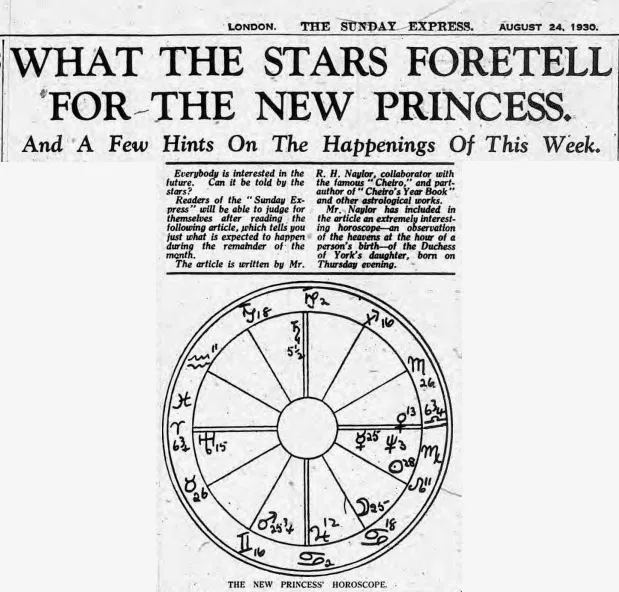
In Europe the horoscope would have been published for the first time in a newspaper around 1930 in the Sunday Express. It was a weekly article in the Sunday newspaper. In the first publication it indicates that "Everyone is interested in the future. Can it be predicted by the stars? Readers of the Sunday Express will be able to judge for themselves after reading the following article..." R.H.Naylor was the author. (See image 1)
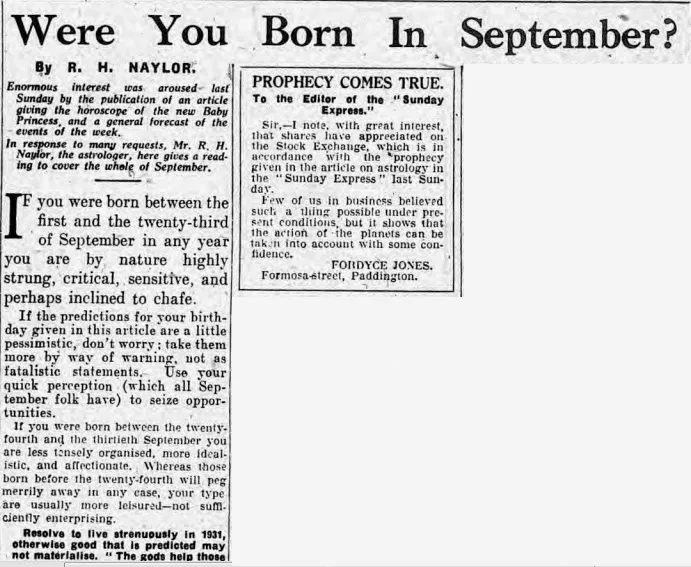
The following week, August 31, 1930, in the second installment it was indicated; "Enormous interest was generated last Sunday by the publication of an article giving the horoscope of the new Princess and a general prediction of the events of the week". (see image 2)
If that were true, we could call such a phenomenon a "frenzy". 84 years have passed since that publication.
Horoscopes, both in newspapers and magazines and books, did not predict World War II. In the cited newspaper, R.H. Naylor indicated, in fact, that there would be no war.
However, that 1930 was the "launch" year of the horoscope in newspapers cannot be a mere coincidence, considering the Great Depression.
"Popular" astrologers as Gisele indicates, did not predict Ayotzinapa nor the disappearances of the Malaysia plane and passengers nor the more recent one of Air Asia. Horangel predicted that Rosario Central would not be promoted in December 2012. As I have said in other cases, the "value" of astrology cannot be judged exclusively by the results. There is a 50% chance of rain. It's easy to be right when the prediction is ambiguous. What must be evaluated are the bases from which the prediction is made.
Of course, the media, through their "Giseles", take care of hiding the enormous blunders of astrologers.
The mass media, through their "Giseles", take care of reporting on social phenomena (which is valid) without questioning their causes and consequences. The "Giseles" don't care at all if horoscopes contain any truth. What matters to them is that the public buys and "believes" it.
The problem of horoscopes published in newspapers is neither inside nor outside such publications. The problem is the meaning given to it. A joke is neither true nor false, right? And the horoscope?
The meanings of the horoscope in modernity
Audiences surely give horoscopes different meanings. For many it is surely mere harmless, pastime entertainment. If we gave it such a meaning, considering it truly harmless, without consequences, then why would the public have a great dependence on its publication?
Theodor Adorno studied the horoscope and found that its advice was "conservative," that it did not promote a critical view of society, but rather that the text asks us to conform. (1)
But Adorno overlooked that beyond the horoscope's "text," such discourse is composed of other signs: it is usually accompanied by a name (which coincides with that of a constellation), a date range, and perhaps an icon. Such signs allow the horoscope to be undeniably linked to astrology.
Perhaps the public considers that the horoscope is made by "anyone while having a whiskey," but what about astrology?
There are studies indicating that a part of the public considers astrology a science, among other reasons because of its suffix.
Gisele, however, doesn't care at all whether astrology is a true discourse or not. Paradoxically, she says she is a journalist, with a master's degree and everything.
RATIONALITY AND EMOTIONALITY IN MODERNITY-POSTMODERNITY
Gisele concludes: "So, even if we pretend to be extra rational and feign disbelief, the numbers give us away."
Your articles also give you away, Gisele. They reveal that there is a part of society that moves away from the rational, considering the non-rational to be good. Neither the rational nor the emotional is good or bad "in itself." The atomic bomb was thought up, created, and dropped through rational as well as emotional thoughts. Fury is associated with anger.
The "crazy guy in the Mini Cooper" as the media called the alleged perpetrator of a death on December 25 did not act rationally.
So-called impulse purchases led to the belief that consumers, for the most part, appeal to the emotional more than the rational to decide, even in the realm of politics.
There are those who doubt this, with some reason: When someone buys a product offered as "3 for the price of 2" they are doing a kind of "calculation."
The problem in these cases is thinking that the rational is related exclusively to the mathematical.
Forgive the example: if a 90% discount on 50-inch LED televisions were offered in exchange for killing a person (a black person, a Jew, a gay person, or any other group segregated by prejudice) how would we analyze the case?
First, the offer was made with criteria of rationality/emotionality. Both components are present in the offer, that is, from the one making the offer. The problem lies in the sense of relating both components, in their causes and consequences.
Similarly, the presumed consumer in this horrible example I thought of, exaggerated to see things more clearly, will they accept the offer or consider it as horrifying as it seems to me?
Whoever accepts it, will they do so for mere economic reasons, through mathematical calculations?
Therefore, such a dichotomy, as it is usually presented, is false. All human beings reason and have emotions. We would cease to be human if we discarded these types of behaviors and ways of thinking.
Those who want to stop being emotional want to be robots, machines.
Those who want to stop being rational want to be instinctive animals or "cave people." Well, there are those who follow the "paleolithic diet." This "anti-modern" stance of wanting to return to the caves, to the illogical or irrational, is a characteristic of what has been called "postmodernism."
We will find it in the avant-garde movements of the 20th century as a reaction to rationality. The search to break structures, to say and think differently, is certainly very valid. But with few exceptions, what was sought to be broken was with rationality and not with capitalism.
Rationality - which does not imply the exclusion of emotions - is vital and indispensable. First, because we are rational beings and not only emotional ones.
Second, because if we cannot know reality - rationally - then we will not be able to control it - with the limitations of the case - nor modify it.
Certainly, this rationality cannot be disconnected from a certain sense of "fraternity" like the one we will find in Aristotle, but also in Marx. It is something more than empathy. It is recognizing that human beings need each other. In treating each other as equals, among ourselves, but also between humans and Nature, human "control" over natural resources would not have the goal of destroying trees, plants, and the environment, since we need them.
And, therefore, the same with people.
This form of rationality, based on equality, has been lost and persists, stoically, in unfortunately minority sectors, although on the rise.
To the extent that we move away from rationality, understood in this way, we will be functional to leaving things as they are. That is what is in astrology and horoscopes. An anesthesia. That is what Gisele celebrates. It is fury.
Sources and related links
- (1)ADORNO, Th.W; Sociological Writings II, vol. 2: Under the Sign of the Stars; Madrid, Akal, 2011
- Blanco, Gerardo: The Meanings of the Horoscope in the 21st Century
- Blanco, Gerardo: The Horoscope in "Women's Magazines"
- Sunday Express: Horoscopes: Tales of the expected
About the images
- Image 1 and 2: Extracts from Sunday Express, August 24 and 31, 1930.