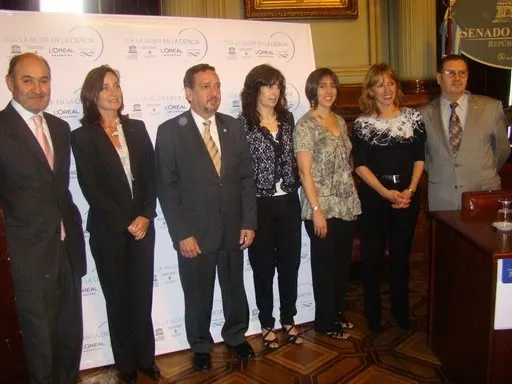
For the fourth consecutive year, the L’Oréal-Unesco Prize with the support of Conicet was awarded, this time to Dr. Patricia Tissera, a researcher at IAFE/Conicet who studies the process of formation and structure of the universe.
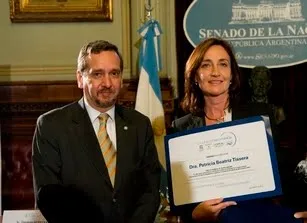
The ceremony was held in the Blue Hall of the Senate Chamber, in the presence of the Minister of Science, Technology and Productive Innovation, Lino Barañao, Senator Blanca Osuna, the Vice President of Conicet, Vicente Antonio Macagno, and the President of L’Oréal Argentina, Germán Herrera.
Each of them spoke a few words that had as a common denominator highlighting the work of women scientists who combine their passion for research and responsibility, and dedication to their family.
In the words of Dr. Macagno, "at Conicet, the work of women in science is an everyday reality."
Dr. Patricia Beatriz Tissera is an astronomer and independent researcher at CONICET at the Institute of Astronomy and Space Physics in Buenos Aires. After receiving her award from Minister Barañao, the researcher stated: "The situation in the area of science has changed positively in recent years. Former President Néstor Kirchner gave science important support and a place on his agenda. The President of the Nation has continued and increased this change by creating the Ministry of Science, Technology and Productive Innovation. It is my deep wish that the course initiated be supported, continued and strengthened from now on to keep growing and be able to give back to society what it has invested and invests in us."
That dark side
"Just as among men there are different races and behaviors, there are also differences in the universe and that is why I investigate what the differences between galaxies are," compared Patricia Tissera.
Although she is known as the "astronomer who never had a telescope," she explains it in a very simple way: she only looks at the sky for pleasure, but when it comes to working, her function is to interpret what others observe.
In that interpretation is included "the dark side of matter" through numerical simulation methods.
Tissera was born on January 2, 1967 in Córdoba. She graduated in astronomy from the National University of that province in 1990 and earned her doctorate at the same institution five years later.
She was awarded the Gaviola Prize in 2007. The same year she received the Houssay prize for young scientists in natural and exact sciences, the Virpi Niemela prize and the Scopus prize.
She is director of the Argentine Virtual Observatory; a member of the Ministry of Science commission for the Gemini telescopes and of the astronomy and space science commission. She has also directed many doctoral and master's theses.
"Gravity allows us to write an equation and, with that calculation, software is developed that allows us to follow the evolution of a physical process and know what action one body exerts on another," explained the astronomer.
That also led her to present the project on the study of the coupled evolution of dark matter and baryons.
Calculating the universe
In the universe there is dark matter and luminous matter. The latter is also called baryonic, and it is what makes up the stars and galaxies that everyone can observe.
In contrast, little is known about dark matter, perhaps only that they are exotic particles that interact gravitationally. This dark matter occupies most of the universe.
"That conclusion was reached when measuring the rotation speed of a galaxy, it turned out to be greater than expected, so it was concluded that there is more mass than what is observed," comments Tissera.
This will be the future challenge, which thanks to the L’Oréal-Unesco prize, she will be able to carry forward. So the motto: "The world needs science and science needs women," would be complete with the addition: "...and the universe needs Patricia Tissera."
The place of women in astronomy and physics
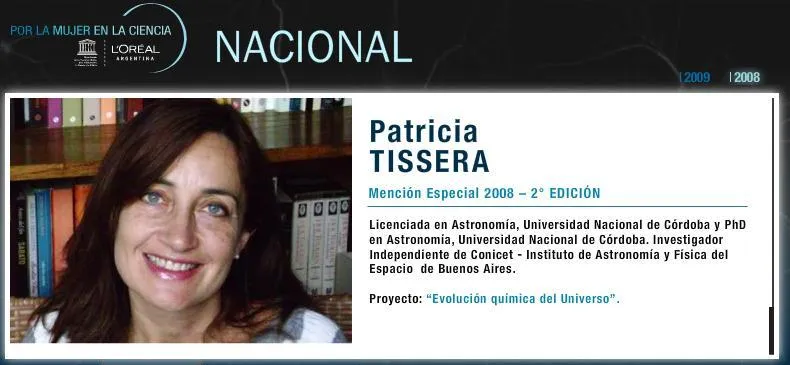
Dr. Patricia Tissera had already been awarded as a second Special Mention in the 2008 Edition of the National L'Oréal-Unesco Prize "For Women in Science" which has the support of Conicet and was awarded to her for her leadership and important contributions in the area of Chemical Evolution of Galaxies. Tissera is part of the Numerical Astrophysics Group of the IAFE.
She was not the only one. Beatriz Barbuy, an astronomer from Brazil, was awarded in 2009.
Furthermore, the scientists awarded in the 2011 edition were recently announced, among them Professor Silvia Torres-Peimbert, from the Institute of Astronomy of the National Autonomous University of Mexico (MEXICO).
Rewarded for her work on the chemical composition of planetary nebulae, which is fundamental to understanding the origin of the Universe.
I recently commented here that in Argentina, women astronomers are stars, since the proportion of female researchers, in relation to the number of men, is very good, especially when comparing the national scenario with what happens in other countries. The fact that CONICET is chaired by a woman and that at IAFE the proportion is very similar to that of men, clearly speaks of an improvement in the gender situation in the country.
Awarded in physics
In 2008, Dr. in physics Karen Hallberg was also distinguished with a special mention.
Dr. in physics Paula Villar (UBA-CONICET) received a two-year study grant in the 2009 edition.
In 2003 Dr. in physics Mariana Weissman was a Laureate for Latin America in materials sciences.
Sources and related links
- The dark side of the universe
- BARAÑAO PRESENTED THE NATIONAL L’ORÉAL-UNESCO PRIZE "FOR WOMEN IN SCIENCE"
About the images
- The photos are from CONICET.
- The screenshots are from the L'Oreal site.