A recent study seems to indicate that precognition is real. Is that so?
Precognition is the supposed ability to know facts before they happen. If we left the definition like that, it would have nothing extraordinary about it. Let's see why:
A man approaches a door. He puts his right hand in the right pocket of his pants. He takes out a set of keys. He chooses one key from the bunch and begins to bring the key to the door lock.
What will happen next?
You know, even before it happens. But that is not precognition, although for the RAE it is defined only as "prior knowledge," clearly the definition must contain something more.
Wikipedia, on the other hand, adds: "it is the supposed ability to know facts prior to their occurrence and independent of their spatial situation that cannot be deduced from information acquired in the present through the senses."
And below it notes: The existence of this phenomenon is widely rejected by the scientific community.
On November 11, NewScientist published an article pointing out a study that, apparently, would support the hypothesis of precognition and would be well done. The study was conducted by Daryl Bem of Cornell University.
Joachim I. Krueger, also a psychology professor at Brown University, however, does not believe in precognition, as he recounts on his blog.
There are at least two aspects to consider as important: the empirical and the theoretical.
Let's go to the first and see how the experiments were conducted and what they seem to indicate. I warn that for many this may be "boring" or tedious, even though I'm only going to describe how two of the 9 experiments conducted were done.
THE EMPIRICAL QUESTION: THE EXPERIMENTS
For this we first have to understand the term Priming.
The concept of priming, initially originating within cognitive psychology, is supported by an important theoretical and research corpus that suggests that the presentation of stimuli of a certain sign favors, via associative link, other semantically related concepts, thus increasing the probability of activating thoughts of similar meaning (Collins, Loftus; 1975).
There are some variants of the priming effect, but for now we leave that aside.
Experiment 1: precognitive detection of erotic stimuli.
50 male and 50 female Cornell students were recruited through a University online system. They received a credit in a psychology course or $5 for this. Before participating they knew it would take about 20 minutes, they would be asked a couple of brief questions, and then, in each part of the experiment, they were shown images of two curtains (on a computer). One curtain had an image behind it, the other had a blank wall. The task was to click with the mouse on the curtain they "felt" had the image behind it. They did it, the curtain moved and showed if it was the correct one. There were 36 similar steps in the experiment.
Many of the images contained explicit erotic images.
Participants signed a consent form and relaxed for three minutes looking at a slow-motion photograph of the starry night taken by Hubble with new-age music.
The hypothesis was that participants could "know" the position of the hidden erotic image with a frequency greater than 50%.
40 of the sessions comprised 12 exercises with erotic images, 12 with negative images, and 12 with neutral images. The positions were chosen randomly.
The remaining 60 sessions comprised 18 erotic images and 18 non-erotic positive images.
Although this may seem like an attempt to find out if clairvoyance exists, it is not. For the simple reason that, in reality, the images were placed behind the curtain image AFTER the participant's choice. Hence it is about precognition.
Results: participants correctly identified the future position of erotic images significantly more frequently than the expected 50%, the paper indicates. 70%, 80%, more? No. 53.1%.
But with t(99) = 2.51, p = .01, d = 0.25.
What are these numbers? Let's say that while statistical significance tests evaluate the reliability of the relationship between two variables, the effect size evaluates the strength of the relationship as a way to calculate statistical power.
The effect size, d, is measured as the standardized difference between two means.
In this case, d=.25 (the value ranges from 0 to 1), when one assumes it should be zero.
It is a low value, but not insignificant. As Melissa Burkley points out on her blog, other studies in psychology and other sciences have similar results and she points to the effect of aspirin in preventing heart attacks as an example.
Another post, written by Daniel R. Hawes explains roughly what these numbers mean, but it would already be too extensive to delve into this.
Bem went further, taking into account previous studies related to extroversion and boredom. We could put it this way: if we had to choose one of two cards to "guess" which is the joker, we might "feel like" doing it a few times, but then we'll find it boring and "won't put effort into it." As if that depended on it...
The thing is, the researcher performed a scale that he applied to the participants according to two simple questions: "I get bored easily" and "I usually enjoy movies I've seen before." Participants had to say if these statements were true or false for them, according to a scale ranging from very true to very false.
Taking this into account, he finds a correlation between those who had a score above the average of that scale (those who got bored less). In those cases, they correctly identified the erotic image 57.6% of the time, d=0.7. In contrast, among the "low-stimulus" participants the result was 49.9%.
Experiment 2
150 Cornell students, 107 women, 43 men. In this case, an image and its reflection are presented, one next to the other, and the participant is asked which one they like more. The computer then shows a masked image on the screen.
As in the previous case there were 3 minutes of relaxation, followed by 36 exercises in which neutral images were presented next to the same images reflected, side by side. Participants had to press one of two keys on the keyboard to indicate which neutral image they liked more. Using the Araneus system the computer THEN designated one of the two images as the target and then showed in flash form, subliminally, on the screen three times a positive one. If the participant had not chosen the target image, a highly negative image was shown, subliminally three times on the screen. If the participant had chosen the target image, the same happened with a positive image.
The target images were shown for 33 milliseconds immediately followed by a masking stimulus for 167 ms.
A Hubble image appeared on the screen for 3000 ms before the next exercise.
The hypothesis was that participants would prefer the target image more frequently than 50% over the other.
For the first 100 sessions the positive and negative flash were selected independently at random. For the subsequent 50 the negative images were put in a fixed sequence, in a range going from those that were most frequently successfully avoided during the first 100 sessions to those that were least avoided.
If the participant chose the target, the positive image was shown subliminally as before, but the negative one was held for the next exercise. If the participant chose the non-target image the negative image was shown and the following negative and positive images were used for the next exercise. In other words, no image was exposed more than once, but a successfully avoided negative image was held across exercises until it was eventually invoked by the participant and exposed subliminally.
The hypothesis behind this variant in the study was that the psi effect could be stronger if the most successfully avoided negative stimulus was used repeatedly until it was invoked.
The results of the 50 sessions do not differ significantly from the first 100, so the 150 were combined for analysis.
Unlike the first experiment four types of analysis were used. The first two are the familiar ones as in the previous case. The third used an alternative index that corrects for unequal frequencies between right/left positions in each session. The result of a session can be represented by a 2x2 table:
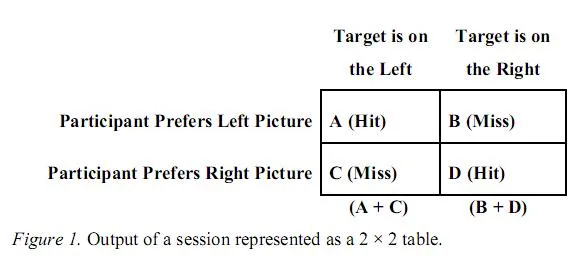
The first column is "The target is on the left" and the other is "The target is on the right".
The first row is the participant's choice of the left image and the other row the choice of the right.
In A and in D there is a match (success, hit) and in B and D there is not.
The conventional hit rate would be hits/trials or (A+D)/(A+B+C+D), but if there is a bias in the distribution of positions, that is if (A + C) != (B + D), it will not necessarily reflect performance.
For example, the RNG places a majority of the targets on the left and the participant also tends to favor images on the left and there would be an artificial inflation.
An index that automatically corrects this is the phi coefficient.
The hypothesis here is that phi would be significantly greater than 0.
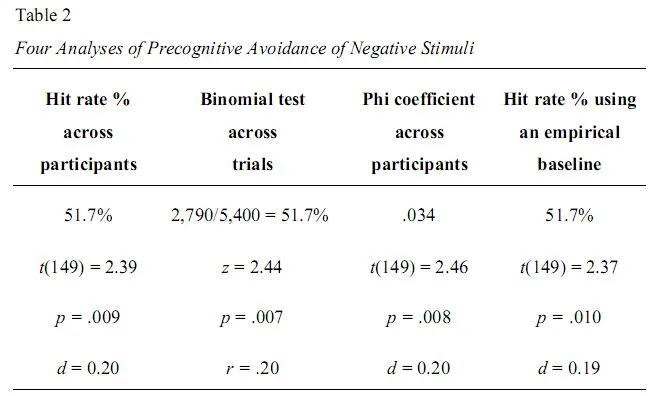
There is a fourth analysis performed with an empirical base computed with 149 virtual control sessions.
Results:
And more:
In the paper a total of 9 experiments are described. The work is 61 pages and it would already be too extensive to explain each one.
Table 7 of the work is a summary of the results of the 9 experiments:
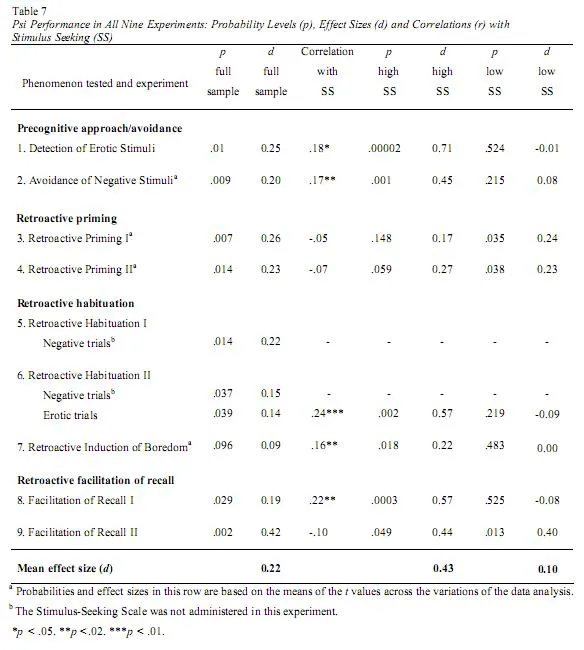
As we can see below the average effect size is d=0.22.
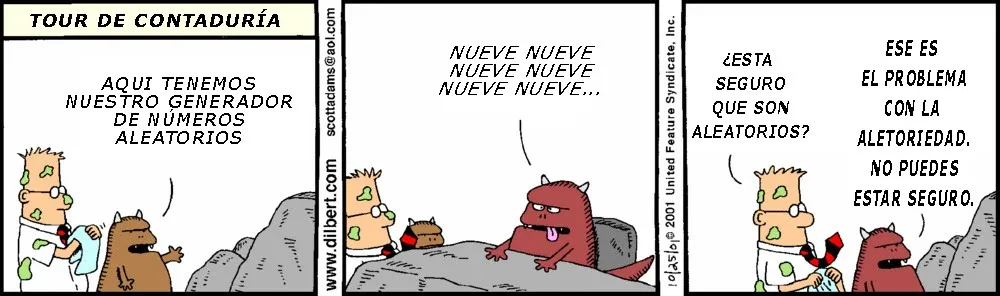
Randomness
I said that the images appeared in the experiments randomly. If we use software to generate random numbers, they will in reality be pseudo-random.
In contrast, random number generators based on physical processes, like radioactive decay, can be used.
The experiments performed for this study used a hardware-based system called Araneus Alea I and, according to the author, it passed the famous Marsaglia diehard tests.
Research strategy
The author says that the goal was to develop well-controlled demonstrations that can be replicated, designing experiments and using statistical procedures that were simple and transparent. The main statistical tool for evaluating the results was the t-test, but as those tests assume that the data are normally distributed, binomial distribution was also used.
The author points out that although it is possible to use more sophisticated statistical techniques than those used here, he deliberately did not do so because they have "the perverse effect" of weakening confidence in the findings in the typical reader.
If one possesses a low Bayesian prior probability about the existence of psi, it is more logical to believe in an unknown failure or defect in the analysis, so he considers that simplicity and familiarity with the procedures are essential tools of persuasion.
The author is cautious in pointing out the problems concerning the replication of this type of experiment and the role of the experimenter, as well as their possible influence.
THE THEORETICAL ISSUE
Then he talks about Psi psychology. He points out that it is not illogical to suppose that it could have been acquired with evolution by conferring survival and reproduction advantages in species. For example, the ability to anticipate and, therefore, avoid dangers confers an evolutionary advantage that would be reinforced by precognitive ability. Hence experiment 2. Similarly, the possibility of a precognitive ability to anticipate sexual or reproductive opportunities motivated experiment 1.
Psi and physics
The author points out that those who have followed the developments of modern physics will know that many features of quantum phenomena are incompatible with the physics of daily life. Many psi researchers believe that there are sufficient parallels between those phenomena and the characteristics of psi.
He talks about quantum entanglement and the influence of the experimenter, but also indicates that quantum hypotheses about psi serve more as metaphors than as models and researchers with more knowledge in physics are more direct, saying that both things have nothing to do with each other.
The problem of time and causality
Although we may be skeptical about telepathy and clairvoyance, it is at least possible to imagine possible mechanisms for these phenomena, such as electromagnetic signal transmissions between brains (this is not supported by experiments). Other possible explanations have been sought in the supposed ability of certain birds to migrate through unknown places, even at night. It has been pointed out that they may possess some sensitivity to Earth's magnetic field.
But, in contrast, not even this would happen with travels to the past. If a person had the ability to anticipate events, it is because the information traveled from the future to the present, that is, it traveled backwards, because we normally experience the opposite.
Now, doesn't all this imply that the future, then, is already written?
There are those who try to answer this question by pointing out, with total ambiguity, that it only happens on certain occasions, with certain events relevant to the person.
Thus, someone who correctly guessed which card will be randomly chosen from a deck, perhaps cannot anticipate the eruption of a distant volcano.
However, we all know multiple stories of people who claim to be able to know the future, but they, in their personal lives (which is what is most relevant), cannot anticipate tremendous misfortunes.
What do the results say?
The results, understood as effect size, are greater than zero, which is what one would assume should happen if there were no paranormal phenomenon.
Does this mean that there is indeed a phenomenon that physics cannot explain?
NO. The issue is that psychologists are not physicists nor do they want to be. That is, they do not attempt to explain any phenomenon. For "psi researchers," it makes no sense to explain a supposed psi phenomenon, because by doing so it would cease to be psi and become a normal phenomenon.
What there is is a statistically significant result, although the interpretation of them can be debated.
However, one must value the researcher's effort to do everything possible so that his experiments can be independently replicated, and that he does not draw hasty conclusions, but on the contrary understands that it is necessary to continue with this and other types of research. On the other hand, the experiments seem to have been designed with great ingenuity to test certain hypotheses through the scientific method. Perhaps the repetition of this type of study could shed some light on the subject.
Conclusion
The conclusion, in my opinion, is that there is no conclusion. At least no significant novelty. There is no discovery. There would be one if there existed an experiment with astonishing results and, much more, if they could be explained.
In this case, neither of the two things happens. There are, to put it one way, statistically different results, although slightly, from those that would be expected if nothing strange were happening, regarding what we know physically occurs in the real world. But whether this is indeed the case or not is truly unsayable, although the repetition of experiments of this type and others could someday shed some light on the matter.
But there is also, in the interpretation of the results, an issue linked to our belief system. As Daniel R. Hawes illustrates, let's think about a pregnancy test. We know it is correct 98% of the time, but 4% of those times is a false alarm. A woman takes the test, it is positive. How do we know if she is within the 98%? How do we know she is not within the 4% of false positives?
Unless we know Bayes' Theorem, we are in trouble.
But notice a difference if:
a- It is a 23-year-old woman who had many relationships with men, without protection b- It is an 80-year-old woman, a virgin
It is an extreme example, but it illustrates that prior probabilities have an important weight when we interpret what our unconfirmed null hypothesis (a positive pregnancy test) really means.
According to Bem, he is not in favor of believing impossible things, like the 34% of academic psychologists who believe the paranormal is impossible. But he thinks his article will increase the probabilities of the other 66% to think at least one anomalous thing before breakfast. Like the White Queen.
Clearly, the author sees the Psi phenomenon as the 23-year-old woman, while others of us see it as the elderly virgin.
Now, let's toss a coin a thousand times (more or less the total number of cases in the study in question across 9 experiments). I claim to have paranormal powers. I am correct 53% of the time. Do you believe I really have those powers? Could there be some defect in the randomness, some statistical error, some effect not taken into account or contingency like a magnetized face?
Imagination and creativity are two very rich human characteristics. For that we have literature, like that of Lewis Carroll or science fiction. And they are also important qualities when thinking up hypotheses and innovative experiments that lead to the discovery of Nature.
The problem is that grandiose claims are made based on partial, unreplicated results, with small and biased samples. And usually, with non-holy intentions. Beware of this. Researching is one thing. Discovering is another.
Sources and related links
- NewScientist: Is this evidence that we can see the future?
- Psychologytoday: Why I don't believe in precognition
- Feeling the Future: Experimental Evidence for Anomalous Retroactive Influences on Cognition and Affect
Daryl J. Bem
Journal of Personality and Social Psychology (in press)
http://dl.dropbox.com/u/1018886/Bem6.pdf
The article can also be downloaded from the author Daryl Bem's site.
DOI: 10.1037/a0021524 - Have Scientists Finally Discovered Evidence for Psychic Phenomena?!, by Melissa Burkley.
- PSI research: What do these Numbers Really Mean?, by Daniel R. Hawes.
About the images
- Comic strip. Credit: Dilbert.
- Figures from the article. Credit: Daryl Bem.