The Stardust spacecraft will encounter comet Tempel 1 on the 14th of the month 02 of this year, while Rosetta is burning fuel like crazy in correction maneuvers toward the unpronounceable comet, in 2014.
I indicated the dates above in that way on purpose because it seems to have a certain symmetry (14/02; 2014).
NASA will give a press conference today about the Stardust-NExT flyby of Tempel 1.
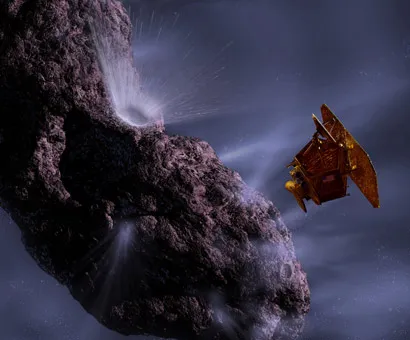
On January 15, 2006, five years ago, the spacecraft completed a historic mission, to begin another. Upon finishing its encounter with comet Wild 2 the spacecraft approached Earth and ejected the capsule that contained the particles collected directly from the comet, as well as dust from the interstellar medium. The samples arrived safely in Salt Lake City. But for the spacecraft the story would continue, now after Tempel 1, a comet that was already visited by the Deep Impact mission. The mission's name now called Stardust NExT adds the acronym that means New Exploration of Tempel 1.
The spacecraft will fly by 200 kilometers from the comet on February 14 of this year.
Toward the unnamable
Rosetta is a European spacecraft heading to comet 67P/Churyumov-Gerasimenko which it will reach in 2014. Yesterday, from the mission team's blog, it was commented that they are performing orbital correction maneuvers for 371 minutes, but it would have started on the 17th and the maneuvers would continue until January 23. These maneuvers are imparting a change in total velocity that, by the 23rd, would reach 778 meters per second. As narrated by Emily Lakdawalla of Planetary Society when Cassini ignited its main engine to enter Saturn's orbit, it changed its velocity by 626 meters.
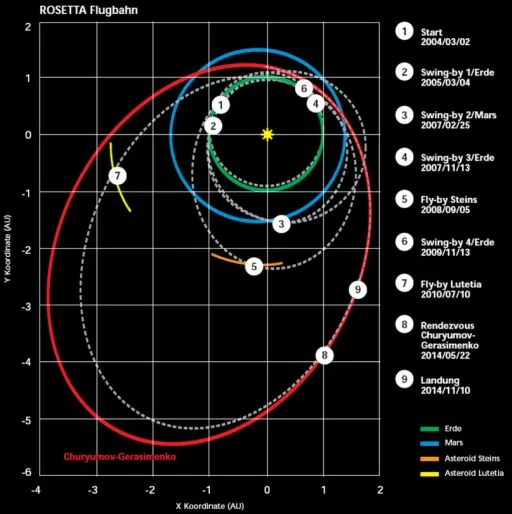
The grid denotes astronomical units (the average distance from Earth to the Sun, about 150 million km). The green circle is home's orbit; blue, Mars; red, Churymov. The dotted line is the spacecraft's route. Some portions of the orbits of asteroids Steins and Lutetia are shown since the spacecraft passed there previously. Credit: ESA / DLR
More comets
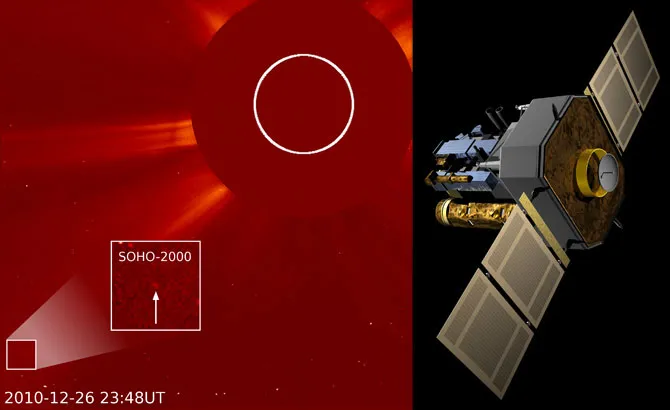
The great comet hunter is SOHO, launched more than 15 years ago (12/2/1995). On December 26 it found its comet number 2000! But SOHO does not discover comets alone. More than 70 people from 18 countries helped find some of those objects in the satellite's images.
The questions about comets
Among the various reasons for studying comets it can be mentioned that comets impact planets. What those comets contain can influence the planets they reach, altering life on them or making it arise. The finding of carbon-laden molecules and amino acids in comets supports this hypothesis called panspermia.
However, a recent study casts doubts on this, pointing out that perhaps the amount of carbon in comets was overvalued.
More info on this, in Spanish, at Ciencia Kanija.
New data on asteroids and panspermia
Amino acids are molecules that have special interest because they can form proteins. Some are considered essential, those that the organism cannot synthesize and we must ingest through diet. One case is valine. And they come in two "flavors" (isomers) that are mirror images of each other, like our hands. They are called levorotatory and dextrorotatory and are known as L and D isomers respectively. In March 2009 NASA researchers reported having discovered an excess of the levorotatory form in the amino acid isovaline in samples of meteorites originating from carbon-rich asteroids. Thus, life on Earth, which in this sense is left-handed, could have a space origin. That is, the existence of meteorites with levorotatory isovaline could explain why in our world amino acids are of that type and not the other.
In a new investigation the team reports an excess of isovaline (L-isovaline) in a greater variety of carbon-rich meteorites, which could be interpreted as support for the initial findings.
See Axxón 1999: Watery asteroids may explain why life is "left-handed"
However, isovaline is not a proteinogenic amino acid, those that are encoded in the genome. For this and other reasons one must be cautious with the Panspermia hypothesis, as Manuel Sánchez tells it.
Comet with an identity crisis?
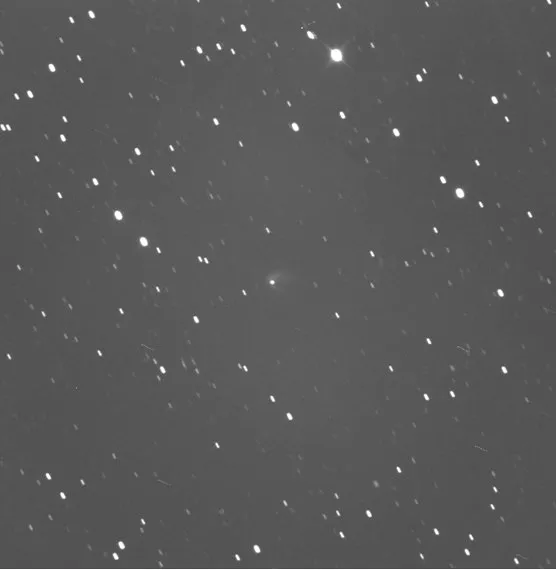
596 Scheila is 113 kilometers in diameter and is considered a main belt asteroid (a rocky object orbiting between Mars and Jupiter), but as a faint tail was detected on it, it is now thought that it would be a comet. Thus, like other objects, they are creating a new classification: main belt comets. It is supposed that if they were comets, being close to the Sun their ice should have already vaporized. The hypothesis that arose is that they are not icy objects, but resulting from the collision between two asteroids. Another example is 3200 Phaethon, the object that gives rise to the Geminids.
Sources and related links
About the images
- Stardust drawing: NASA/JPL/UMD/Pat Rawlings
- SOHO images. SOHO's comet 2000, detected by a Polish amateur astronomer on 12/26/2010. Credit: SOHO/Karl Battams.
- Image of 596 Scheila, composition of 10 images of three minutes exposure each, obtained via robotic camera in New Mexico. Courtesy of Bill Cooke and Rhiannon Blaauw, NASA's Meteoroid Environment Office, Marshall Space Flight Center, Huntsville, Ala.