While space agencies set up warning systems, a new site allows calculating the consequences of an asteroid impact.
The European Space Agency (ESA) recently launched the Space Situational Awareness (SSA) Programme. While perhaps no course of action is possible against certain asteroids, on other occasions we may be able to take actions such as deflections or, at least, evacuation of regions. But none of this will happen if there are no continuous observations and warning systems.
The possibilities for action were recently addressed in an article published in El País by Detlef Koschny, of ESA-SSA.
NASA has the Near-Earth Object (NEO) program.
There we can see that for 13-11/2010 there were at least 5 near-Earth objects in close approach, with diameters from 19 to 920 meters and speeds of about 20 km/s. (The diameter is estimated based on the object's absolute magnitude).
We can also learn about the upcoming close approaches to our world and note that on January 7, 2011, the passage of an asteroid (2008 EA32) between 1.3 and 3 kilometers is expected, at a distance of 0.1965 astronomical units (about 29,395,981 km).
Whether out of our own curiosity or because we want to share that information in a forum, blog, or classroom, it's certain that the question immediately arises: And what could happen?
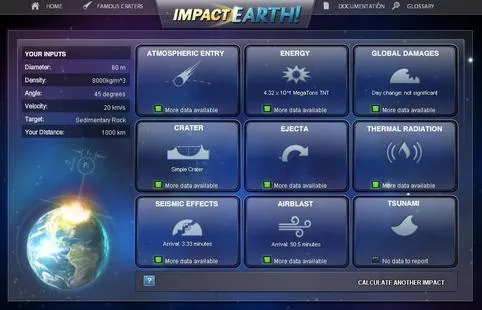
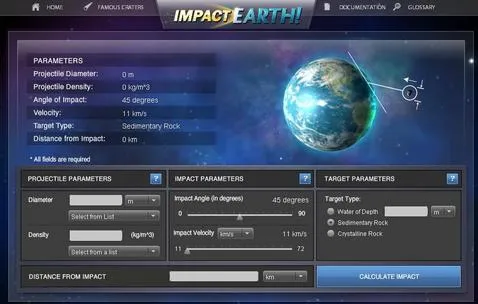
To get an idea of the consequences of an impact, we now have the ImpactEarth! page, made by Purdue University.
There, by entering data such as the diameter (in several possible units), density, impact angle, speed, target type, and distance from the impact, we can get an idea of the impact's consequences.
The developers, Collins, Melosh and Marcus (from Imperial College London and the University of Arizona) published an article in Meteoritics & Planetary Science 40, Nr 6, 817–840 (2005) about this application.
There they explain how to estimate these environmental consequences of the collision of extraterrestrial objects with our world.
The page existed previously, with a much simpler design, in an earlier version still available.
As happens in many other cases, the site is only in English. For entering the parameters, I don't think this is really an obstacle, but it is, however, for understanding the results.
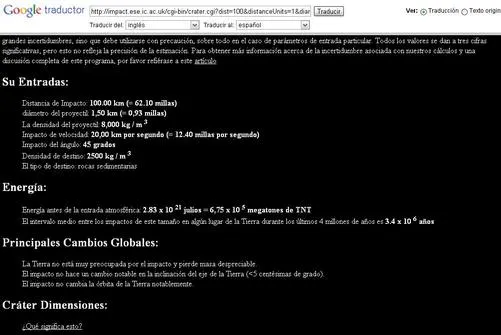
But if we use the earlier, text version, and after pressing the calculate button, we copy the resulting URL and paste it into Google Translator, we will immediately have a link on the side with the page translated into our language.
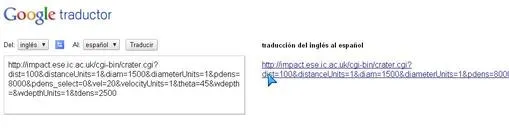
Automatic translations are not reliable and, in some cases, really bad, but for this it can be useful for those who do not handle English.
Sources and related links
- Earth Impact Effects Program: A Web-based computer program for calculating the regional environmental consequences of a meteoroid impact on Earth
Gareth S. COLLINS, H. Jay MELOSH, Robert A. MARCUS
Meteoritics & Planetary Science
Volume 40, Issue 6, Pgs 817–840
DOI: 10.1111/j.1945-5100.2005.tb00157.x
http://www.purdue.edu/impactearth/Content/pdf/Documentation.pdf
About the images
- Screenshots of ImpactEarth!