A collection of images, sounds and videos that relate science and art. Today: Three cosmic Valentine's Day images; Space Music: The symphony of science; and Beau Lotto and his optical illusions. I invite you to marvel.
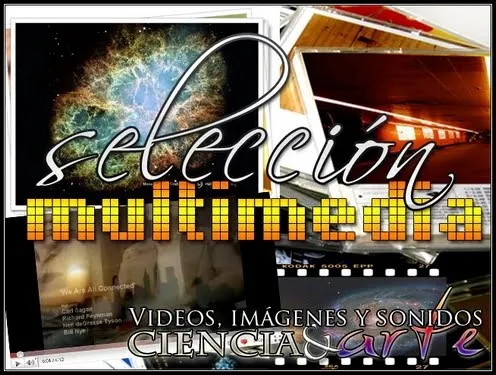
A decade ago 3C294: an hourglass of X-rays
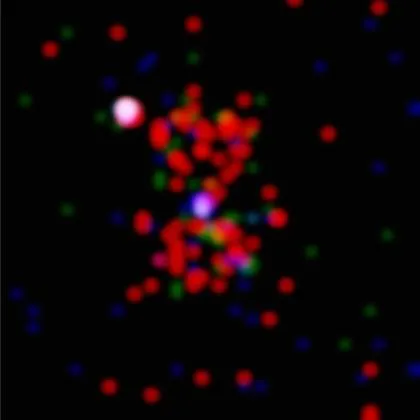
This image from the Chandra Observatory shows hot gas enveloping the distant galaxy known as 3C294. This X-ray emission is considered a signature of an extremely massive galaxy cluster, one of the largest structures in the universe. Astronomers think they captured the cluster at a time when the universe was only 20% of its current age. The image reveals an hourglass-shaped X-ray region around the previously known radio galaxy (shown with the central blue object). The intensity of the X-rays is shown in red for low-intensity emission, green for intermediate, and blue for the highest energies observed. The orbital X-ray observatory observed 3C294 for 5.4 hours on October 29, 2000 and the image was released on February 15, 2001, a decade ago. Eros, an asteroid love
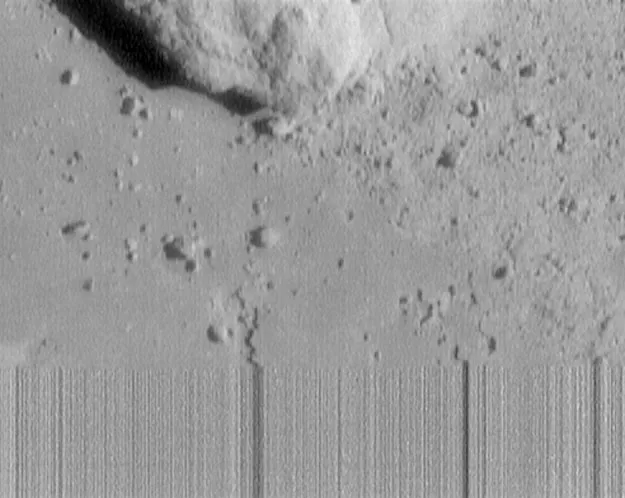
On February 12, 2001 NEAR-Shoemaker became the first spacecraft to land on an asteroid and send signals from the surface. Since the robot was not designed for that contingency, the success of the landing on asteroid 433 Eros was not assured. Above is the last image taken before its descent, at 130 meters above the surface and extends about 6 meters. The image was published as the Astronomy Picture of the Day from NASA on February 13, 2001. Also in Spanish at Observatorio.info. Credit: NEAR Project, JHU APL, NASA A rose for Valentine's Day
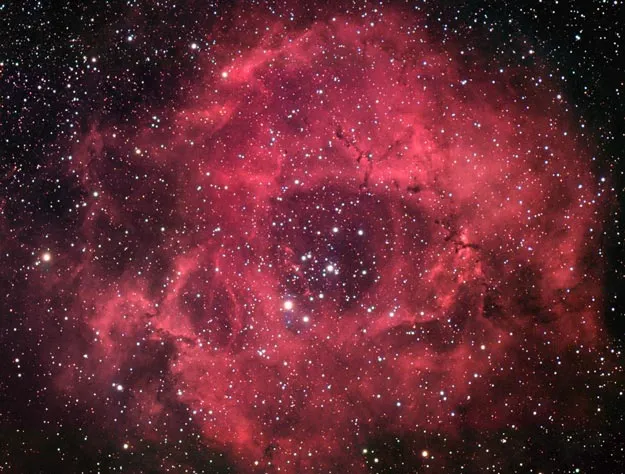
"Could the Rosette Nebula have any other name that looks this sweet? The bland designation by the New General Catalogue of NGC 2237 does not appear to diminish the appearance of this flowery emission nebula.", they asked in the Astronomy Picture of the Day, one day after the publication of the image above. Also in Spanish at Observatorio. The image was taken by the extraordinary astrophotographer Robert Gendler. The connections with Valentine's Day and, especially, the landing on Eros, have a correlation now, ten years later, when tomorrow the 14th the Stardust spacecraft meets comet Tempel 1, as we announced in There we go, comets.
Space music The symphony of science The project is led by John Boswell and its goal is to bring scientific knowledge and philosophy to the public in a novel way, through music as a medium. Science and music are two passions of Boswell, as he himself points out on the site Symphony of science. The existence of the project is largely due to the work of Carl Sagan, Ann Druyan and Steve Soter, with their production of the Cosmos series. Boswell's passion for music developed during his adolescence, but it was recently, after obtaining a degree in economics, that he decided to start an electronic music project called Colorpulse. Inspired by The Gregory Brothers and DJ Steve Porter, along with his experience and composition, led him to experiment with mixes of scientists' voices that culminated with "A Glorious Dawn" in 2009. The very positive reception that sound had, released in a video that quickly became popular on YouTube, motivated him for another attempt: "We are all connected". Since then, riding on the impact of both tracks, the project created a total of six videos. While we sometimes complain about the little dissemination of science in the mass media and the apparent disinterest of young people in the hard sciences and scientific thinking in general and we hit our heads when we hear on television that, incredibly, if we add the last two digits of our year of birth and add the age we will turn this year, incredibly the result is 111, an apparently "spiritual" number, or we see a recognized sports journalist show off his "magnetic bracelet", while all this is happening, I say, the Symphony of Science and its high impact tells us at the same time that all is not lost. There are many, many people there who, beyond wanting to be entertained by shows -which is logical and human- also recognize that there is something transcendent in human activity. Art and science are two examples of that. And the symphony of science combines both. In this video list we can see the six that make up the symphony, all of them with Spanish subtitles. The tracks, along with various mixes that generated new versions, can be downloaded for free from the Symphony of Science site. Also, although not necessarily linked to science, the Colorpulse project deserves to be known. It is also possible to download tracks for free and some songs will surprise you.
TED Talk video: Beau Lotto's optical illusions Beau Lotto's color games confuse your vision, but at the same time reflect what we normally cannot see: how our brain works. This fun firsthand look at our versatile sense of sight reveals how evolution colors our perception of what is really out there. I think Beau's presentation was very good, although it seems it was hot... If you liked the video, you might want to visit Beau Lotto's site and, in particular, learn about the software that relates music with colors.