The Leiden/Argentine/Bonn survey of the 21 cm emission of galactic neutral hydrogen was carried out in both hemispheres to have a map of the whole sky. The southern contribution was made from Argentina. What is its value?
Not long ago I wrote here about ethics and science, focusing on only certain aspects. One of them is whether it is morally good or right to allocate public funds to the development of astrophysics research that, in most cases, does not seem to have a direct impact on people's quality of life, something that does seem to exist in other disciplines such as biology or chemistry.
I pose the dilemma by putting myself in the devil's advocate's shoes, a clarification I suppose was unnecessary, but just in case, let it be made.
This means that I do not agree that this dilemma exists as it is posed, but I do think it is valid to ask it (and there are people who do) and that it is good to answer it, with arguments.
One of the possible answers revolves around what we consider useful. Sometimes the impact of astrophysics on people is linked to its usefulness. From that point of view, astrophysics (except for topics like the study of the Sun and near-Earth asteroids) would not be useful.
But it is not the only possible definition. Let's think about how different topics of study arise and what impact they have within the sciences. It might be inefficient to carry out research on a field that has already been extensively studied and about which there is a lot of literature, unless it is approached with a novel focus.
Novelty is essential in a scientific study. Even so, if we use the ADS service and search for the keyword "Moon" we will see a lot of recent work on our satellite. All of them include some novelty. All novelties have their value. But some could be considered more novel than others. Confirming previous studies is important, but perhaps generating new knowledge could be considered more valuable. That can be done without generating one's own data, using third-party data. In the new paradigm of science, this methodology is becoming increasingly common and allows research without having large observatories, without large public funds.
But that will be possible to do from anywhere.
Differential science
A characteristic that can distinguish research is its differential potential. Making a difference is paramount in several aspects of human endeavor. In marketing it is considered essential, otherwise it would be the same to buy this product or that one (in most cases it IS the same and they try to pass it off as if it weren't...)
This blog, the perceptive reader will have noticed, tries not to replicate the same content as all the others and seeks topics or differentiating approaches.
In astronomy this also happens, particularly with a characteristic that can distinguish one country from others: its place in the world. Argentina has a privileged situation on the globe: we are in the Southern Hemisphere, from which we can observe a sky different from that of the North.
It is true that the Old World and the Great Power are neither slow nor lazy and that nearby here they have placed their bases, Europe through ESO and the United States through Carnegie.
But, equally, Argentina can exploit this differential so that the research done here is more useful, different from what can be done elsewhere and, therefore, with a higher level of novelty and scientific impact. It is a way of giving a twist to the definition of usefulness, but I believe it is not a forced twist, but an authentic and concrete one.
On the other hand, in this space I have been talking about scientific policy. If ethics and science often seem dissociated, it happens even more with the relationship between science and politics, although both exist and play a very important role.
When thinking about research topics, a national astronomical policy could be focused on topics that, for various reasons, can generate a greater impact by adding differential values.
A notable example of both things is the survey of the 21 cm emission of neutral hydrogen. While there is a survey in the Northern Hemisphere, another was carried out, jointly, in the Southern Hemisphere, from the Instituto Argentino de Radioastronomía.
It is known as the LAB survey (Leiden/Argentine/Bonn) and contains the combined data obtained by the Leiden/Dwingeloo survey led by researcher W.B., Hartmann & Burton, 1997, of the northern sky (declination = -30º) with that carried out by the IAR of the southern skies (declination = -25º), led by Drs. Marcelo Arnal and Esteban Bajaja in 2000 and 2005.
According to the Argelander Institute page, the data were corrected by the Radioastronomisches Institut of the University of Bonn.
Hence the survey is known as LAB.
The Instituto Argentino de Radioastronomía dedicates a special page on its site linked to Large-scale Surveys. There, the importance of these surveys is explained in a didactic way:
"Due to their characteristics, the IAR radio telescopes are ideal for undertaking projects aimed at observing, at a specific frequency, large areas of the sky. For this purpose, one of the most important characteristics is the angular resolution of the instrument to be used. At the frequency of 1420 MHz, the radio telescopes of our Institute have an angular resolution of about 30' of arc (approximately equivalent to the size of the full Moon).
If with such an instrument one wished to completely observe the energy emitted by the neutral hydrogen atom (HI from now on) coming from an area of the celestial sphere that, as an example, covered a strip around the galactic plane with an extent of 20º in galactic latitude and 150º in galactic longitude, it would be necessary to observe about 48,681 different positions in the sky.
Observing each of them for a period of about 4 minutes (this is the average time with which each sky position was observed in the HI survey of the Southern sky), that would imply an uninterrupted observation time of about 135 days. Larger diameter telescopes (for example 100 meters) would have a higher angular resolution (on the order of about 9', a little less than one third of the diameter of the full Moon), but would take much longer to perform the same observations, about 1,488 days (equivalent to almost 4 years)."
About the LAB survey, another page explains what it is about:
"A high-sensitivity survey of the 21 cm line of neutral hydrogen of the entire southern sky south of declination -25º was carried out.
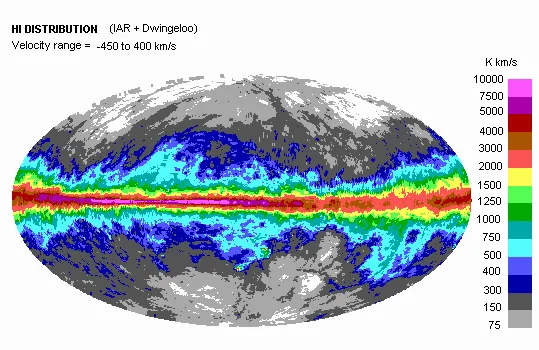
This survey was performed in galactic coordinates, in grids of 0.5º in each coordinate. The velocity range covered is between -450 and +400 km s-1, with a spectral resolution of 1 km s-1".
The image that begins the post is a combination of both surveys, the Northern and the Southern one, and shows the distribution of hydrogen across the entire sky.
More images can be seen on the IAR website.
These surveys have a good impact because they are data that can later be used by researchers from all over the world to apply to different topics.
In the ADS database there are about 34 mentions of the LAB works. But if one takes one of the main papers and searches for citations, one will find about 570.
These data, of course, can be used in the very countries that generated the surveys, as is the case with studies of high-velocity clouds by Ricardo Morras.
On the Argelander page there are two videos that show a sweep through the data, with projection at the Galactic center and at the galactic anti-center (*).
The following video shows the sum of both videos, after a 20-second introduction with the data of the involved researchers.
Video: The Leiden/Argentine/Bonn Galactic H1 Survey
http://www.youtube.com/watch?v=t2zO82RC9kQ
It must be said that there is at least another similar survey, conducted at Arecibo.
The value
Scientific research, in this case astrophysical, although it can be understood from a certain point of view as not very useful, in relation to its level of impact on people's quality of life and in comparison with other disciplines, can, at the same time, be considered useful in relation to its impact on the scientific community itself. And a characteristic that adds value to research is its differential feature that can generate a more important novelty from a country due to some variables such as its location on the globe.
This IAR survey is, in my view, an excellent example of national astronomical policy, in which a maximization of resources is allowed and science is generated with a differential and complementary value to the studies carried out by the great powers.
It is, for this very reason, and because these initiatives in many cases also produce technology transfer, a good example of useful astrophysics. Because they are not papers that then sleep the sleep of the just, but are used (hence the useful) by other researchers in the world to produce even more novelties. And they also generate a look at this part of the world, which elevates local astronomers and allows the establishment of highly valuable international collaborations.
We have talked about the Auger project on other occasions, but it would be unfair not to mention it in this context, because it also has a characteristic linked to its location on the globe, within the national territory.
In short, science in general and astronomy in particular have many topics of interest. But undoubtedly, our place in the world can generate differential developments.
Another way of saying that Argentina must seek its north. And, as a Latin news channel says, "our north is in the South".
(*) Note: Let's say the Galactic center is the point around which our Milky Way rotates, about 24,000 light-years away from the Solar System in the direction of Sagittarius.
The galactic anti-center is defined as the point where galactic longitude (l) is 180º and galactic latitude (b) is 0º. It is the direction opposite to the galactic center, so the number of stars decreases when looking towards the outskirts of the Milky Way. It is located in Gemini (RA = 6h 17m 0.0s Dec = +22d 30m 0.0s)
Sources and related links
- IAR: Obtaining radioastronomical databases
- The Leiden/Argentine/Bonn Galactic H i Survey
- Kalberla, P.M.W., Burton, W.B., Hartmann, Dap, Arnal, E.M., Bajaja, E., Morras, R., & Pöppel, W.G.L. (2005), A&A, 440, 775 (astro-ph/0504140)
- Bajaja, E., Arnal, E.M., Larrarte, J.J., Morras, R., Pöppel, W.G.L., & Kalberla, P.M.W. 2005, A&A, 440, 767 (astro-ph/0504136)
- Arnal, E. M., Bajaja, E., Larrarte, J. J., Morras, R., & Pöppel, W. G. L. 2000, A&AS, 142, 35
- Set of links about LAB on Connotea
About the images
- Illustration credit:
Kalberla, P. M. W.; Burton, W. B.; Hartmann, Dap; Arnal, E. M.; Bajaja, E.; Morras, R.; Pöppel, W. G. L.