A European project will allow tracking astronomical events across the entire sky by linking radio telescopes in both hemispheres and even from space.
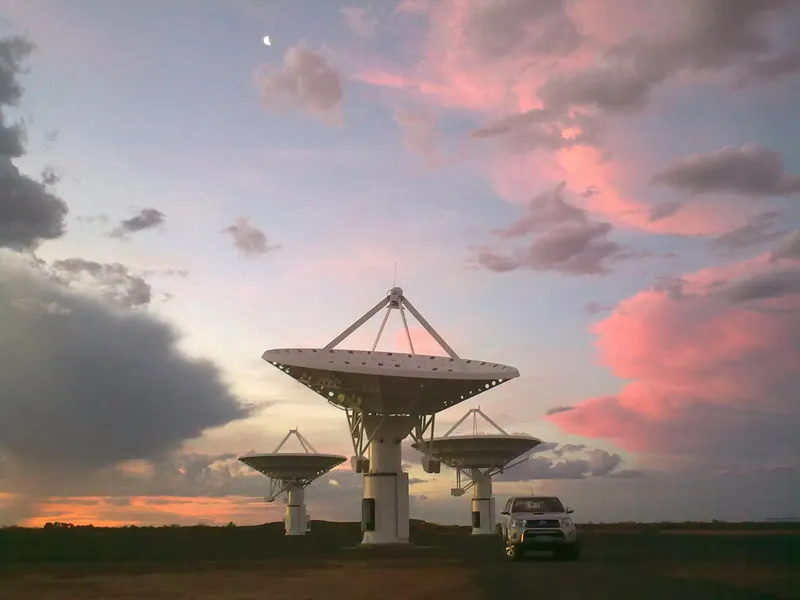
Funded with 3 million euros from the European Research Council (ERC) over the next five years, the 4 Pi Sky project will use a combination of ground-based and space telescopes to study rare events such as neutron star collisions and supernova events. 4 Pi Sky combines three telescope systems. One is LOFAR which consists of 10,000 antennas across Europe and will be used to track objects at a frequency of 30-240 MHz. The others are MeerKAT in South Africa and ASKAP in Australia, which will be used to track phenomena at frequencies above 1 GHz. When combined, the telescopes will be able to monitor the entire sky, as scientists will be able to link the telescopes to not lose track of a phenomenon while the Earth rotates. ASKAP is the new generation of radio telescope being developed by CSIRO (Commonwealth Scientific and Industrial Research Organisation, Australia's scientific agency). It will consist of 36 antennas of 12 meters in diameter each and, when completed, will be one of the most important radio telescopes in the world. Its construction is expected to be completed in 2013. MeerKAT is a precursor instrument for the SKA, a project that promises to revolutionize radio astronomy. Currently South Africa and Australia are fighting for a place for the SKA, after having left out of contention places like Argentina. It will be 3,000 receivers linked with a collecting area of one square kilometer that would have 50 times more sensitivity and be 10,000 times faster than the best current radio telescopes. MeerKAT is being built near the planned site for the construction of the SKA. The team is currently working on KAT-7, a seven-antenna interferometer in Karoo. A high-speed data link will connect that location with the control center in Cape Town. MeerKAT will consist of 80 antennas and its completion is also expected for 2013.
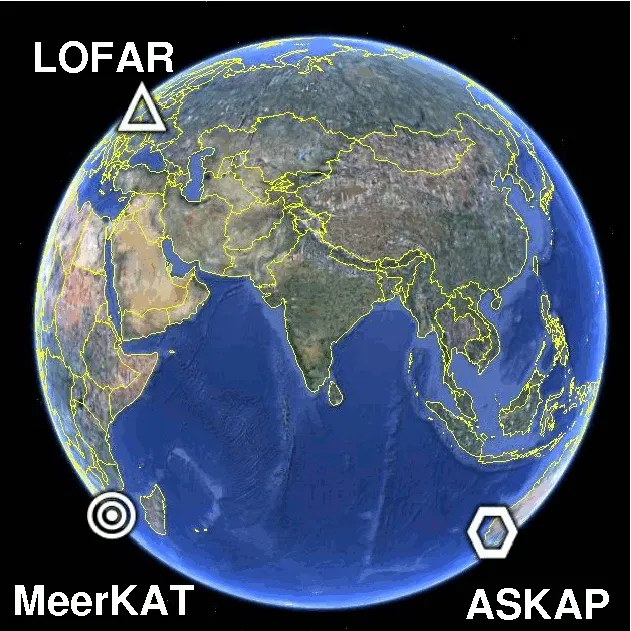
"This is really a project that will try to coordinate what we can do with these telescopes in terms of optimizing their performance and getting the software running," said Rob Fender, lead astronomer of the project, from the University of Southampton in Britain. But besides the telescopes here on the planet's surface, the 4 Pi Sky project will enable researchers to use MAXI, the All-Sky X-ray Monitor of the Japanese Space Agency, which is aboard the International Space Station and studies events at wavelengths between 0.5 and 30 keV. Meanwhile, the decision on where the SKA will be installed is expected next year. Why is the project called 4 Pi Sky? Because of its coverage. Given the location of the three telescopes on the Earth's surface, which for practical purposes can be considered a sphere, the coverage of the radio telescopes would be 4 pi sr. The symbol sr means steradian, a derived unit from the International System for measuring solid angles, the three-dimensional equivalent of the radian. If the area of a portion of a sphere is r2, a steradian is the solid angle subtended by that portion at the center of the sphere. Ergo, 1 pi sr is a quarter of a sphere, 2 pi sr is half a sphere. 4 pi sr is the complete sphere. The animation on the steradian Wikipedia page is very illustrative. Sources and related links
- Telescope team plans to track the whole sky, by Michael Banks of Physics World and James Dacey.
- 4 PI SKY
About the images
- Image of three KAT-7 antennas.
- Coverage chart of 4 pi Sky/Rob Fender.