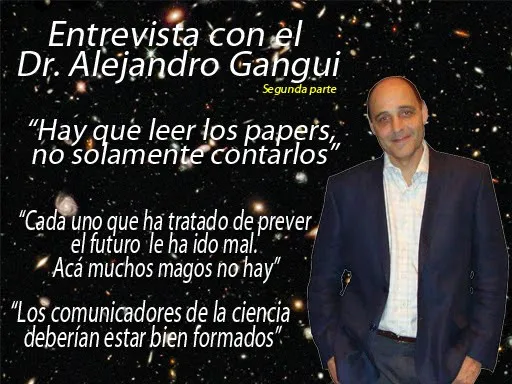
Interview with Dr. Alejandro Gangui, Argentine astrophysicist, about astronomy, education, and science communication. First part.
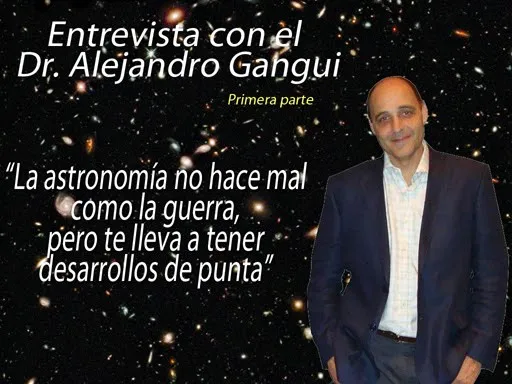
With the aim of answering a set of questions of my own and from readers, a pleasant conversation took place between this humble servant and a researcher whose curriculum vitae is longer than the transcription that follows.
-In the world there aren't many astronomers, there are astrophysicists...
-No, no, there are astronomers.
-There are. Isn't it a declining career, in favor of astrophysics?
-No, no, because there are many purebred astronomers, people who studied astronomy, in La Plata, in Córdoba...
-And in the world?
-And in the world...
-Because you studied astrophysics.
-I studied astrophysics, I'm not an example in that either, let's say
-But those you studied and worked with were also astrophysicists: Dennis Sciama, Brandon Carter...Cosmologists at least are all physicists, as is logical...
-In general they come from that side, but there are also people who switched from one area to the other.
-But it's easier to switch from astrophysics to astronomy than the other way around.
-Eh, it depends on how research takes you. There are people who start with archaeology and end up doing astronomy, I mean they start with the more humanitarian sciences and end up with the harder ones and from this side there are quite a few who come from being astronomers and end up doing supernova remnant physics more than positional astronomy. There are others who, on the contrary, came more from astrophysics and are searching for extrasolar planets, it's not that they are studying them in physics but they are looking at them and finding them to see where they are.
-And the comparison with those professionals you worked with in Trieste or Paris, can you work side by side? Was your training at UBA sufficiently important to be able to speak in different languages but in the same mathematical-physical language?
-Yes, yes, in principle there is a certain difference in level, one always goes well below and the guys are well above.
-But is that because one predisposes oneself that way?
-No, one measures one's words well before speaking with this type of people. It doesn't mean one doesn't have one's own ideas, but when one discusses, it's like, without there being an authority principle, one tends to respect a bit the experience, especially in things that are within their area of expertise. Then with time one becomes more of a colleague, but it's not like I spent years and years of my life, it was always a bit at the disciple level.
-I wanted to talk a lot about education, because you have dedicated yourself strongly to the educational topic and to outreach.
-Careful, I am not a pedagogue or an educator.
-But, in practice...
-Of course, in practice yes, especially in the astronomy topic where there isn't much...
-There are very few. Beatríz García in Mendoza and little more.
-No, then there are other groups that do education. But since astronomy is not a subject that is in the curriculum of primary or secondary school practically...
-No, it's not.
-It is in some years, in some places.
-In some places. I did a national high school and nothing..
-In theory. In practice it's not there because of the issue that teachers don't feel confident...
-But there is also a cultural issue because we are taught by heart all the rivers of Europe and no constellations.
-Well, that happens in general, but it will also happen in other subjects too. It's more than anything the issue that teachers, even though it's in the curricular design, in the NAPs, the núcleos de aprendizaje prioritarios [1], teachers in general, as they don't have much confidence with these topics or because there are certain things that are not by memory and you have to start reasoning...
-There's the issue. Because the fundamental value of astronomy for me [in education] is that it leads to thinking...
-Of course, it leads you to think...
-Distinguish between the real and the apparent...
-Yes, yes, that's a bit the idea. When any type of statement has to be thought about, then, no, stop, the Sun is over there so the Moon is on this side, so the phase is such and such, that's not memory, it implies a little bit of thinking and when you have to think in three dimensions in space it's a whole difficulty. That's why there isn't too much, but there should be a bit more. Well, the attempt we make is so that there is little by little. But yes, I got a bit into those topics from the point of view of having people around me who know well the topics that can be worked on because there are people who know more about pedagogy than astronomy and there I compensate with what I know about astronomy.
-A slightly more technical question. When one asks about the big topics of current cosmology, many topics are talked about, but it's very unusual to hear someone ask themselves: what is space? Is it an answer that is already answered? Space-Time, let's say, what difference does it have with the ether?
-Well, no, the ether was a kind of medium that permeated all space
-It was supposed that there had to be a medium for photons to be able to...
-A bit like waves in water...
-And today it's not necessary because it travels in a vacuum. But that vacuum is something...
-Well, that vacuum is defined within a space, without space there could be no vacuum.. That space is an entity that escapes a bit what astronomers and astrophysicists dedicate themselves to studying to work and they consider it as a given thing.
-But it doesn't stop being an important topic, or am I crazy?
-In general it's more touched by people who do a bit more philosophy...
-Of course but philosophy is ideas, which are very good to have, but which one cannot contrast with observations. Let's say that there is a frontier there... Is it continuous, is it discrete, is it composed of particles?
-Well, there it is. If it is continuous or discrete there are people who are asking themselves that, if space-time has or does not have a fractionation or if it is continuous as we think today.
-Is that verifiable?
-To effectively see what space is like microscopically you have to go explore very, very large energies, on the order of the Planck scale...
-And that also implies mixing relativity with quantum...
-Yes. Relativity, which in a way is space on large scales, gravitation, which is the interaction that dominates on large scales, and then also the microscopic which involves quantum. And since there the two theories don't go hand in hand and for that reason there is no theory that can represent it. But there are ideas about what space is like. This comes from the side of physics, theoretical physics. But for people to start asking about reality, whether there is space, what it is and isn't...
-Right, that's already philosophical.
-In fact there are books written entirely about that, say, for example by Max Jammer [2], who at some point chatted with Einstein, has books like "The concept of space" and others, and there it is discussed a lot about what is interpreted as space and there is a whole very interesting historical part. Again, to get into those subtle topics it's like the language itself, the vacuum, nothingness, are not synonyms for these people. When one speaks one sees everything the same, well, you have to be a bit careful...
-With the definitions...
-Right, I mean, nothingness, as an entity, as an ontological entity, has a different concept. Hence you have to be a little careful. But, yes, there are people interested in the topic. But astronomers or astrophysicists don't need to know what it is to say, well, my working hypothesis is that it exists, that it behaves like this. Obviously if space changes completely the whole building one can construct falls apart. But, like everything, one relies on other people to be able to continue, right?
-A difficult, prickly question. Is astrophysics useful? Useful in the sense of changing people's lives, society's. Because studying binary stars, interstellar space...
-No, but not only that. If you don't have some spur in your back that leads you to make technological developments, you wouldn't make them. In many countries there is the war industry: the development of GPS, etc. Astronomy is one of those things that don't do harm like war, but also leads you to have cutting-edge developments.
-But that's rather serendipitous...
-No, no. Even, telescopes with adaptive optics and such, have mechanisms that modify the telescope mirror so that air turbulence is compensated and putting that in the eye and we are modifying the cornea, so that what you have problematic in the lens can be compensated.
-Technology transfer as the most important value at a practical level, let's say.
-Yes, one looks for the materialist side, from here to ten years what am I going to have with all this that astronomers spend, besides with a precision technology. Knowing in what place on Mars such and such probe will land implies a precision that then, little by little, or quickly, also reaches current technology. GPS came out perhaps for a military reason, but now everyone uses it, the laser they also didn't think what it was for and now we all use it. And now, the more people there are dedicated to finding the technological side to any invention no matter how strange or academic it seems, with many people with that vision of business entrepreneurship, that will go faster and faster. There is very strong cutting-edge technology. And there is a cultural part that we cannot overlook, right? For example atomic physics doesn't have that cultural part. Since we have memory everyone liked to look up, at the sky. In astronomy the cultural comes together, the simple comes together, the technological development comes together. Then a bit of curiosity is added and all that gives a pretty interesting combo, which other areas of research don't have. Astronomy has the ingredients to be a transversal area, that runs through many other areas: from biology, chemistry and others. And as we said, it also has a cultural part, a historical one, and of development in technology.
The second part of the interview was published on Monday, February 28:
A Look at the Cosmos and Closer to Home (2)
A brief profile of Dr. Alejandro Gangui
Dr. Alejandro Gangui was born in Buenos Aires in 1964. He received his degree in physics from UBA in 1991. In 1995 he obtained the title Doctor Philosophiae in Astrophysics at ISAS/SISSA, International School for Advanced Studies, in Trieste, Italy, with the doctoral thesis "Cosmic Microwave Background Anisotropies and Theories of the Early Universe", supervised by Professor Dennis W. Sciama. He was a postdoctoral researcher at the International Centre for Theoretical Physics (Italy) and at the Paris Observatory (France), in the group of Brandon Carter.
He is an independent researcher for CONICET at the Instituto de Astronomía y Física del Espacio (IAFE).
More data on his scientific and outreach work, among other things, on Alejandro Gangui's website.
Sources and related links
Notes:
- [1]: NACs - Núcleos de Aprendizajes Prioritarios
- [2]: Refers to: "Concepts of space: the history of theories of space in physics", Max Jammer, Courier Dover Publications, 1993 - 261 pages. See on Google Books.
About the images
- Combination of: Photograph from Concurso la Ciencia en los Cuentos 2009. Credit: Viviana Bianchi; with background image of Hubble Ultra Deep Field Infrared. Credits: NASA, ESA, Z. Levay (STScI), G. Illingworth (UCO/Lick Observatory and the University of California, Santa Cruz), R. Bouwens (UCO/Lick Observatory and Leiden University) and the HUDF09 Team.