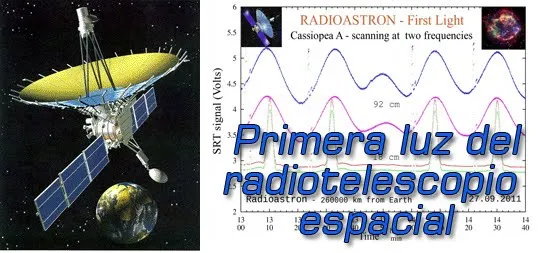
On September 27, the first light of Cassiopeia A was detected with Spektr-R (RadioAstron) the Russian radio telescope in orbit.
After several decades of efforts and delays mainly economic, Russia successfully launched, in July of this year, a satellite for radio astronomy. After an initial scare when it could not deploy the antenna, the observatory is functioning as expected and has already provided its first light.
What is the point of putting a radio telescope in orbit? the reader who knows that the limitations that telescopes have in other wavelengths, such as visible, on the Earth's surface are not an obstacle for radio astronomy may ask.
The idea is to do very long baseline interferometry (VLBI) together with ground-based instruments to achieve an impressive resolution.
This technique is used by radio telescopes on the surface, such as the VLBA in New Mexico and VLBI, and allows having a virtual instrument as large as the distance between them, with the limitation of the Earth's diameter.
But by putting a radio telescope in orbit this limitation vanishes and the resolving power grows enormously.
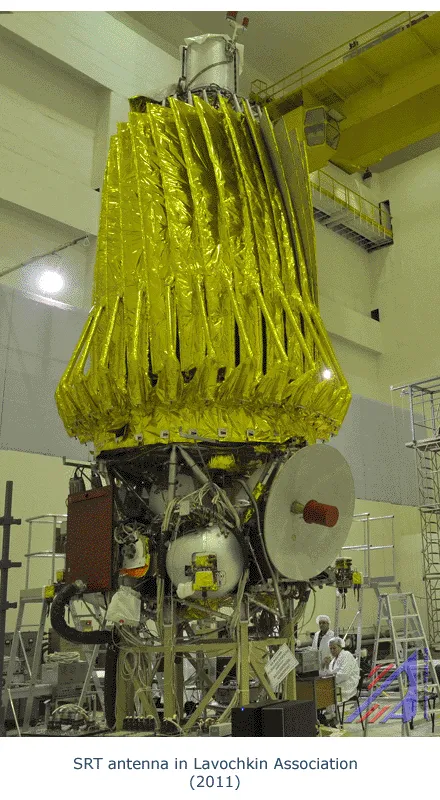
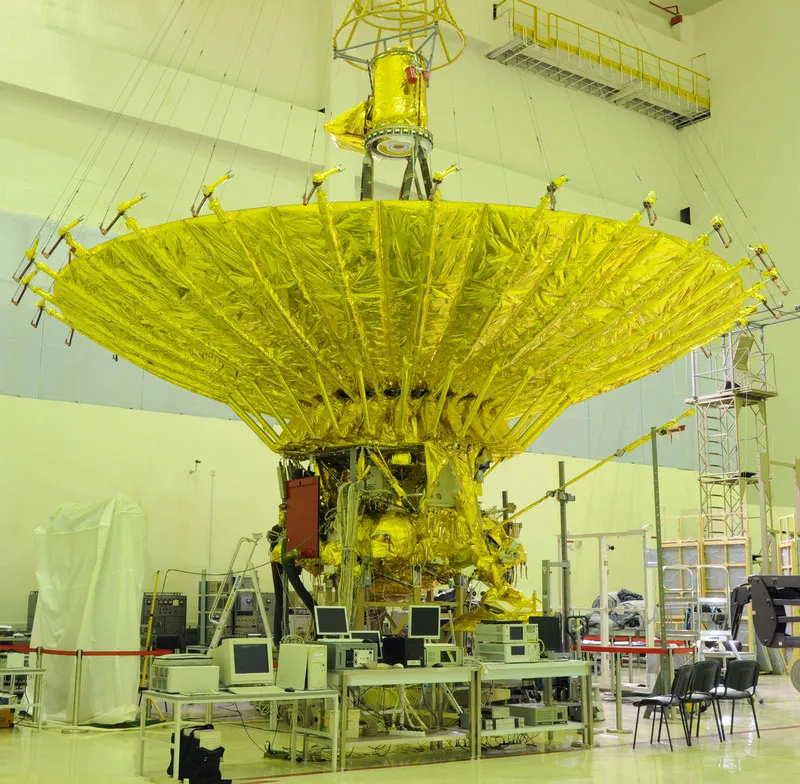
Planned in the early 1980s, this satellite -which has a 10-meter antenna divided into 27 foldable petals- suffered multiple delays due to lack of funds. A fleet of Spektr satellites covering different wavelengths had been planned, something in the style of NASA's Great Observatories (Chandra, Hubble, Spitzer, Compton). But when the Soviet Union collapsed and funds evaporated, Russian scientists focused on the Mars-94 probe (Mars-96), which ended up failing.
And there attention turned again to Spektr whose priority was Spektr-RG, in X-rays until the launch of Integral in 2002 and Spektr-R moved to the front of the priorities.
The idea of linking radio observatories in orbit and on the ground is not new. An immediate precedent is HALCA or Muses-B which did the same until 2005. From its maximum orbit that spacecraft created an interferometry baseline of 21,400 km.
But Spektr-R (Spectrum-R or RadioAstron, which is simpler) goes further, as it has an elliptical orbit with an apogee at 340,000 km, almost at the Moon's orbit! The orbit is not stable as it will vary: the perigee from 400 to 65,000 km and the apogee from 265,000 to 360,000 km with an eccentricity between 0.59 and 0.96.
With the apparatus, which consists of several instruments, an attempt will be made to study the structure and dynamics of radio sources inside and outside the galaxy to learn more about star formation, black holes, dark matter and interstellar space.
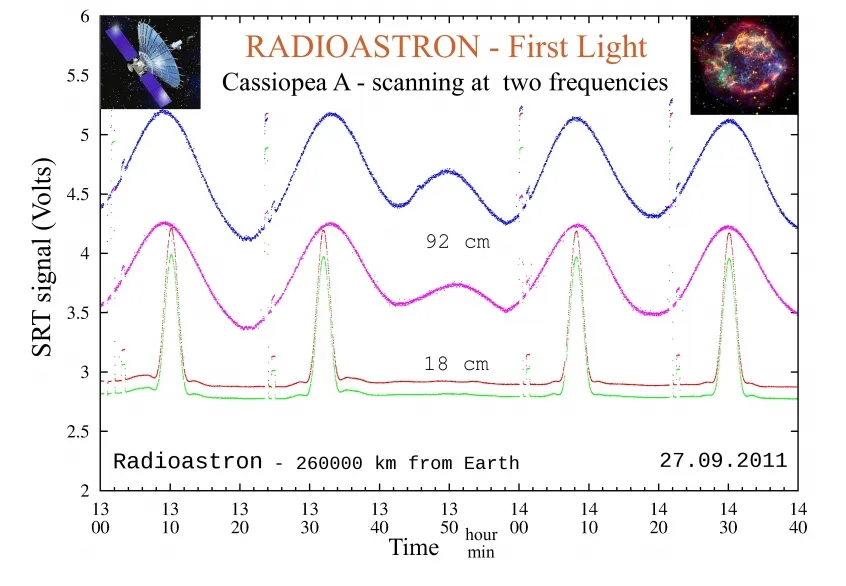
The most recent news of this incredible apparatus, sometimes nicknamed "Russia's Hubble," although the American space telescope is not a radio telescope, or also called "Russia's big eye in space" is its first light, performed by observing the supernova remnant Cassiopeia A in two perpendicular directions. Signals were successfully detected in two bands of 92 and 18 cm, according to Nikolai Kardashev of ASC.
In the excellent blog Eureka by Daniel Marín there is a lot of information about RadioAstron for those who are curious.
http://www.youtube.com/watch?v=Uak5KprXMy8
Sources and related links
- Spektr R will allow seeing beyond the end of the Universe
- Russian Space Web: Spektr
- Eureka: Radioastron, the space radio telescope
- RadioAstron Project
- Russia Launches a Telescope, Decades in the Making
Daniel Clery, Science 29 July 2011: Vol. 333 no. 6042 p. 512
DOI: 10.1126/science.333.6042.512
About the images
- Photograph of the Spektr-R antenna. Credit: RadioAstron.
- Photo of Spektr-R during final tests. Credit: NPO Lavochkin.
- Graph of the first light. RadiAstron.