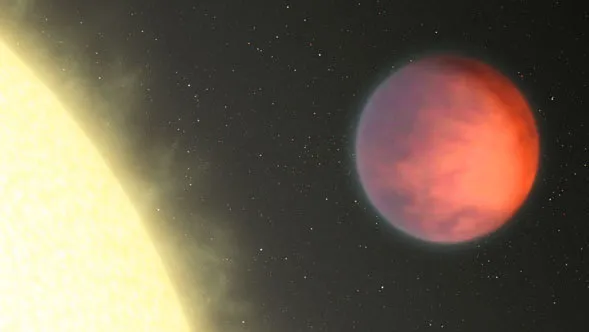
Astronomers believe they have found for the first time an object carving its way through the disk surrounding a young star.
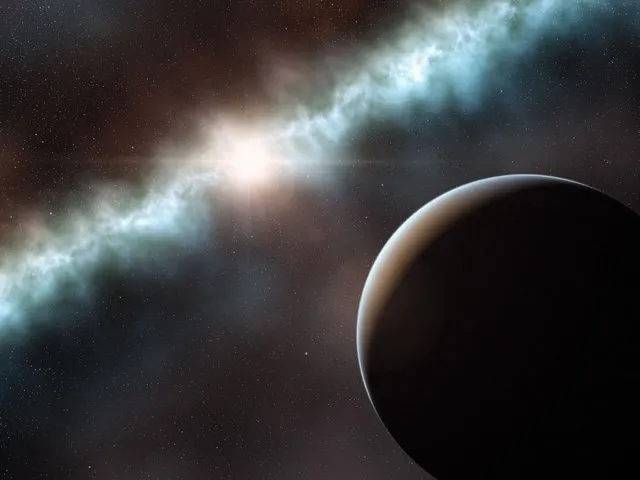
Using the Very Large Telescope (VLT) of ESO, in the Antofagasta Region of Chile, an international team of astronomers has managed to study the ephemeral disk of material surrounding a young star, where a planetary system could be forming. For the first time, a smaller companion [*] was detected, which could be the cause of the large gap observed in the disk. Future observations will determine whether this companion is a planet or a brown dwarf.
Planets form from disks of material surrounding stars, but the transition from dust disks to planetary systems is rapid and very few objects are identified during this phase [1].
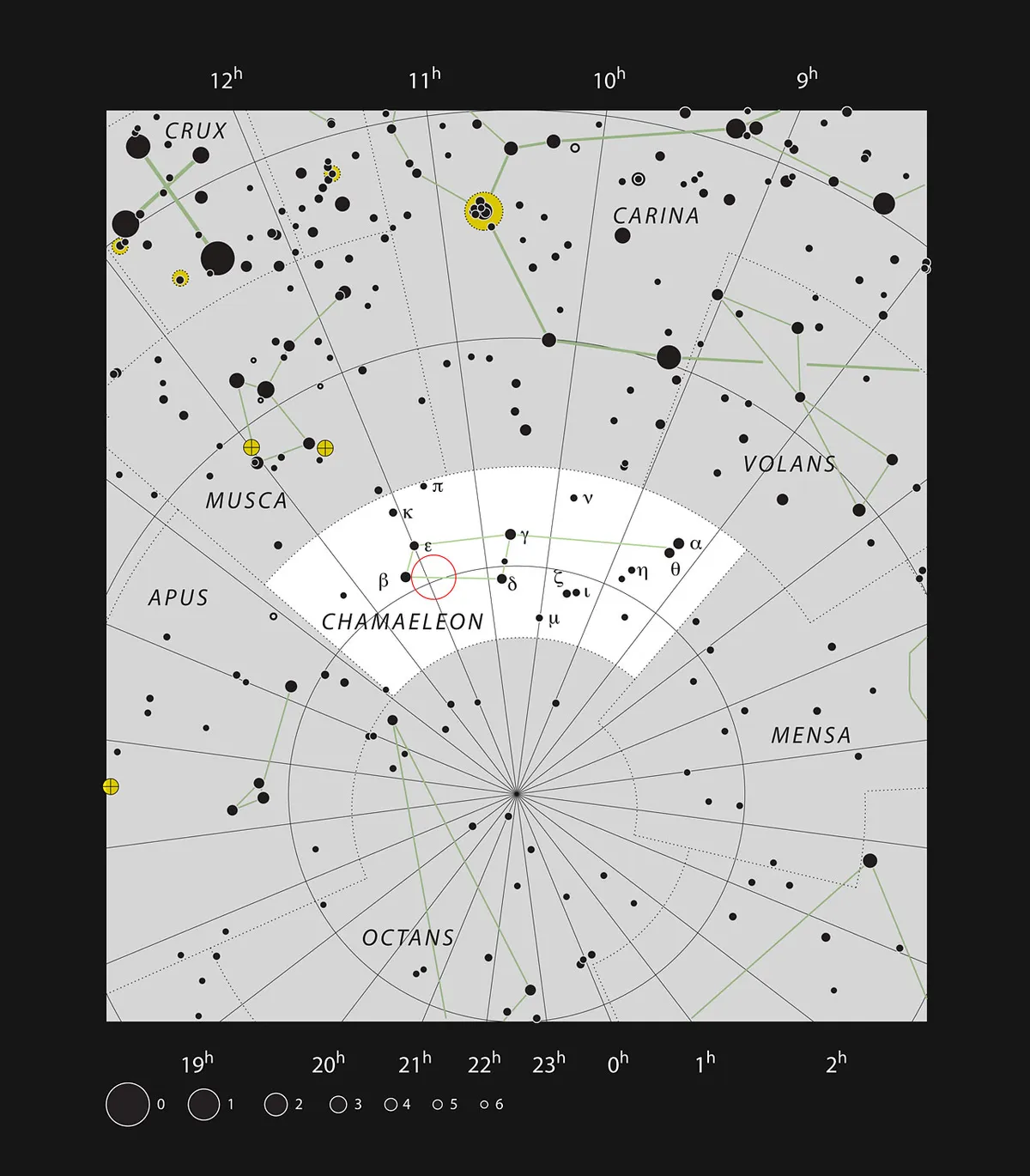
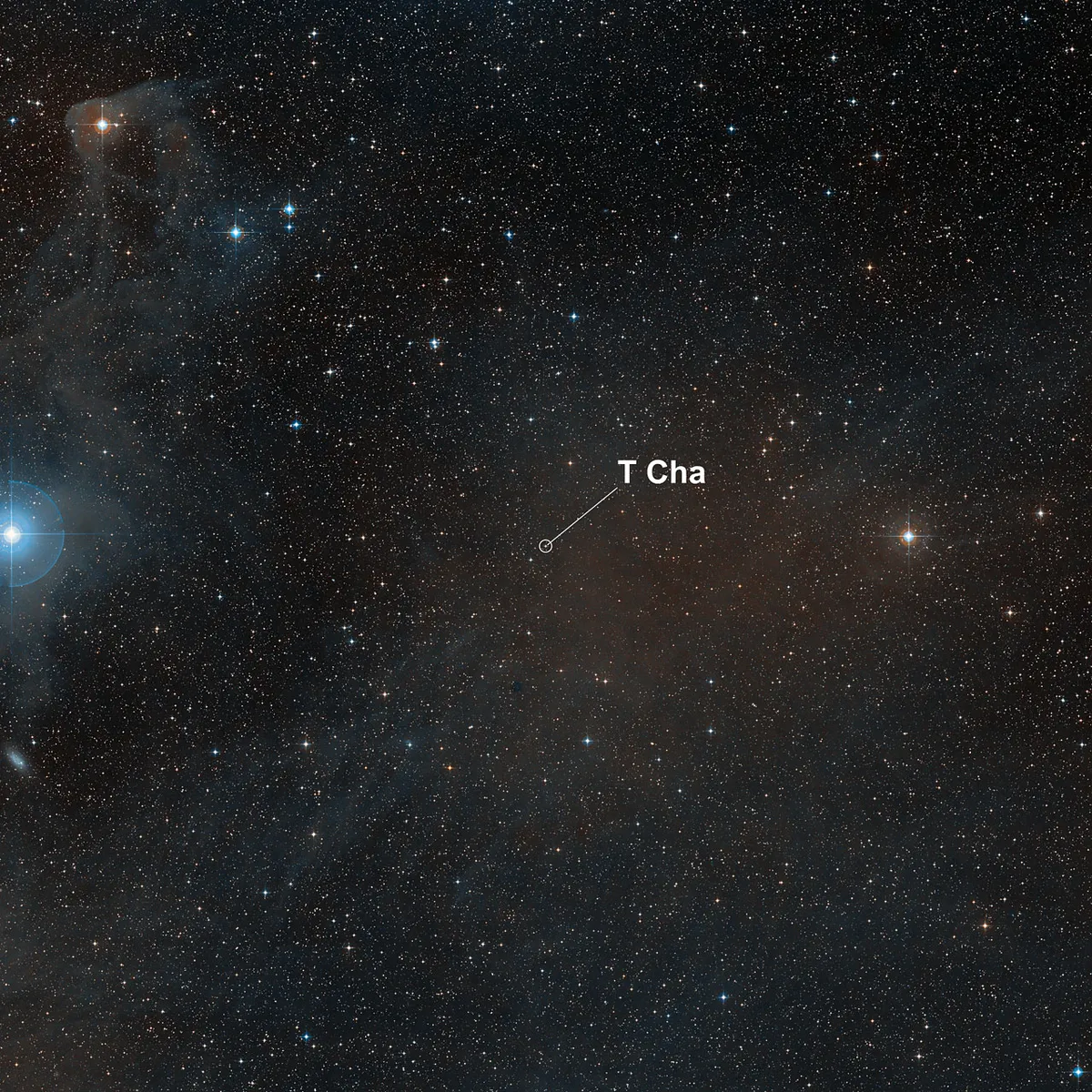
One of these objects is T Chamaeleontis (T Cha), a faint star located in the small southern constellation of Chamaeleon, which is comparable to our Sun, but much closer to the beginning of its life [2].
T Cha is located about 330 light-years from Earth and is only about seven million years old. Until now, no planet in formation has been found inside these transitional disks, although planets have previously been observed in more mature disks.
Astronomers first observed T Cha with the AMBER instrument, installed on the VLT Interferometer [3]. Thus they found that part of the disk material formed a thin ring of dust just about 20 million kilometers from the star. Beyond this inner disk they found a dust-free zone and an outer disk, starting in regions located 1,100 million kilometers from the star and extending outward.
Nuria Huélamo, (Centro de Astrobiología, CAB/INTA-CSIC, Spain), the lead author of the second paper, continues the story: "For us, the gap in the dust disk around T Cha was conclusive evidence, and we wondered: are we witnessing a companion carving a gap inside the protoplanetary disk?".
However, finding a faint companion so close to a bright star is a huge challenge, so the team had to use the VLT's NACO instrument in a new and powerful way, called SAM (sparse aperture masking), to achieve the goal [4]. After careful analysis they found clear signs of an object located within the disk gap, about one billion kilometers from the star –a little farther than Jupiter in our Solar System– and near the outer edge of the gap. This is the first time an object smaller than a star has been detected in the gap of a transitional disk surrounding a young star. The evidence suggests the companion cannot be a normal star [5], but it could be a brown dwarf [6] surrounded by dust or, even more interestingly, a newly formed planet.
Huélamo concludes: "This is an excellent joint study that combines two different state-of-the-art instruments at ESO's Paranal Observatory. Future observations will allow us to discover more about the companion and the disk, and also understand what feeds the inner dust disk.".
Meanwhile, the companion hides in the southern constellation of Chamaeleon, camouflaging itself with the stellar foliage to go unrecognized...
Video: Zooming in on star T Cha
The zoom sequence begins with a wide-field view of the spectacular Milky Way. Gradually we zoom in on the faint star T Cha in the little-known constellation of Chamaeleon. A disk surrounds this very young star. The disk appears to be in two parts, a narrow ring close to the star and the remnant of a disk of material farther out. A companion object has been detected in the 'gap' of the disk that could be a large planet or a dusty brown dwarf.
http://www.youtube.com/watch?v=48L1HKm7NI8
Credits: ESO/S. Brunier/A. Fujjii/Digitized Sky Survey 2. Music: John Dyson (from the album Moonwind). Acknowledgment: Davide De Martin
Notes
Clarification: The claim that this would be the first time a planet in formation has been detected was made by ESO. I wouldn't be so sure. It wouldn't be the first time, at least, that claims like this have been made.
[1] Transitional disks can be detected because they emit less radiation at mid-infrared wavelengths. The absence of dust near the star and the creation of gaps and holes can explain the absence of this radiation. It is thought that newly formed planets may create these gaps, although other possibilities exist.
[2] T Cha is a T Tauri star, a very young star that is still contracting toward the main sequence.
[3] Astronomers used the AMBER instrument (Astronomical Multi-BEam combineR) and the VLT Interferometer to combine the light from the four 8.2-meter telescopes of the VLT and create a "virtual telescope" 130 meters long.
[4] NACO (or NAOS–CONICA) is an adaptive optics instrument installed on ESO's Very Large Telescope. Thanks to adaptive optics, astronomers can remove most of the aberrations caused by the atmosphere and obtain very sharp images. The team used NACO in a new way, called SAM (sparse aperture masking), to find the companion. This is a type of interferometry that, instead of combining light from multiple telescopes, as the VLT Interferometer (VLTI) does, uses different parts of the mirror of a single telescope (in this case the mirror of VLT Unit 4). This new technique is particularly good at finding faint objects that are very close to other bright ones. VLTI/AMBER is ideal for studying the structure of the inner disk and is less sensitive to the presence of a distant companion.
[5] The astronomers searched for the companion using NACO in two different band spectra –at 2.2 microns and at 3.8 microns. The companion is only visible at longer wavelengths, meaning the object is cold, like a planet, or a dust-enshrouded brown dwarf.
[6] Brown dwarfs are objects of intermediate size between stars and planets. They are not massive enough to fuse hydrogen in their core, but they are larger than giant planets like Jupiter.
Sources and related links
- This study was presented in two papers: Olofsson et al. 2011, “Warm dust resolved in the cold disk around TCha with VLTI/AMBER”
A&A Volume 528, April 2011
DOI10.1051/0004-6361/201016074
and Huélamo et al. 2011, “A companion candidate in the gap of the T Cha transitional disk”
DOI:10.1051/0004-6361/201016395, which will appear in the journal Astronomy & Astrophysics and are already accessible for free. - ESO: Planetary Formation in Action?
About the images
- Illustration by ESO/L. Calçada.
- Map of the constellation Chamaeleon. Credits: ESO, IAU and Sky & Telescope
- Image of T Cha. Credits: ESO and Digitized Sky Survey 2. Acknowledgment: Davide De Martin