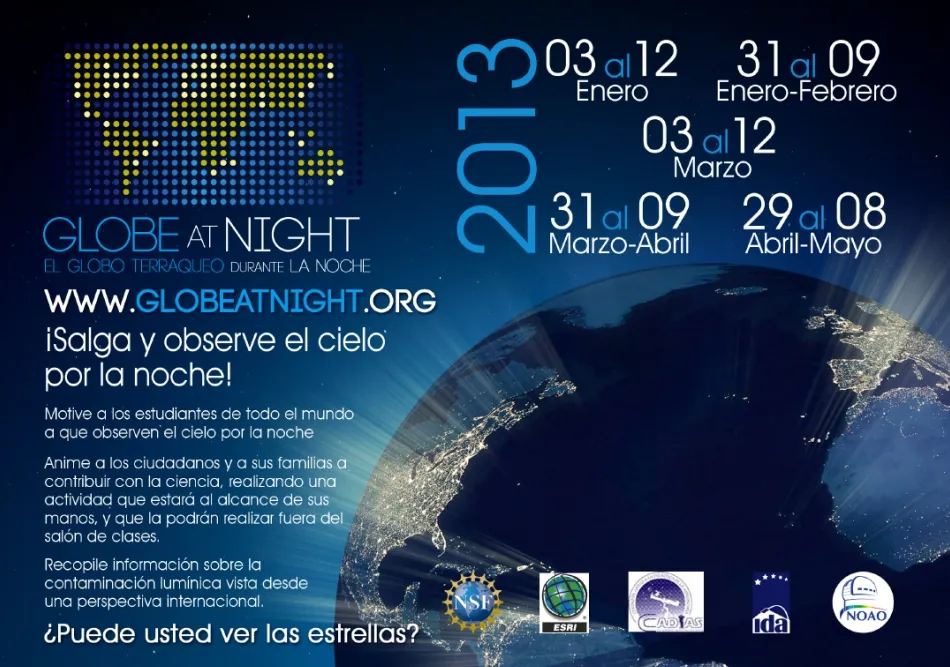
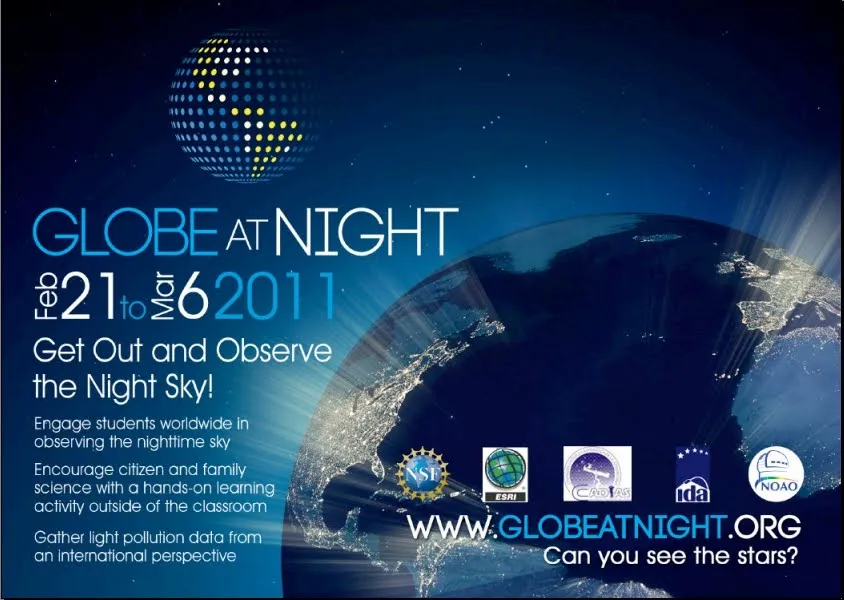
As in previous years, this year the global GLOBE at Night campaign will be held, so that citizens of the world can contribute to measuring the light pollution of our cities. It will be from February 21 to March 6. There will be a second chance.
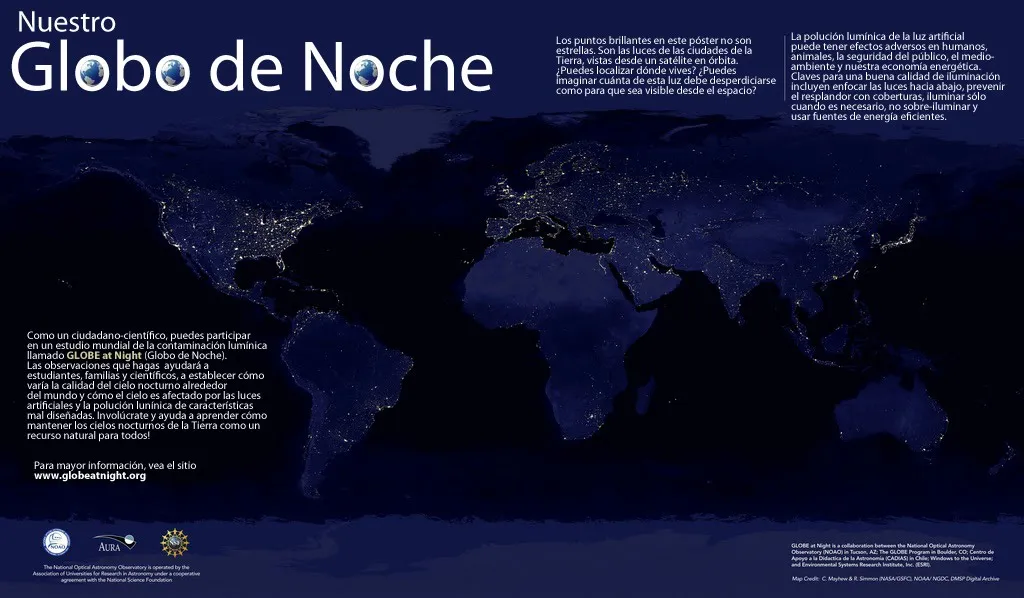
Light pollution is not a problem for astronomers, it is a problem for all of us who like to have our heads held high. The myths and legends of the past come to life every evening in the theater of the sky and that drama is being lost because we cannot see the stars due to the excessive and inadequate lighting of large cities.
No one wants nights to be completely dark for wandering the streets, because it would be seriously dangerous. But public lighting is often inefficient and at the same time not suitable for its main purpose: to illuminate the streets, not the sky.
As a form of citizen science in which we can all participate, the Globe at Night or Globo de noche (GAN) campaign is carried out year after year with a simple goal: to estimate the light pollution of our city and create a map with those records.
This year the campaign will be between February 21 and March 6, but there will be a second campaign, between March 24 and April 6 (for the Southern Hemisphere).
How are the measurements made?
There is a very easy-to-understand guide in Spanish (pdf format) on the GAN site. It's the same as in past campaigns:
We try to estimate how many stars are visible from the same constellation. It is a good parameter for measuring pollution. For this you need:
1-Know our position on Earth
2-Know where to look
3-Make an estimate of what is observed
4-Report the data
1-Our position on the planet can be known in several ways. A very simple one is with a GPS device. Currently many families have a global positioning device at hand.
Otherwise we can use an application called GeoCoder.
2-We will all be observing the same constellation: Orion, the hunter. It is one of the easiest to see. After sunset, if it's not cloudy, we'll go out to observe the sky, taking the necessary precautions (don't leave children alone, bring warm clothing).
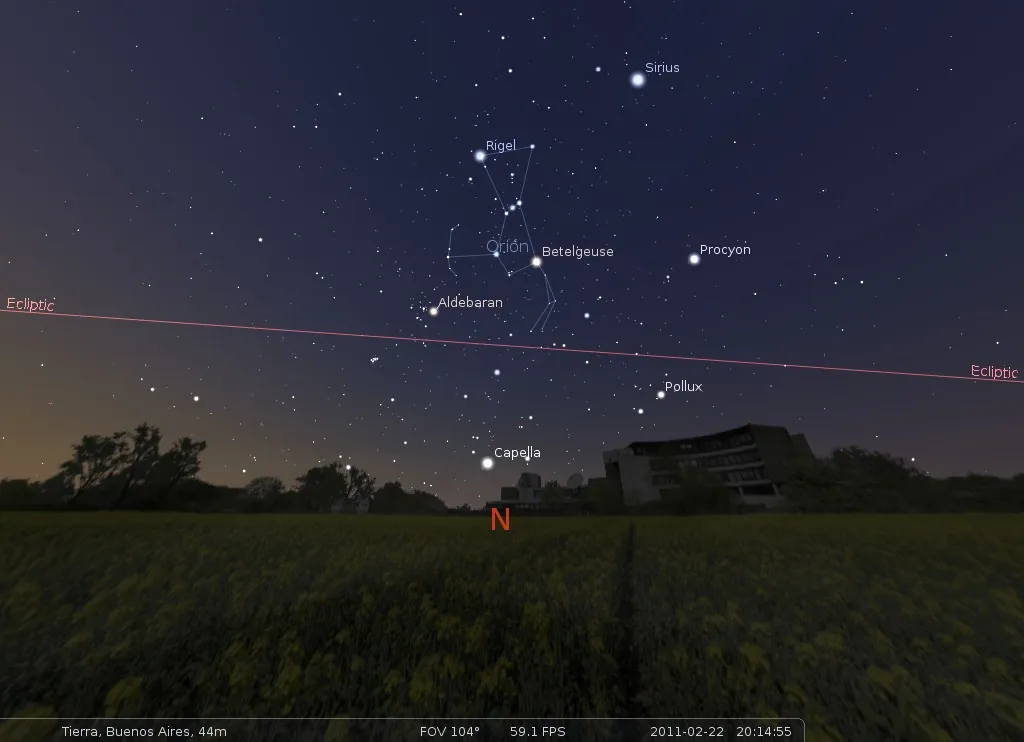
To the North, Northwest, Betelgeuse will be easy to see. We shouldn't wait too long because Orion will set early, so not long after 21:30/22:00 h because later it will get closer and closer to the horizon and will be more difficult to observe.
Our Globe at Night
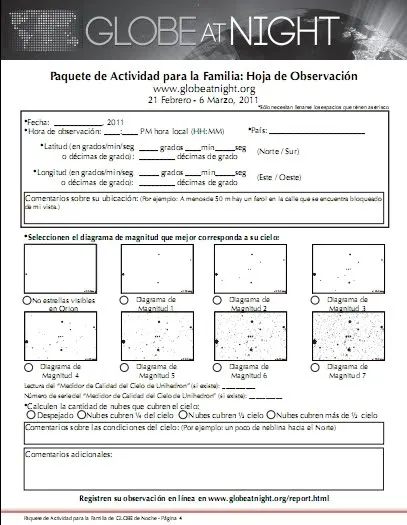
3-For the third point we will download the GAN material in Spanish. The material has "Magnitude Charts" like these:
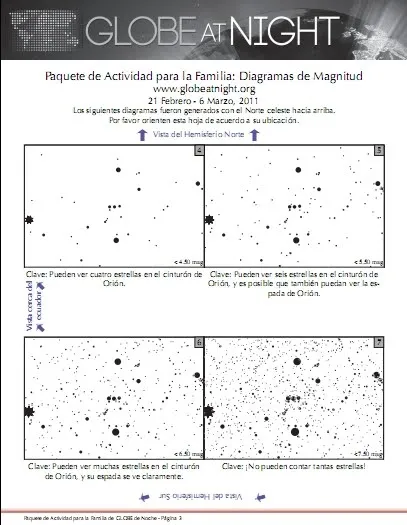
Note: the idea is to print this material to be able to use it, which is why the stars are shown in black and the sky in white. Note that the same charts can be used for the Northern Hemisphere and for the Southern (also for the Equator), it's the same sky, but upside down!
So that's why, on the map pages, to compare with the sky of the Southern Hemisphere, you have to turn the page over:
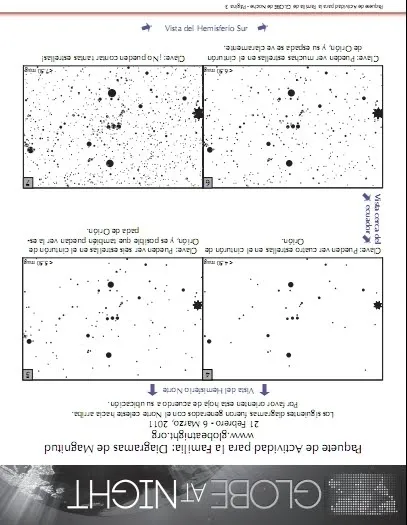
However, the stars "move" during the night and it won't look exactly the same. Actually, it's the Earth that rotates and that's why the sky appears to change.
Let's see in Stellarium how the sky would look on February 22 at 22:00, towards the North:
Now let's compare a magnitude chart and the Stellarium view:
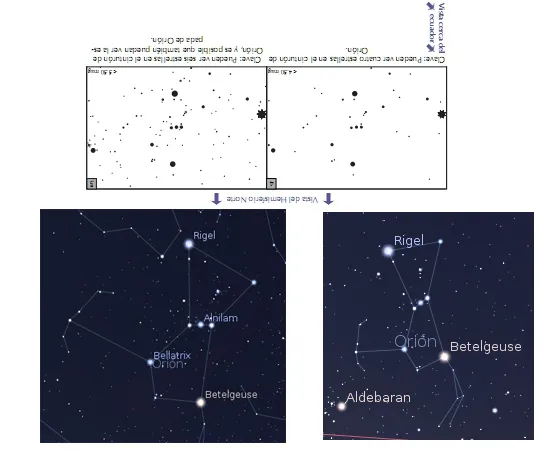
As can be seen, they are the same stars, but not exactly in the same position. It will depend on the time and latitude. In the case of latitude, broadly speaking, this view will not differ too much for countries in the Southern Hemisphere, at about 40º Latitude. But it can look different depending on the time we look at the sky. However, taking the bright and sharp little red star, Betelgeuse, as a basis, it will be easy to identify the constellation.
What we see in each rectangle are a few stars in the Magnitude 1 one, a few more in the next one and so on. The idea is to compare these maps with what we see in the sky. If we are able to see the Three Marys, as the ones that form the hunter's belt are commonly called, then we already know we are on the Magnitude 3 or higher map. The difference between 3 and 4 seems to be the three "little stars" that appear above the belt. (The one in the middle is actually the famous Orion Nebula).
Thus, by comparison, it will not be difficult to establish which map our sky matches.
4-Reporting the data is simple. In the GAN content, in addition to the magnitude maps, there is an observation sheet so as not to forget the data. They must be reported through the Globe at Night site.
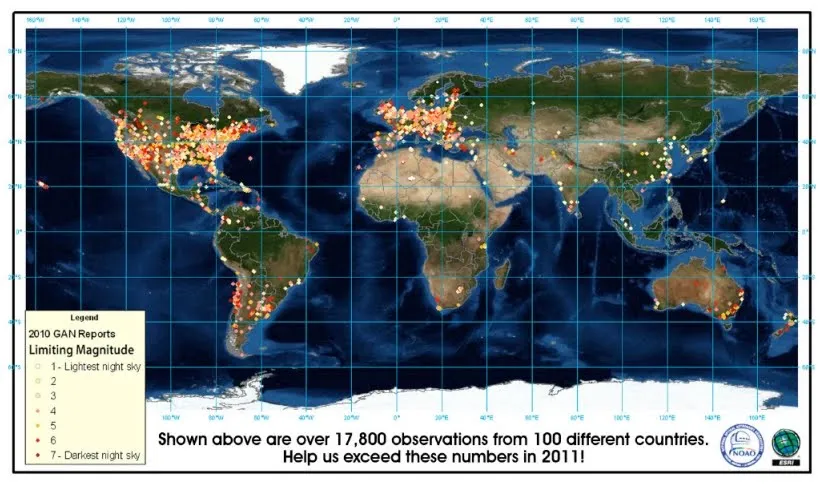
Of course, we can consult the data produced in previous campaigns.
In Buenos Aires the weather doesn't seem to help these days, as it is cloudy, but it will clear up. Good luck and clear skies to all.
Sources and related links
About the images
- The images used are from GLOBE at Night. and the screenshots were taken with Stellarium 0.10.5.