Citizens and their families are encouraged to become "Citizen Astronomers" and contribute to science by performing a simple and beautiful activity: looking at the sky.
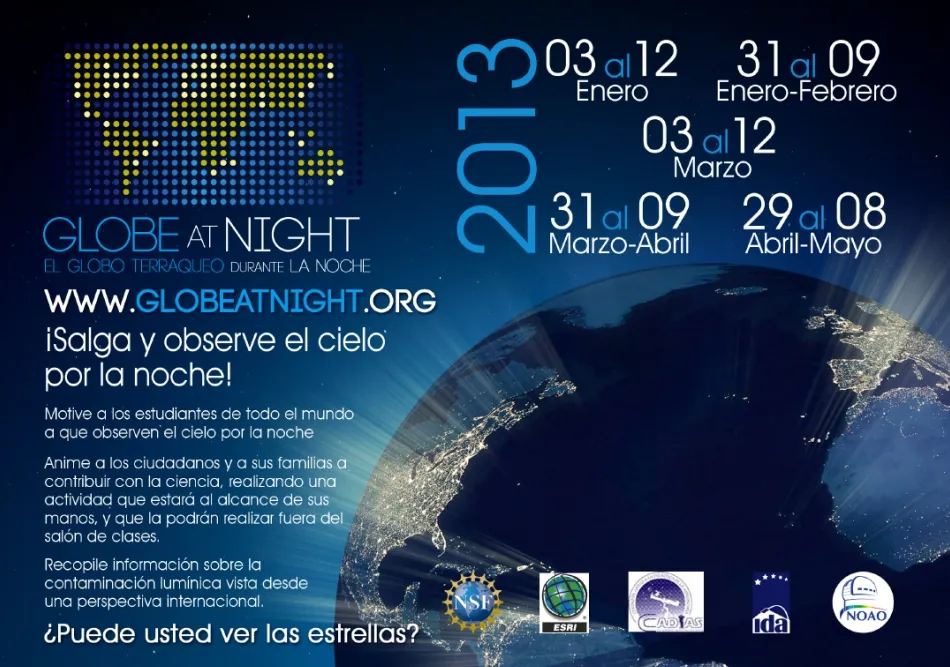
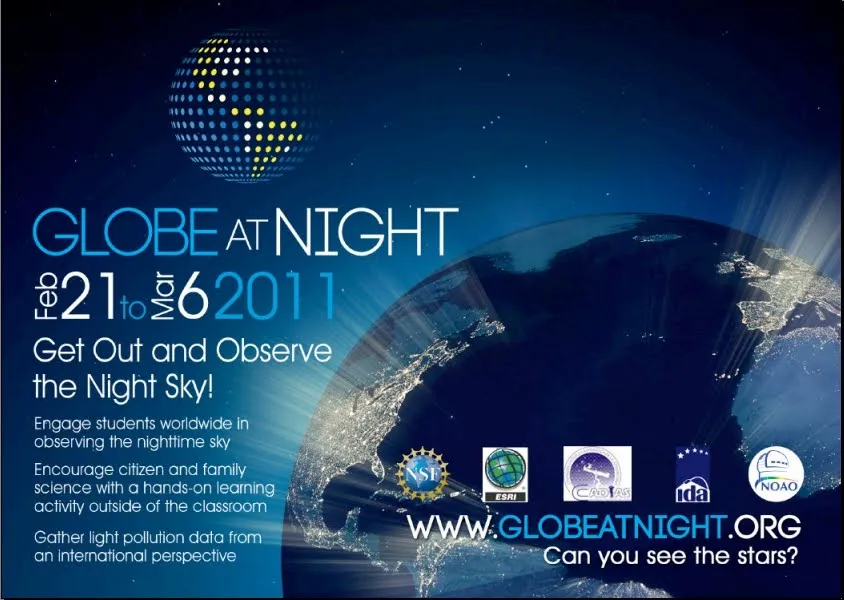
GLOBE at Night is an international citizen science campaign to raise awareness about the impact of light pollution. Citizens are invited to measure local sky brightness and submit their observations so that, together with many others from around the world, they increase the records that scientifically show how urban lights affect the number of stars we can observe with the naked eye.
Light pollution not only affects our right to observe the sky, but also energy consumption since in many cases public lighting is inefficient, generating greater economic cost and environmental impact.
2013 Campaign
This is the eighth year of the campaign. During 2012, 16,850 observations were made (two thousand more than the previous year, but a thousand less than in 2010) in 92 countries, even though 20 of those countries contributed 95% of the measurements. In that ranking, Argentina is in fourth place (879). Chile, Spain, Mexico, and Uruguay are also among the countries that participated the most.
About 50% of the limiting magnitude observations had a value of 3 or 4, typical of medium and large cities. 80% of the measurements were made in areas with light pollution and less than 20% from places where it is possible to observe the Milky Way.
How to Participate
GAN takes place on specific dates. In 2013 it will be held between the following: March 31 — April 9, April 29 — May 8.
On this blog we have commented on the campaign in previous years and it really is very simple to participate. It is recommended that this campaign bring together parents and children, teachers and students, as well as being carried out in astronomy clubs.
On the GLOBE at Night page there is material in Spanish with the instructions, which are basically:
1-Know your latitude and longitude.
2-Go out one hour after sunset (between 20 and 22 local time) and observe one of the three suggested constellations: Orion, Leo, Southern Cross.
3-Match what you perceive in the sky (the number of stars in the chosen constellation) with one of the graphical magnitude samples.
4-Report your observation.
5-Compare your report with thousands of others around the world.
How to do all this
It's very simple! From the online application in Spanish, everything is easy.
As soon as we access the application we will see fields that are automatically filled with real-time data, such as the date and time and, in some cases, also the geographic location. But if the latter does not happen or you do not want that data to be generated automatically, you can use the included Google Map to plot your location.
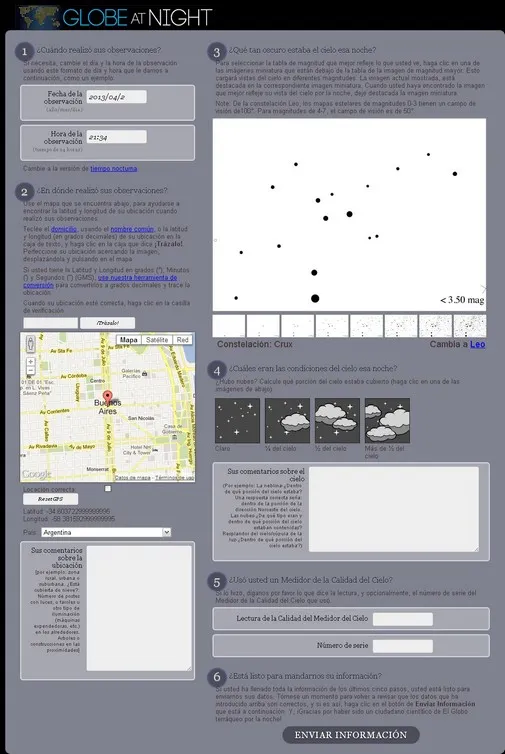
Then we will see a chart of the constellation Crux, very easy to identify in the sky from our country.
That chart can be changed with the thumbnail images below. The idea is that the chart we choose matches what we have observed.
With mobile devices it is possible to make the report at the very moment of observation. Note that if this is the case and there are other people nearby still observing, the phone will generate light, which is why it is suggested to choose the option "Switch to night-time version".
If, on the other hand, we do not have a mobile device, it is recommended to print the brochure, in Spanish, which includes the charts, and duly note the environmental conditions, date and time.
If we decide to observe Leo, instead of Crux, along with the thumbnails we will have that option.
Make it easy, but safe!
The whole procedure is very simple, but that doesn't mean we should be naive. Children must be supervised by an adult, which is why teachers and parents are encouraged to carry out the activity with students and children.
At night the temperature can vary, particularly in winter. Having extra clothes in some bag or backpack ensures that if the temperature changes we will be prepared. At night, it is also preferable to have bright or reflective colored clothing, especially if we are going to observe near a road where cars travel.
This is Global Astronomy Month (GAM) during which activities are held all over the world to disseminate and enjoy a heritage we have in common: the sky.
At Astronomy Without Borders the activities to be held during GAM 2013 are detailed.
Citizen Astronomers
Last year the Observatorio Astronómico de Córdoba (OAC) joined this campaign, the results of which can be found on its website.
Sources and related links
- GLOBE at Night
- AWB: GAM 2013
- Citizen Astronomers
About the images
- Credit: GLOBE at Night.