A collection of images, sounds and videos relating science and art. Today: Lunation in images and stars in formation; Space Music: Quasars; TED: Will Wright presents Spore; This week: A giant ring of black holes.
A decade ago
The idea of this section is to rescue images published about ten years ago. They allow a comparison over time that is sometimes interesting and, also, to combat a bit the fleeting nature of publications.
Lunation

On February 18, 2001 the Astronomy Picture of the Day was the faces of the moon. The image shows a sequence that illustrates how the moon changes during the Lunation, the period between two identical phases that lasts 29.5 days. As the Moon orbits the Earth, the half illuminated by the Sun becomes increasingly visible.
It was also published in Spanish on Observatorio.
Credit: António Cidadão
The star-forming region S106
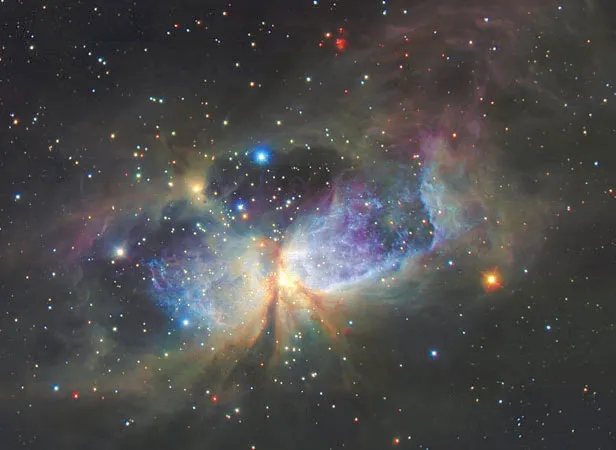
The massive star IRS4 is beginning to spread its wings. Born only 100,000 years ago, the material flowing from this newborn star has formed the nebula called Sharpless 106 Nebula (S106), photographed above.
The photo was the Astronomy Picture of the Day, APOD, of February 20, 2001. Also available in Spanish on Observatorio.
Credit: CISCO, Subaru 8.3-m Telescope, NAOJ
Space Music
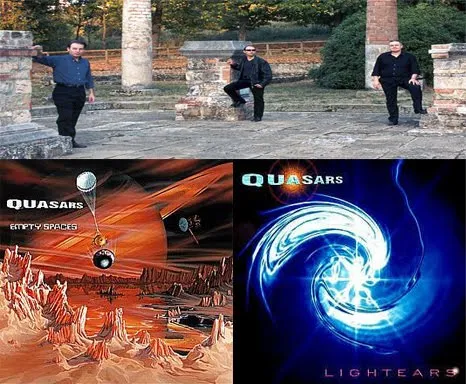
This time I present to you Quasars, an Italian group involving three musicians: Flavio, Andrea and Giovanni. Their first album saw the light in the year 2000 under the title "Empty Spaces". The second work emerged only in 2008, "Lightears".
The group's first song was The Prophet. The name may generate the confusion that it is a "mystical" type of lyric, but the first stanza already indicates that this is not the case, but rather tells what an extraterrestrial thinks of us.
One of the songs I like the most from this first work and from everything edited by Quasars is Incoming contact.
I believe that if you listen to that song you could fall in love with the group.
Lightears does not contain any song with that name. The title arises from the combination of the words Light and Tears, in English. The second term alludes to water. These two elements of nature are combined into a word that also sounds like the English word for light-years (light years) which evokes the vastness of space.
The second album opens with an introduction (A Ray of Light, part 1), followed by the song Fearless (without fear) which talks about the chains with which society binds us and invites us to act without fear, like Icarus.
Walking in the Wind, the third song, talks about how the flow of people's lives goes, some wasting their life. The burden becomes heavy, but you must go on, even if there are clouds on the horizon.
The Sea is like life, perhaps infinite, but one day you will touch the other shore.
Neptunia is an instrumental song that begins with sounds of thunder and rain, but then a very catchy combination of sounds emerges. Do not miss listening to the song.
Echoes of the Stars is a song to identify with: "I am a dreamer/ I live in my little world/ From my observatory/ every night I observe stars and planets".
In Sensynapse a synaptic sensation is spoken of, alluding to déjà vu.
The album closes with the second part of A Ray of Light in which it is stated that we are so busy that we do not realize that life is full of surprises. It is a song about the destiny of life and about how to live it, a topic that bathes the disc with its water and its light and its relativistic depth.
The lyrics of the songs appear on the individual pages of each song on Jamendo, but also on the Quasars site, in Italian and in English.
Quasars' music is available on Jamendo, a site from which artists can make their developments known freely and for free, although it also has the possibility of making donations to the musicians we like the most.
In successive editions of this section I will comment here on the works of Argentines, as well as Ibero-American artists. If you wish any particular artist to be reflected here, you only have to tell me.
TED Talk
Will Wright creates toys that create worlds
The creator of virtual worlds like SimCity and The Sims, presents us Spore, a creature creation game released back in 2007. A free trial version (206 MB) can be downloaded from the Spore page. An example of a created creature, in video.
This week
A giant ring of black holes
During Valentine's week the Chandra Observatory published a series of images and videos about a particular ring. But a particular jewel of black holes. The following image is a composite of Arp 147, a pair of interacting galaxies 430 million light-years from Earth. It shows X-rays in pink and optical data from the Hubble Telescope in red, green and blue.
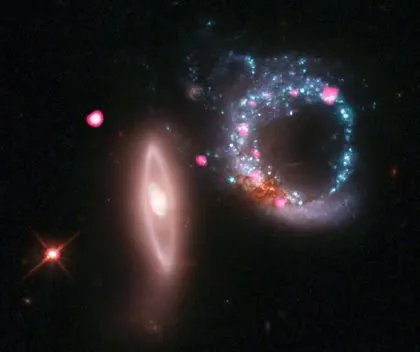
Arp 147 contains the remnants of a spiral galaxy (on the right) that collided with the elliptical galaxy on the right. The collision produced an expanding wave of star formation that shows a blue ring containing an abundance of massive young stars. These massive stars will evolve to explode as supernovae, leaving neutron stars and black holes.
A fraction of these dense objects will have companion stars and will be sources of bright X-rays as matter from the stars falls onto the dense objects. Around Arp 147, 9 X-ray sources were detected so bright that they must be black holes, with masses between ten and twenty times the mass of our Sun.
An X-ray source is also detected in the nucleus of the galaxy on the left, but it is seen better in the X-ray image.
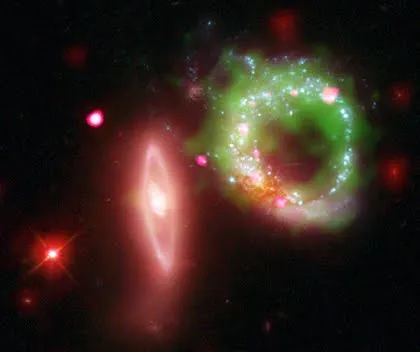
Here we see the same objects with infrared observations from Spitzer and ultraviolet from GALEX.
The results of these observations were published in Astrophysical Journal (2010 ApJ 721 1348) by its authors Saul Rappaport, Alan Levine, David Pooley and Benjamin Steinhorn.