A collection of links to music, images and videos that relate art and science. Today: The Witch Head Nebula; Sebastián Cirillo and The Edge of the Singularity; IRrelevant Video: The Astronomer in Therapy.
Images of the decade
Today: The Witch Head Nebula
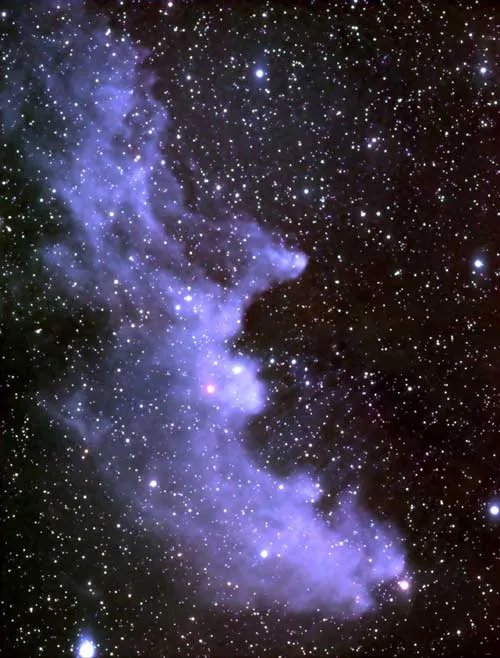
The suggestive shape of this reflection nebula is associated with the star Rigel in the constellation Orion. More formally known as IC 2118, the nebula shines primarily by the light reflected from the star at the hunter's foot (Rigel=foot) located above and to the right. The blue color is given by the dust, as the grains reflect blue light more efficiently than red, by the same physical process that causes the daytime sky to appear blue. The nebula is located a thousand light-years away.
The photograph, which belongs to Gary Stevens, was the Astronomy Picture of the Day on February 27, 2001. Also on Observatorio.
(If you see a witch's head in the nebula, be sure to read the Science in Motion section)
Space Music
Today: Sebastián Cirillo and The Edge of the Singularity
Browsing through Jamendo it's not hard to find artists who, despite producing free and open music, do a formidable job. And within all the available material it's possible to search. That's how I found Sebastián Cirillo and his album The Edge of the Singularity.
On the album's page, Sebastián says he is an Argentine, born in '76, and that, inspired by reading books like "Cosmos" by Carl Sagan, "A Brief History of Time" by Stephen Hawking and other texts on physics and astronomy, "The Edge of the Singularity" is the soundtrack of the worlds he visited while reading.
Planetary systems, galaxies, subatomic particles and even some of the cities from "The Martian Chronicles" by Ray Bradbury were the triggers for a sonic adventure, which can be an astronaut walking inside a black hole or a journey to one's own inner space.
I contacted Sebastián to tell me more about it.
"I am passionate about Astronomy, I have loads of books, and whenever I can I go by an observatory to peek at the cosmos, I don't officially dedicate myself to that, actually I am a musician, recording technician, music producer and since I recently moved back to live in Mercedes, a teacher at a music conservatory."
He refers to the Buenos Aires city of Mercedes where there is an observatory.
"I spent all my childhood and adolescence there, operating a 60cm Cassegrain telescope, at least every night I didn't go out somewhere to play the guitar... or I did both things at the same time..."
The union of music and the cosmos
Sebastián told me that "When I decided to dedicate myself to music I did it from the same place that captivated me about astronomy... driven by curiosity, exploration, discovery, I am a musician more interested in the physics of sound than in musical analysis texts... let's say, that's why I naturally dedicated myself to recording and production, but always from the place of constant search"
Since the tracks on "El borde..." have no lyrics, I thought it appropriate for him to tell us what the inspiration was in each case, what they try to mean. In his own words:
Solar Wind... it's very graphic, it represents just that... somehow I saw myself enveloped in the flow of particles emitted by the sun... and as with the rest of the album I felt the need to put a soundtrack to that.
And for that I used a sampler, which is a device that allows you to record sounds to then process them and play them back, its most common use is to transport any sound on a chromatic scale, but the possibilities for sound manipulation are infinite. What I did through a time stretching algorithm was to convert small "sound particles" of less than a second in duration into pieces of 1 or 2 minutes...and they became "sonic textures" over which I improvised with a synthesizer. I recorded the result, it has almost no editing, and the only additional process was to then run the synthesizer phrases and effects through a guitar delay.
Kosmische Dans:
I asked him if it meant "Cosmic dance" and in what language, since using a translator it was similar, but not identical, to the same phrase in Norwegian and German.
"As you rightly said, it refers to 'the cosmic dance', I wanted the name to be German, because I was looking for that sound of the words, but it turned out that I ended up with a German-Norwegian hybrid (in German it would be: Kosmische Tanz). The idea came out while playing a synthesizer through its arpeggiator, which is a contraption that builds arpeggios from the notes you trigger on the keyboard, that got recorded and then I built a 'counterpoint' with another arpeggiator and over that I improvised with another digital synthesizer that emulates a classic Roland TB-303... that was recorded live directly into Pro Tools, which is my recording system on the computer, and then I mixed and processed it, also running some sounds through guitar pedals and through an old 'octave the kitten' synthesizer."
- = + (less is more): came from a single synthesizer (the kitten) connected directly to a Korg A4 guitar pedalboard, the conceptual idea came from Brian Eno, to create a system that produced music by itself, with minimal intervention from me. I just turned it on, configured it and recorded what came out. From those experiments came many things that I later used in other songs on the album, but the most interesting was this sort of "analog mantra" I generated with the Kitten's low-pass filter. What I did was raise the filter resonance to the maximum to make it "self-oscillate" and I modulated the frequency with the VCO operating at a very low frequency sending a rectangular wave (whose width varied from the LFO) and the sum of its two Sub-Octaves... this produced a kind of very interesting rhythmic sequence which is what you can hear in the track.
It is also a tribute to simple things, which need no more... that the more stripped down they are, the better they work...
System: I was reading "Cosmos" by Carl Sagan and this idea of possible fictional planetary systems came up... and it occurred to me to generate tones that correspond to frequencies that matched Kepler's laws and thus synthesize "sonic planetary systems". For this I used MAX/MSP programming to design a special synthesizer that generates those sounds. What I recorded with that is the texture upon which that track is built, and on top of that I added some synthesizers and a pattern that had emerged from the system I used to make -=+.
Moss: Moss is inspired by Bradbury's Martian Chronicles... some landscapes of the cities, like the "Moss City" gave me incredible images, à la Kubrick. And I tried to musicalize those landscapes, soundscapes... in Moss you hear sounds from a synthesizer and a ring modulator, over some loops that are guitars played backwards...
Bowl: this song has two triggers. One is a bowl that my wife brought me from a trip to Nepal, which when rubbed with its mallet produces a tone and the other trigger was "the music of the spheres" a belief that was defended from Pythagoras to Kepler who thought that the movement of celestial bodies produced a tone, a music.
What I did was take the sound of the rubbed bowl and put it in a sampler to be able to play some subtle melodies with it. The sound of water falling "inside the bowl" is a product of the kitten, and comes to represent the mixture of matter flowing into that cosmic bowl that would be the cosmos.
Le Petit Cosmonaute: in many astronomy texts the example of the little astronaut who is devoured by a black hole appears... this song is about the dramatic adventure of this little astronaut who is swallowed by a cosmic singularity.
The first part, before the chaos, is a journey, with a subtle melody from a Theremin, which acts as a transporter... Then the little astronaut begins to stretch until he becomes as thin as a noodle and is caught by the black hole... The music hints that le petit cosmonaute passed to the other side and that what he found is fascinating, but we will never know...
Note: In my communication with Sebastián, I ventured that this track was about that. I was not mistaken, not because of any virtue of mine, but of his, in recreating sounds that immediately led me to think of the not at all comfortable idea of being devoured by a black hole.
La Petite Cosmonaute from cybero on Vimeo.
Entropic Uncertainty: for that track, I gathered a bunch of loops I had left over from the album, most came from improvisations with synthesizers, the kitten and a Korg DW6000, some processed guitars, etc., which I loaded into an MPC500 that I had for a while, but it didn't work well for me, I think it was the only thing recorded from that, I combined all those loops and triggered them but without synchronizing their tempos. Thus emerged a kind of chaos that took shape as the song progresses, the superimposed and crossed rhythms begin to make sense. Some fragment of the track could be cut and looped and it would be a hit on the dance floors... on a macro level it's absolute disorder, but at times fragments of absolute coherence are formed...
The music of El borde de la singularidad can be downloaded completely and for free through Jamendo, where it is also possible to collaborate with the artist through a donation.
The sounds of "El borde..." are not all "comfortable" to the ear, although they are to the intellect, in the sense that deep space is represented with sounds that are related in some way to what they are physically speaking. The cosmos is an unfriendly place for human beings. Temperatures that go from absolute zero in interstellar space to millions of degrees on stellar surfaces, the speed of a tiny asteroid, the gravitational force of very dense objects, are represented in a way that is only humanly possible: through the particular perception of the reader of science fiction stories and astronomy books, of the one who spent hours with his eye at the eyepiece, of the one who marvels at nature and shares those sensations with others with a sensitivity and creativity that are worth highlighting.
I don't want to fail to mention Sebastián's participation in a musical project in homage to Federico Moura (leader of the group Virus, legendary in Argentina in the 1980s) that was created on Facebook. Track 10, Transeúnte sin identidad, was covered by Sebastián and, in my opinion, is the best of the entire tribute.
You can learn more about Sebastián on his Jamendo page or in his space on MySpace.
Science in motion
IRrelevant Astronomy: Astronomer in therapy
The video series called IRrelevant Astronomy is produced by the Spitzer Space Telescope team. Since the telescope captures infrared (IR) radiation, a play on words is made to indicate that these are educational and comedic videos.
One of the ones that amuses me the most is the episode called Psych Out. I think even someone who doesn't know English will be able to understand what it's about, but better if it's translated. Here I make available the original video with embedded subtitles.
As in a Rorschach test, an astronomer is shown images and must say what he sees. According to the psychologist, he has a problem...
Video:An astronomer in therapy
http://www.youtube.com/watch?v=O2X2HrwIz3Q
Credit goes to the Spitzer IRrelevant astronomy team.
Some notes on the video:
Some images taken by Spitzer are shown. To get more data and images about those objects, I point out what they really are, through Spitzer press releases:
The "rose" Rosebud: Rosebud of a Reflection Nebula
The Helix Nebula (the eye): Comets Kick Up Dust in Helix Nebula
The Serpent: Where Galactic Snakes Live
Stephan's Quintet: A Shocking Surprise in Stephan's Quintet
The spider is a black widow: Black Widow Nebula Hiding in the Dust
Mountains of creation: Now You See Stars, Now You Don't
The letter G is RCW 79: A Bubble Bursts
The song the therapist hums is Twinkle Twinkle Little Star whose rhythm is also used as the alphabet song.
It should be noted that what we see in the deep cosmos through telescopes is not exactly as it is. Humans cannot see in infrared or X-rays, so to allow us to visualize that data collected by the instruments, it is "painted" with colors. That is why it is said that astronomical images are, in many cases, "false color" compositions.
On the other hand, what we see has no extra-scientific meaning. That it seems we see a face does not mean there "is" a face.
The same thing that happens with the constellations.
For many, this distinction is obvious. Others, however, believe they see in the cosmos images that represent their beliefs.
The same thing happens, not only with astronomical images, but with almost anything. The interpretations made of "images" that seem to appear on walls, the shape of a cheese on a slice of bread, etc.
This phenomenon is known as Pareidolia. Something I talked about in "Random Thoughts" regarding how difficult it can be to discern between a "created" pattern and a random one.
(By the way, if in the image above you believe you see a pyramid, before going to the psychologist, consult Euclid's Elements, because, at most, it would be a triangle...)