Thanks to the Einstein@Home volunteer computing network, researchers were able to discover a pulsar 30,000 light-years from Earth.

Einstein@Home is a project that allows users of individual or organizational computers to contribute their unused computing power to help analyze scientific data. There are many projects of this type, like SETI@home, which searches for extraterrestrial intelligence, but also many others on various topics.
In this case, the project searches for gravitational waves from pulsars using data from the LIGO detector. It also searches for radio pulsars in binary systems with data from the Arecibo Observatory.
Pulsars are rotating neutron stars that emit pulses, radio waves, gamma rays or X-rays, that is, they emit periodic radiation. A neutron star is an extremely small (tens of kilometers) and dense object believed to form when a massive star undergoes a type II supernova explosion. The density is so great (1017 kg/m3) that electrons and protons form neutrons. The resulting object can avoid gravitational collapse thanks to the pressure of those neutrons.
"Pulsars are the cores of old stars that were crushed by gravitational forces," said Bruce Allen, project director and physicist at the Max Planck Institute.
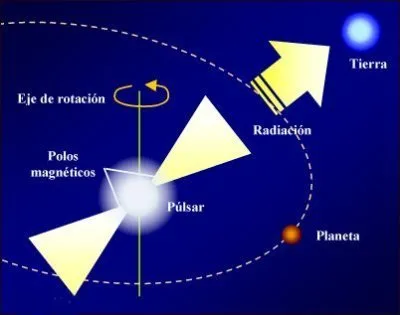
By using the computers joined to the project, researchers have access to more processing power. In studies of this type, computing power is tremendously important.
Doing a lot, giving little
What we users give (I include myself because I am a part of it), in relation to the use of our computer, is variable, it depends on what each user determines. And it is not definitive, one can grant greater or lesser resources or even stop using it for a while, according to each one's needs at the time.
But the return for so little could be very valuable. In this case, the Einstein@home project has already discovered two pulsars. The first was found in August of last year, 17,000 light-years from Earth, rotating 40 times per second and belonging to a binary system. The most recent one, identified as PSR J1952+2630, is similar. "The second pulsar is located in the same part of the sky and rotates at almost the same rate," Allen reported. However, unlike the previous discovery, in this case the pulsar still belongs to a binary system and its companion star is a white dwarf more massive than usual (at least 95% of the mass of our Sun).
The processing power has been expanded by the use of GPUs, graphics processing units, in addition to CPUs, central processing units. Although GPUs (graphics cards) were designed to display graphics, video games, they can now be programmed to process information faster than CPUs. Thus, Allen and his team, together with NVIDIA, the graphics card company, improved the project's software so that GPUs can be used more efficiently.
How it works
The software, once installed, does not require any handling by the user, but an initial configuration and, if desired, the program can be reconfigured later. This configuration involves indicating when the program will run, how much memory and disk space will be available for its use, and some other options.

In this way, one can install the software, which is not exclusive to this project, but is a general program called BOINC to which the user then adds projects according to their interest. It is very simple to add projects: just choose one, create a user and then indicate that in the program.
The data to be processed will be automatically downloaded via the internet and processed according to what the user stipulated in their configuration. This can be: only when the computer is not being used, which is very practical, or always, or, if you have a CPU with several cores, you can indicate to use only a certain number. In the same way, you can indicate when the internet connection will be made to download data and upload results.
Numbers
When a set of data or work units is finished processing, those results are sent to the project, where they are validated. If the validation is positive, the user receives a number of "credits". These credits are only a way to recognize the user and a way to estimate when they contribute their computer. It is not a race to see who has the most credits, nor can they be used to buy anything. A user with many credits is usually one who uses very powerful computers or a set of them, often in their work. The average credit, however, can be small (for example if we used a modest computer and then changed it for a better one). But the possibilities of contributing do not exclude users with medium or small computers, even if they process less data. Let's see:
The Einstein@Home users who processed the data that made the discovery possible are: Dr. Vitaliy V. Shiryaev (Vit-MIPT), a radio physics graduate from Russia, and Stacey Eastham (staceman), a 39-year-old Englishman who works in vehicle testing.
But it could have been any of the Einstein@Home users.
Shiryaev has a total credit of 859,700 and an average credit of 1765 and joined on 7-1-2008.
User staceman joined Einstein@Home on 28-12-2009. His total credit is 264,546 and his average credit is 2,830.
However, in the previous discovery, user Myat participated, whose total credit is 120,815, his average credit is 7 and he joined on 28-11-2005.
The next one could be you.
Sources and related links
- Einstein@Home Taps Donated PC Graphics Processors to Uncover a Second Pulsar
- Arecibo PALFA Survey and Einstein@Home: Binary Pulsar Discovery by Volunteer Computing
B. Knispel, P. Lazarus, B. Allen, et al.
arXiv:1102.5340v1 [astro-ph.GA] - Einstein@Home
- Einstein@Home España
- BOINC
About the images
- Logos of Einstein@Home and Boinc.
- Illustration of a pulsar from the page planets in pulsars, by David Sánchez Gómez