What conditions are needed to be an observer of the sky? Is there a way to estimate their number and for that to be useful?
The Drake Equation is famous and controversial. It is often said to be of little use, that the formulations usually made with it are very weak, as they depend on multiple assumptions or partial estimates without sufficient support.
I believe the exact opposite. Thinking is useful and estimates are usually a problem to solve, like puzzles, whose first objective should be the joy of using our mental capacities.
This, however, does not prevent estimates from effectively having a practical application, of course.

The question
A week ago, along with a group of people led by Diego Hernández, who teaches a course at the Planetarium of the City, I went, for the second time, to a locality in the Province of Buenos Aires 230 km from the Federal Capital. Yamay used to be a town of 3,000 inhabitants. Today only its shadows remain. And not even that, since it has no electric light. It is the ideal place, close to the large urban center, to make observations of the sky. A sustainable tourism project is being developed there that is worth knowing about, so I take the opportunity to invite you to learn more on the Yamay page.
There, with a completely clear sky, the light of the stars is... incomparable. Unlike the previous trip, which I recounted here (A night in Yamay), this time I did something I had been depriving myself of for ages. Lying down on the grass to observe the magnificence of the sky. A dark sky in which the Milky Way seems to rule everything.
While I let my pupils fill with photons, I thought: whoever lives in a place like this, even without a telescope or binoculars, can undoubtedly be considered a "Sky observer". If they look up regularly, of course. Neither much knowledge nor instruments are needed. Let's review the history of ancient discoveries, for example, the precession movement, splendidly told by Alejandro Tropea in "Hipparchus and the precession of the equinoxes".
What is needed, then, to be considered a continuous observer of the sky?
The answer
Actually, what happened to me at that moment was a self-reproach. Why did I take so long to take the reins of my life to do what I like?
What have been the obstacles, real and imaginary, that prevented me?
Leaving aside the excuses we sometimes give ourselves and which are personal, I do believe there are some concrete obstacles to overcome to become a sky observer.
First, you have to be a certain age. It is debatable what the range will be, but there is no doubt that we must have a certain development and certain physical possibilities. Surely babies cannot. With older people it is more difficult to discern because there are 80-year-olds who are perfectly capable and many who are not.
An implicit variable is that you have to be human. Ergo, for now I will say:
Obs=P*.fmn
That is, the number of Observers is equal to the total population (of the world, a country, a region), denoted P*, multiplied by the fraction of people older than m and younger than n, where m and n are the floor and ceiling of the age range, denoted fmn.
That is not enough. To see, to look, to observe are words often used as synonyms, referring to the same action, but we know that while we have our eyes open (and the optical capacity) we will see a great many things, but we will pay attention only to some. The latter happens, to a large extent, due to interest. Observing is not only looking, but also measuring. That's why astronomers have observatories. This implies, even if not done professionally, some level of knowledge which, again, is related to interest. With the interest in observing the sky will come the interest in learning.
The level of interest is difficult to discern. In any case, it should be added as a variable, fi, the fraction of people interested in observing.
Then one thinks about instruments. But before that, it occurs to me to make an exception. If a person lives in a locality with a tremendously dark sky, whether or not they have instruments (telescope/binoculars) they could be considered a sky observer. It will be not a little that they will be able to observe, even if only with the naked eye. Even measure and collaborate, for example, estimate the brightness variability of certain stars.
Estimating what we call truly dark skies is also a problem, although there we already have more concrete data, such as those produced by GaN. So I add this variable, fco, that is, the fraction of people with dark skies.
The rest of the people will be those who are not the right age, have no interest, but also those who do have both and do not have dark skies. Within this huge subgroup, one can still be an observer thanks to different issues. In principle, the possession of some instrument. Here then we must do the following:
Obs=(P*fmn.fi.fco) + (f!co.fT)
where what appears in the first parentheses are people of a certain age, with interest, with dark skies. To that we add the fraction of people without dark skies (the symbol ! is used in programming to denote negation) multiplied by the fraction of people with Telescope/Binoculars, fT.
If for the first parentheses, when formulating the equation, we estimate that fco is 30% of the given population, then we immediately know that the fraction of people without dark skies (f!co) is 70%. Careful, fT is not a percentage of P*. I am not interested in knowing or adding babies who might have a telescope, nor uninterested people who might own one. And I said I am also not interested in whether or not a person living in a place with a dark sky has an instrument because I am going to count all of them, even if they have no instruments.
So the f of fT refers to the fraction of people without dark skies, but that group which arises from the first parentheses that takes into account the previous variables. That is, from now on, f!co is (P*fmn.fi.f!co).
Then, it is possible that someone has an instrument, but does not use it, despite being interested. This can happen for a number of reasons, among which should not be overlooked the population that lives in buildings from which observation is difficult.
And there are also people who do not have instruments, despite having interest.
In both cases I will group these two subgroups into the variable f!T, fraction of people without instruments.
One thinks: if I have the age, if I have the interest, but I don't have a dark sky and I don't have a telescope or binoculars, I'm done. No. One can overcome that obstacle in a wonderful way: by approaching a group, club or association. This can include a very small group, of friends, not necessarily an organization. But not all people with the previous requirements can do it. So it will only be a part, fca, the fraction of people in clubs or associations. But I don't want to count twice. I want to count only those who do not have dark skies and do not have telescopes (or have them but cannot use them).
So:Obs=(P*fmn.fi.fco) + (f!co.fT) + (f!co.f!T.fca)
The third parenthesis takes into account the fraction of people without dark skies, without a telescope, but who are part of some club or association. There they will be able to learn and observe.
Ready? Have we reached the end?
I think we could add one more variable. The fraction of people without dark skies, without an instrument and who cannot approach an association. This can happen due to schedule reasons (it is assumed that observing is done at night), due to work or family issues. It is also possible that there is no association near the home, that one lacks mobility (personal or public), etc. That situation can be temporary.
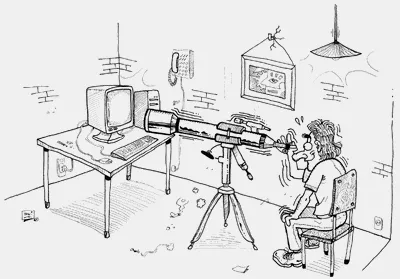
An option to temporarily overcome that situation can be provided by new technology. Robotic telescopes with internet access are a good way to "approach" observation when one does not possess the previous requirements. I'm not saying it's the same, but part of the experience can be replicated. I have already commented here on some of the possibilities of access to telescopes via the internet.
At least for the subgroup that does not meet the previous conditions, it is an option.
Ergo, I add the variable fw, the fraction of people with access to web telescopes. And so it remains:
Obs=(P*fmn.fi.fco) + (f!co.fT) + (f!co.f!T.fca) + (f!co.f!T.f!ca.fw)

Formulation
We can solve the equation, estimating each variable. One way is to assume that the conditions are widely favorable, even though we know the opposite occurs, only to estimate the ceiling. Another way to use it is to assume variables well below what we might consider real, only to estimate a floor.
Example:
P*= Argentine population as of 2011=4x10⁷ fmn= According to the international database of Census.gov, there are 32 million people between 10 and 74 years old, 80% of P*.
Now let's suppose that within the subgroup 50% were interested in observing the sky. It's a rather high assumption. Let's suppose that 50% have dark skies. Here we would have the total of the first parenthesis.
If 50% had dark skies, then 50% do NOT have them. Let's suppose that within that subset, 50% had instruments. We would have the second parenthesis.
Now let's suppose that among all those who do not have dark skies or telescopes, 50% are part of an association. We would have the third parenthesis.
And if finally we suppose that among those who do not have dark skies, instruments, or are part of an astronomy club, 50% have access to some telescope via the internet, we would have the fourth parenthesis.
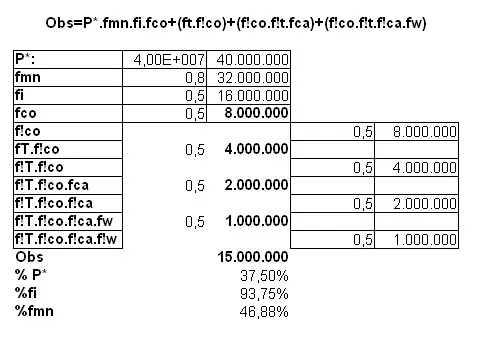
For the Argentine Republic that would imply a number of observers of 15 million people, 94% of those who would be interested and 37.5% of the total population. It is more of a ceiling.
Practical utility
If we applied this equation with more real numbers, arising from a serious analysis, with more concrete data, the ideal would be to do it for regions smaller than a country. From this type of formulation, it could emerge where and to what extent the problem lies, if in a region the number of observers is very low.
How are things at home?
This note, not the equation, but its development, allows us to also take two things into account: just as there are obstacles to being sky observers, there are also excuses.
Many years ago, a friend gave me a gift as simple as it was extraordinary. She gave me a poem that has accompanied me, along with awareness and self-criticism, ever since. I think that, to some extent, this post arose from there, from that self-examination and I think it would be good to share it: "Air and light and time and space", by Charles Bukowski.
Sources and related links
- From Astronomers to Spaceships
- Discover, Observe and Enjoy the Sky | Facebook
- 25 Tips For The Frugal Astronomer
About the images
- The opening image is a combination of:
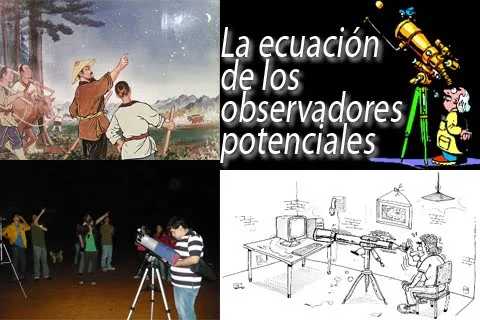
Cartoon by Javi, on Astrored; Chinese astronomers on El beso en la luna; astronomer illustration, on UniverseToday; meeting photo, from Astrocedia. - Equation image with background image from Starts with a bang.