The first astro-ecological drone project could be an answer to some of the efforts in species conservation.
If Galileo's revolution was using a telescope to look at the sky, now, four centuries later, the opposite seems to be happening. An astrophysicist and an ecologist from Liverpool John Moores University propose using astronomy technology and knowledge to observe endangered animals on Earth.
Interdisciplinary collaboration is a growing global trend in science. The use of "drones" for various purposes has also increased. The authors of the research published in the International Journal of Remote Sensing manage to combine the flying devices, thermal cameras, and techniques used to analyze objects in outer space as a response to one of the great challenges of the 21st century.
Professor Serge Wich -a pioneer in the use of drones in ecological conservation and founder of conservationdrones.org- pointed out that as an "eye in the sky" conservation drones "help fight illegal deforestation, poaching and habitat destruction that has led many species to the brink of extinction like rhinos, orangutans and elephants. Now, with techniques similar to those used in astrophysics to find and identify objects in the distant universe, we can do this same thing more efficiently".
The researcher adds about the current panorama that "The World Bank estimates that ecosystems generate USD 33 trillion in losses each year" and hopes that their development will help respond to this growing problem.
Dr. Steve Longmore (lead author of the published work) explains what astronomical knowledge contributes:
"Astrophysicists have used thermal cameras for many decades. The techniques we have developed to find and characterize the faintest objects in the universe are exactly those needed to find and identify objects in thermal images taken with drones. The key to success is building libraries of heat profiles that act as 'fingerprints' to allow us to uniquely identify the detected animals".
The next step in the research is to expand these techniques to other applications such as disaster aid, search and rescue.
The introduction of the published paper indicates that an important task for the research and conservation community is to monitor the distribution and density of species. Usually this work was done in the field, on foot or by car, from the air with helicopters or more recently with satellites. The problem with large-coverage aerial work is its prohibitive cost.
Drones could be a more efficient solution due to their cost-benefit ratio.
In the work they use the term UAV to refer to unmanned aerial vehicles, that is, drones, and the word UAS to refer to the system that includes the device plus the imaging equipment. Work with drones has been done, until now, with cameras that operate in visible wavelengths. This has two problems: it can only be used during the day when some activities like poaching often occur at night; and since the light obtained is reflected sunlight, the brightness of objects is similar, making it difficult to discern between different animals or people. Since the body temperature of most warm-blooded animals is approximately 300 K (27ºC), using detectors sensitive to that emission could improve the detection of those creatures. The peak of the energy distribution for objects at that temperature is ∼10 µm. With cameras operating in this thermal (infrared) regime, the task could be accomplished. On the other hand, at the same wavelengths, cooler objects like plants and terrain rarely emit strongly and there would be greater contrast between the environment and the animals. The advantages of this scenario are maximized in dry and cold environments and diminish as temperature and humidity increase.
Infrared thermal cameras were not usually very economically accessible, but currently technology has lowered their cost. There are several recent works on different species. While data increases, the bottleneck for achieving a good scientific result is the analysis tools. Manual detection and identification of species can take a long time and the results depend heavily on the person in charge.
This is where the technology for detecting faint objects from astronomy and "artificial intelligence" techniques can contribute to performing the task more efficiently.
The paper recounts this adventure consisting of building a detection and identification architecture based on astronomical software algorithms and automated drones with a thermal camera.
This architecture has four components illustrated below:
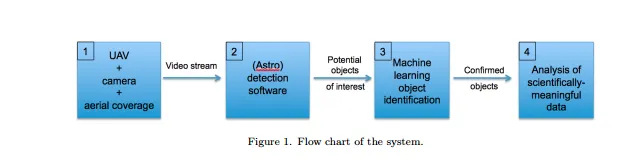
The first component is the hardware (drone + camera) and the flight path, altitude and speed. Components 2 and 3 are software to identify objects in the acquired video.
Technical details
The researchers chose Python as the language for its portability and availability of open-source packages. In particular they used the routines available in ASTROPY (http://www.astropy.org/), a standardized, free and open-source package for that high-level language. Specifically they used PLOTUTILS routines to identify and extract sources from the images.
For source identification they used OpenCV libraries which rely on machine learning ("artificial intelligence") algorithms that consist of providing the libraries with two sets of images: one containing images of the objects of interest and another with a similar configuration, but without the objects. The libraries process those images and a series of vectors describing the object are obtained.
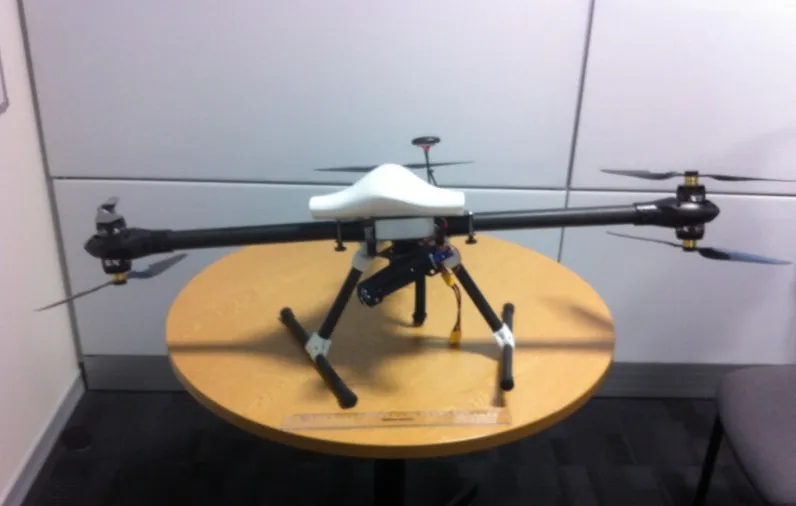
The equipment used was a Y6 750mm carbon fiber hexacopter with a FrSky Taranis transmitter (433 MHz), Multistar 6S 800 mAh lipo battery and a laptop as a station. The passively cooled (thermographic) camera was a FLIR, Tau 2 LWIR
Thermal Imaging Camera Core with a 7.5 mm lens and 640x512 pixels at 75 Hz.
According to a quick web search, the equipment would have an approximate cost of USD 9000 (see below).
Conclusion
We are getting used to the use of drones, and in many cases it still seems costly for the general public and without major utilities. However, there are uses in journalism that seem promising and certainly in different areas of science, aerial images with light and maneuverable equipment allow for a multiplicity of creative uses to solve data acquisition problems quite quickly. In relation to scientific budgets, always limited, it is possible to find in these units a more accessible solution.
But these devices necessarily show their value together with cameras or other devices. Thermal cameras are still demanding on the common consumer's pocket. However, to use the acquired data, the researchers had to develop a custom system. Through trial and error, they adjusted the variables until obtaining an encouraging result that could have many applications in species conservation and humanitarian tasks.
The software originally intended for astronomy has gained -once again- prominence in another scientific field. And it is wonderful that these interdisciplinary collaborations with technology transfer exist. It is inspiring that astronomers can use their capabilities and developments not only to solve problems of enormous distant objects in space-time, but also the great challenges in our little piece of the universe that we want to preserve.
Sources and related links
- Adapting astronomical source detection software to help detect animals in thermal images obtained by unmanned aerial systems
S. N. Longmore et al
International Journal Of Remote Sensing; Published online 06-02-2017
DOI: 10.1080/01431161.2017.1280639 - arXiv:1701.01611 [astro-ph.IM]
https://arxiv.org/abs/1701.01611 - Eurekalert: The solution from the skies to save endangered species
https://www.eurekalert.org/pub_releases/2017-02/tfg-tsf020617.php - TAU 2 LWIR THERMAL IMAGING CAMERA
http://www.flir-tau-buy.com/product/tau-2-lwir-thermal-imaging-camera/ - Y6 750mm carbon fibre Hexacopter complete built
http://www.droneshop.biz/multirotors/y6-carbon-fibre-hexacopter-complete-built-and-test-flown-system.html
About the images
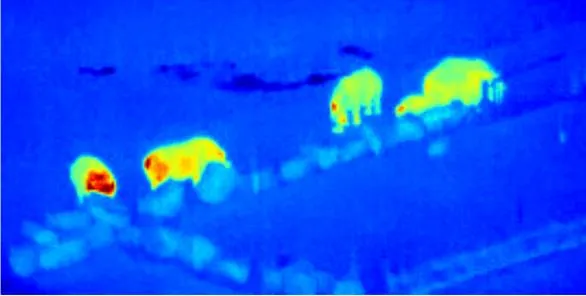
Initial image: False color image of rhinoceroses at Knowsley Safari Park.
Credit: Liverpool John Moores University
Fig. 2: Photo extracted from the cited authors' paper.
Fig. 3: Graph extracted from the cited authors' paper.
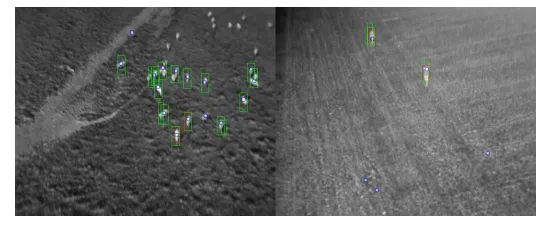
Fig. 4: Video image capture by Dr Steve Longmore, Professor Serge Wich, Andy Goodwin, Ron Collins, Simon Pfeiffer.