A collection of links to music, images and videos that relate art and science. Today: The closest stars, Jupiter, Saturn and the Pleiades; Space Music: Jaime Heras, The Astronaut; and an ingenious device: The astrolabe.
Images of the decade
The 25 closest stellar systems
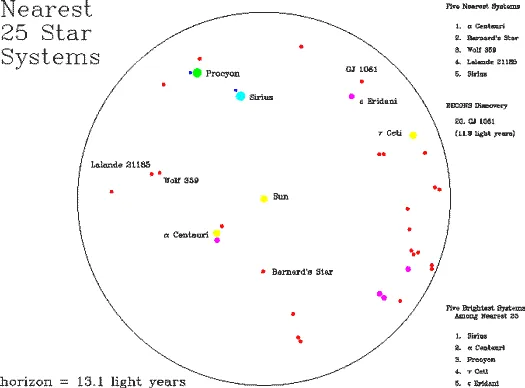
On March 18, 2001 the Astronomy Picture of the Day (APOD) was not a photograph, but a diagram of the closest stars to Earth, after the Sun.
Also on Observatorio.
Credit: T. J. Henry, RECONS Team
Jupiter, Saturn and M45
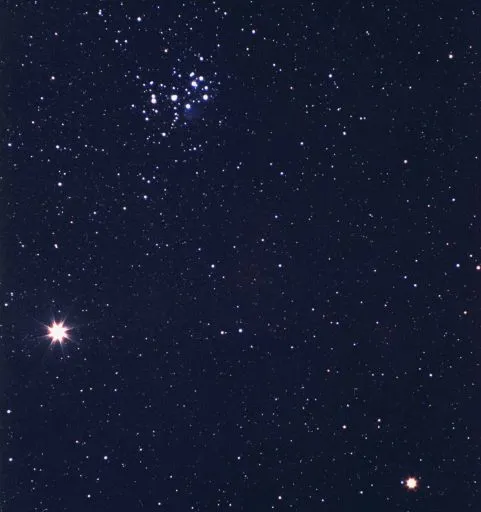
On March 22, 2001, however, it was a photograph.
Jupiter shines above and to the left of a faint Saturn. Above lie the Pleiades or M45.
More on Observatorio.
Credit: Ken Webb.
Space Music
Today: The Astronaut, by Jaime Heras
The Astronaut is a fiction story with narrations in Spanish.
"Father, here Firstborn beginning recording," begins the first story, The Mission.
Aboard the Asimov, the astronaut heads to a system from which a message with a pattern, presumably intelligent, seems to have been emitted.
While the Asimov heads there, the astronaut hibernates. But, something happened, the incident. "Here there be dragons". (Here be dragons).
What happened to Benjamin? And where are they?
It seems all is lost, that it will be an astronomical funeral, but an opportunity arises, a wormhole and...
The story is thrilling and the music is perfect.
The album can be downloaded for free from Jamendo, but it is also possible to donate a sum of money to the artist.
I spoke here before, in the 2011-03 selection, about this fabulous artist. On that occasion about his album Celestia.
The album has another version, in English (The Astronaut), about which a video has been created (made by http://www.gfx-maniac.de/) that can be seen, in three parts on YouTube.
To learn more about this artist's work, you can visit the Blog of Jaime Heras.
Science in motion
Today: Tom Wujec shows the thirteenth-century astrolabe.
Instead of showing another new technology, Tom Wujec goes back to one of our first but most ingenious devices: the astrolabe. With thousands of uses, from telling time to modeling the night sky, this old technology reminds us that the old can be as brilliant as the brand new.