On March 17 and 18, the Latin American Seminar on 1-to-1 Experiences of the Conectar Igualdad program was held, which reported on the progress and challenges of the project.
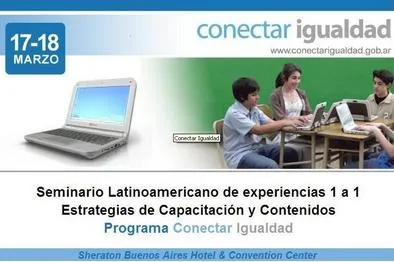
From the famous One Laptop per Child (OLPC) project to date, a lot of water has flowed under the bridge in different countries around the world. The objectives and implementations in Latin America have been different and learning about the experiences of each country is enriching.
Not everywhere was or is the goal to achieve a 1-to-1 experience, where each student and teacher has their own computer. In some cases, they are 10-to-1 experiences, in other cases, pilot experiences have been tested in small groups with handheld computers, etc.
The seminar tried to reflect these experiences through the accounts of representatives from Costa Rica, Colombia, Chile, Peru, Paraguay, Brazil, Ecuador, Uruguay, Mexico, Argentina.
On the other hand, the seminar also allowed access to ideas surrounding the Argentine project, its characteristics, its progress during 2010, the projected progress this year, its objectives and limitations. And there were also 1-to-1 workshops.
It is possible to learn the details of the seminar on its website and the details of the Conectar Igualdad project (PCI) on its portal.
I would like to transcribe here sensations and notes from my time at some of the seminar's talks, to tell my experience. I did not attend the entire seminar, as I left at noon on the first day for personal reasons. And the spots for the workshops were already sold out at the time of registration.
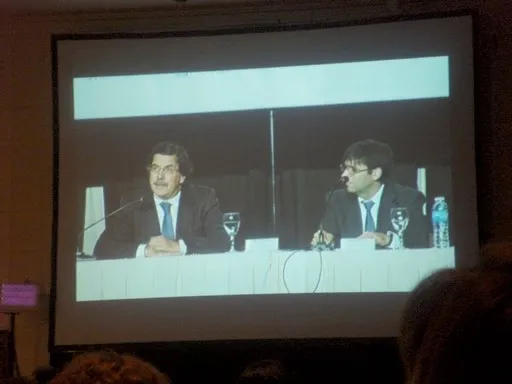
The first talk was a presentation by Diego Bossio, executive director of Anses, and by Minister of Education Alberto Sileoni.
From the first, I highlight the enormous logistical work that a project to distribute 3 million laptops in Argentina implies. Buying them or assembling them in the country (I noted that 440 thousand will be assembled in Argentina and 425 thousand will have national motherboards).
From the second, I noted: "We don't believe in miracles" and the promise that the laptops will reach all teachers, all secondary schools, schools for children with disabilities, and the ISFD.
Then I listened to Luis Alberto Riart Montaner, Minister of Education of Paraguay, and vice president of the Latin American Educational Portals Network (RELPE). He said that "The first link is the teacher" and warned that computers should not be like a magic mirror. The opening of dining halls or soccer fields in schools attracted many students. But that does not necessarily generate a better education. For that, teachers are needed. Will laptops then be like magic mirrors that attract students, but without generating change?
In a decade we will forget the current situation, everyone will have their computer and we will have to account for whether learning happened or not.
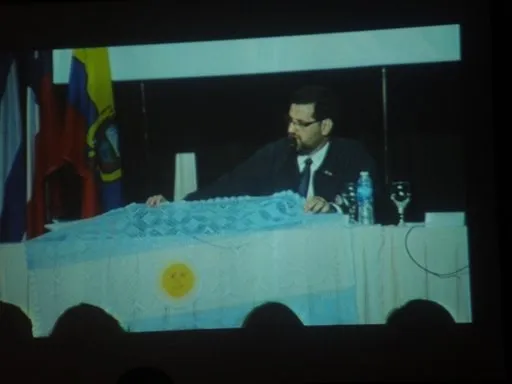
Then I listened to Pablo Fontdevilla, director of PCI, and María Inés Vollmer, Deputy Minister of Education.
They spoke about general aspects and Vollmer in particular about some regulatory aspects, such as resolution 123/2010.
Later, already at home and via the internet, I managed to listen to the talk by Cecilia Sagol, from Educ.ar, who spoke about teacher training courses on the portal and the resources that site has. Internet safety and the ways in which kids interact on the web were also discussed.
The next day I was able to attend the talk by Silvina Gvirtz (PCI) and Guillermo Golzman from the Ministry of Education.
The first referred to the project having a social objective: to narrow the technological gap between those who can access technologies and those who cannot. But she emphasized the pedagogical objective of improving the quality of teaching.
If today we are largely passive consumers of technology and make little use of it, in relation to its potential, we must change that.
The PCI has a technological base (the netbooks themselves and the so-called technological floor, the requirements needed for everything to work). It also has a pedagogical base in the software with specific applications for education.
But, and Gvirtz highlighted this, a new model of teacher work is necessary.
Among the innovations incorporated by the project, it is not widely known that the netbooks have "desktops" for the teacher and the student, with specific applications. For the teacher, there is a program called Maestro that allows monitoring what the students are doing. The idea is not to snoop or control in a Big Brother sense, but to learn how students learn, to see how they collaborate. That, however, can be used differently by each teacher. And, in fact, it was said that many do not know how to use it.
At that point, Gvirtz pointed out that she is leading an experience called the 2011 Innovation Schools Program to accompany teachers from 3000 schools in five provinces.
Golzman's presentation was also nourishing, pointing out paths and questions. I am left with the idea that not every change implies an improvement, but that every improvement is a product of change.
Then, I listened to Javier Firpo from INTEL, Laura Serra from RELPE, and Mariana Maggio from Microsoft.
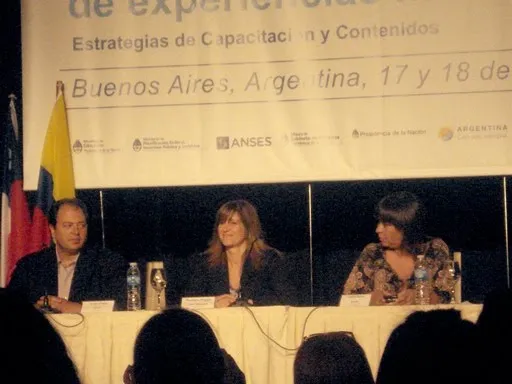
Firpo began with a succinct recount of the inclusion of computers in schools, but I think the warning was very important: "That teachers don't get stuck with today's stuff".
He also spoke about the ATC21S.org program and its inclusion of Latin America, with a pilot experience in Costa Rica.
Maggio cited Larry Cugan and the repetitive cycle: high motivation, great effort, little use. [Note 1]
Laura Serra pointed out something that may be obvious and is not always so: one size fits few, in reference to the myth of the average student. And this, I say, is valid for students, teachers, parents.
She also spoke about how to lead without control: seeking commitment and how to stimulate challenge, also in relation to divergent attention (pointed out by Maggio).
In short, there was a summary of the project and its progress and scope. At this point, I must say that when the idea was announced, I was skeptical. History often drags us along and it is logical to think in that context that some promises are just that.
But here it was possible to come into contact with a project that is much more than the distribution of netbooks. While it is true that this will cause a reduction in the digital divide, that is not enough. That there is a repeated and deep reflection and concern about it I found promising.
And I speak of concern not only from the reflective side, but from the creation of content, training and updating courses, contact networks, so that the computers do not circulate on a rope without a net.
The project is truly ambitious. It does not seem easy to distribute 3 million netbooks (and something more) in a short time. Let's take into account that about technological floors: the school must have electricity, a server, wi-fi connections.
But also the teachers will have to learn and adapt.
The Minister of Paraguay, at the time, showed what could be in a teacher's portfolio. Books, pens, papers. There was no computer. It is not necessary, a teacher is something else, a guide, a facilitator. Neither does he have to know everything about everything (as Serra pointed out) nor is it wrong for the students themselves to teach him how to use the computer.
I think it was Firpo who spoke of teacher professional development more than training. It is not enough to take courses to get a higher score, the teacher must professionalize, improve, dare.
The generation of content is paramount. There are many "loose" materials. Their multimedia integration is a real challenge.
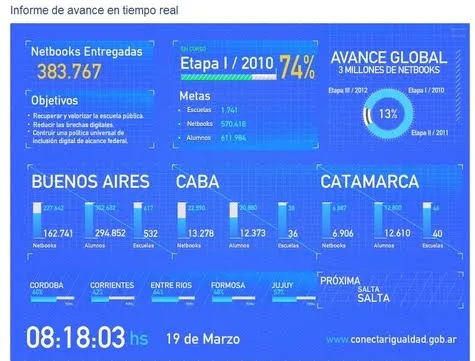
You can access the real-time progress report from Conectar Igualdad
Criticisms
It is difficult to criticize a project of this magnitude without falling into relativisms and subjectivities. On the one hand there is a growing expectation on the part of teachers, parents and students. There is also some suspicion that this will materialize. If you look at it in detail, the project is really ambitious, that is, difficult to fulfill.
But that is cured with time and the established objectives are quite concrete and close.
Those expectations, in some cases, are focused on the arrival of the equipment, in a passive way.
What I think was missing were demonstrations. Beyond the workshops, which I could not attend (besides, the vacancies were exhausted since I registered for the seminar), concrete examples could have been given in the teaching of this or that topic.
If a teacher's exposition will no longer be a "master class" and there is video display and software use, what does the student take home? Is a summary, diagrams, etc. produced? Where do the books, the notes remain? How will the use of the blackboard be now?
A change of this type generates uncertainties. Sometimes, exposing ways of teaching promotes copying more than innovation, but I believe that concrete models are needed, samples of how to integrate technology without dying in the attempt.
At some point I thought of the acclaimed TED talks. Concise, concrete, stimulating and triggering talks. I'm not saying that didn't happen here, but I think there was a lack of... examples, use cases, success stories that promote not copying, but teacher entrepreneurship, without that implying they become showmen.
It must be said, however, that this was a seminar whose objective was to share experiences in Latin America and not a training course.
The Basic Course of Conectar Igualdad
Explanatory video by Vera Rex, from OEI
http://www.youtube.com/watch?v=Xc_Sy4gNKQ8
The positive aspect
That some five thousand people are interested in progressing in education is, without a doubt, stimulating. That the State has a direct involvement in this is paramount and must be highlighted without mincing words and aside from any partisan political speculation. The portal Educ.ar was born in other political moments of the country and there it is, generating new forms of teaching, sponsoring the creation of content.
That there is a deep reflection regarding teacher professional development and the use of ICTs from several related organizations is formidable and consolidates a governmental distribution initiative. Without this safety net we would be facing a proposal whose impact would be equally great socially, but not very significant pedagogically.
Something that made me very happy was the concern to generate critical thinking, in students and teachers. Not only in some talks, but in the audience's questions.
Ah, I must also say that the coffee and the medialunas were delicious, but what filled me the most was seeing hunger to learn and teach, to build a better country. The goal is complex, but it always seems difficult before you do it.
Sources and related links
- The 1:1 experiences seminar brought together more than five thousand people
- Conectar Igualdad Program
- [Note 1] A book by Larry Cuban on the subject is "Oversold and Underused - Computers in the Classroom". Alejandro Piscitelli made a critique of that book by Cuban and, logically, tells what it is about.
About the images
- Own images. ConectarIgualdad is on Flickr. (Hey, could you upload the images with a CC license by default, no?)