2011 is the International Year of Chemistry. But how long is a year in chemistry, geology and astronomy? A commonly used definition generated some long faces.
The need to unify the definition of "year," Celeste Biever recounts in New Scientist, became apparent for geologists and chemists in 2006. At that time the Task Group on Isotopic Data in Geosciences (TGIG) composed of members of IUPAC (the International Union of Pure and Applied Chemistry) and IUGS (the International Union of Geological Sciences), attempted to update the half-lives of radioactive elements, used by geologists to date specimens.
"The numbers are always reported in years, but nobody defines the year they are using," said Norman Holden, a nuclear chemist at Brookhaven Laboratory and a member of the task group.
The term year is slippery. The second, the only unit of time recognized by the international system, is measured by the oscillations of cesium atoms. But the Earth does not travel around the Sun an exact number of days. Nor does each orbit last the same, thanks to the Sun's gravity.
There are many definitions of year in astronomy. For example the Julian Year, of 365.25 days (or 31,557,600) seconds, which is the basis of the light-year.
But the group opted for the tropical or solar year, which is the time elapsed between two successive passages of the Sun through the mean equinox.
But this changes a little each year because the Earth's orbital period is slowing down (at a rate of 0.53 seconds per century). So the group chose to take as a reference point the year 2000, when the tropical year lasted 31,556,925, 445 seconds. Furthermore, they decided to use the name Annus, from Latin, to refer to the year and denote it with the symbol a, expressed in terms of ka (kilo-annus), Ma (mega-annus), to refer to periods of thousands or millions of years.
However, after the proposal, made in 2009, some members of the American Geological Society did not agree.
They do not object to the idea of precisely defining the year or the chosen duration, but rather that geologists already use the symbol a to denote years in past times or "absolute age." Historically, the abbreviations yr, ky, My (also yr, kyr Myr) denoted the time interval between two events.
In this system, the time interval between 100 million years ago and 90 million years ago - in both cases in the Cretaceous period - would be written 10 My. But in the new system it would be written 10 Ma, a notation that geologists would read as "10 million years ago," a period that would fall in the Miocene.
That is, geologists use the notation 100 My to denote time intervals and not "absolute" time, since that notation does not mean "100 million years ago," but "100 million years," as an interval between two epochs, for example.
And, at the same time (redundantly), they use the expression 100 Ma to refer to "absolute" time, when indicating a period of "100 million years ago."
Geologist Nicholas Christie-Blick points out that removing this distinction creates unnecessary confusion.
The TGIG group, however, believes that "two different units were used for the same quantity, which is against the rules of the SI" and point out that with other units of measurement, such as temperature or length, no distinction is made between relative and absolute.
In the debate, Paul R. Renne, of the University of California, Berkeley, together with Igor Villa, of the University of Bern, point out some examples:
"All will presumably agree that a magma at 1000 K is 100 K hotter than one at 900 K, because 1000 K - 900 K = 100 K. Chemists, physicists and geologists have managed equally well using the same unit for absolute and differential values.
Another cited example is taken from NASA: "On May 4 the spacecraft executed its second trajectory correction maneuver. By firing its main engine for 95 seconds, the spacecraft's speed changed by 18.2 km/h." Obviously, these two scientists in favor of the proposed change point out, NASA did not mean that the spacecraft came to have the speed of a bicycle and it is clearly communicated by the use of "by" instead of "to" in the last sentence. That is, it would be different if the last phrase had been: "the spacecraft's speed changed to 18.2 km/h"
The physical sciences editor of Science, Brooks Hanson, when consulted by New Scientist, pointed out that the publication has distinguished between age and time interval for almost 20 years and that a change would confuse readers.
Ian Corbett, general secretary of the International Astronomical Union, commented that establishing a definition of year that astronomers also agree on is not a high priority: "I don't see why there would be a burning need to have a common definition of year, when it is something that varies."
Changes always generate some resistance because we are creatures of habit. And this case was no exception. In the vehement discussion there were those who made a face of Annus.
However, the search for definitions is valid and debates are usually constructive. Thinking costs nothing. The only thing you can lose is time...
Sources and related links
- New Scientist: Push to define year sparks time war
- IUPAC-IUGS common definition and convention on the use of the year as a derived unit of time
Norman E. Holden et al
Pure Appl. Chem., 2011, Vol. 83, No. 5, pp. 1159-1162
DOI:10.1351/PAC-REC-09-01-22 - Convention on the Use of Units for Time in Earth and Planetary Sciences
About the images
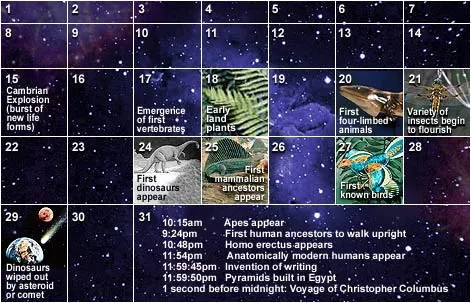
- Image of Carl Sagan's Cosmic Calendar in Cosmos, taken from Gas y tiempo, by Civilización Perú.