Today is a date on which it is possible to celebrate, for those of us who use the Gregorian calendar and regardless of our language, PI day. Is it possible to find a more ecumenical date?
For a few years now, English speakers, particularly in the United States, celebrate PI Day on March 14. They do it on that day because of the way they write the date in their language: 3/14. That is, they write the month first and then the day.
In Spanish this is not possible, although the date 22/7 has been suggested, since the slash is also used as a division symbol and 22 divided by 7 is a good approximation to this fascinating irrational number.
And where is PI?
But in both cases, where is PI? In 3/14 there is no PI. The slash is just that, not a decimal point. It's a date, not a number. In the other case, the same.
That is why the proposal to celebrate PI Day on April 26 (or April 25 in leap years) is more elegant.
To explain how this date arises, we are going to do some calculations. Don't be alarmed, reader, they are very simple calculations. If you have a spreadsheet at hand, like LibreOffice, I encourage you to use it. That way you can check the information presented here and also save your spreadsheet for other calculations.
I will explain this in two parts. The first is a general notion. The second, which arises from the previous one, explains why the April 26 proposal is a suggestion related to the Gregorian calendar. Finally, in a third part of this article I will comment on some conclusions about it.
FIRST PART: PI IN THE SKY
The April 26 proposal arises from an idea that can later be implemented in other ways. We'll see why. But the fundamental thing is the basic idea:
Suppose you walk 10 blocks (1000 meters) every day between your home and your work.
It is possible to "find" PI on your way to work in this way.
PI=L/x where L is the way to your work (1000 meters) and x is the length of a segment, which we could call A-B, on that route.
What is the value of x? Well, we solve for x, the unknown, and we have:
x=L/PI
If L=1000
x=1000/PI x=318.31.
This means that after walking 318.31 meters you would have covered a distance that, when divided by the total path, results in PI:
1000 / 318.31 = 3.1415...
This same reasoning has been suggested in relation to the Earth's orbit around the Sun:
The Earth orbits the Sun. We know that planetary orbits are ellipses and not perfect circles. But in the case of Earth, although this is true, the fact is that it is an orbit very similar to a circle. As an approximation, understanding Earth's orbit as a circle is not bad.
In either case, whether we think of an ellipse (NOTE 1) or a circle, it is possible to calculate its length. With the idea of a circle in mind it's easier, since we all know how to calculate a circumference:
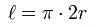
To do this calculation we need to know the radius or diameter of the circle.
In the case of the Earth-Sun system, the radius is the average distance between these two objects. That distance is known and used as a unit of measurement: the astronomical unit, close to 150 million kilometers.
According to Wikipedia, one AU is equal to 149,597,870 km.
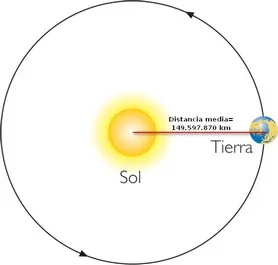
If the length of the orbit, calculating it as if it were a circle, is L, then:
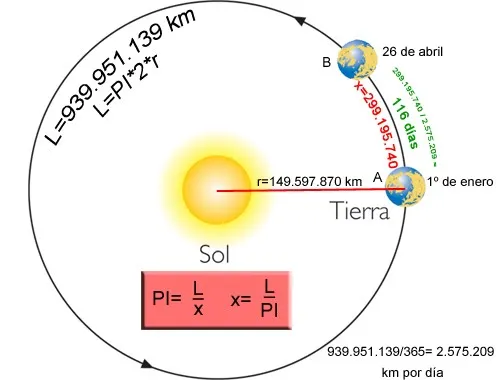
L=PI * 2*r, where r=149,597,870.
Therefore L= PI * 2 * 149,597,870, that is:
939,951,139 km (9.40E+008 in scientific notation.)
In plain language, that's nine hundred thirty-nine, almost nine hundred forty million kilometers!!
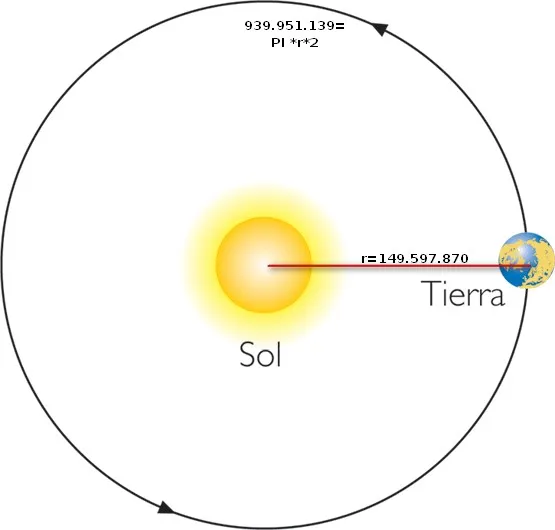
Where is PI?
As before, we reason like this:
PI=L/x x=L/PI
where x is the length of a segment in Earth's revolution, which we could also call A-B.
Since we know L and PI it's easy:
x=939,951,139/PI x=299,195,740 km (1)
Note: someone will say: How strange that x is twice the astronomical unit!
If we follow the example of the commute to work, here applied to the orbit of the Sun, we could say that when the Earth travels almost 300 million km, we find PI in the sky, since if we divide the total length of the orbit by that amount we will get PI:
939.951.139 / 299.195.740= 3,14159...
The time factor
We can do something more now and ask how long it takes the Earth to travel x, that is, to revolve around the Sun 299,195,740 km.
It is not difficult to answer this approximately, like this:
If the Earth takes 365 days to travel the entire orbit, that is 939,951,139km, by dividing both quantities we will have what it takes per day:
939,951,139/365= 2,575,209 km per day.
If the Earth moves that amount per day, how long will it take to move x?
From (1) we have that x= 299,195,740 km, so we divide:
299,195,740 / 2,575,209 = 116.18 days.
Thus, we conclude: After 116 days of revolution, the Earth travels an amount of km (299,195,740) that, when divided into the length of the orbit (939,951,139), gives us PI as a result.
We could also take as a starting point the average orbital speed, according to Wikipedia, 29.78 km/s. We remember that it is average speed by virtue of Kepler's Second Law, right?
Then, if it is 29.78 km/s, per minute it will be that times 60. If we multiply that result by another 60 it will be the speed per hour and if we multiply that by 24 it will be a value close to the daily revolution speed, about 2,572,992, very similar to the previous value.
SECOND PART: PI IN THE GREGORIAN CALENDAR
With these simple calculations we can count 116 days on the calendar. In the West we use the Gregorian calendar, which begins on January 1. Thus, PI day will be day number 116. For regular years it will be April 26. For leap years it will fall on April 25.
The advantage of celebrating Pi Day on April 26, compared to other dates, is that in this reasoning Pi is indeed present, as it is a number and not a subjective way of interpreting a written date. Furthermore, it is not limited by language like the previously mentioned ones. But...
NOTE 1: LENGTH OF THE ELLIPSE
If we want a little more precision, or if curiosity strikes us, we could calculate the length of Earth's orbit not as a circle, but as what it really is, an ellipse.
But you will only be able to do this if you possess a slightly more advanced knowledge of mathematics and do not ignore the precious Kepler's Laws.
However, it is possible to calculate the perimeter of an ellipse with a simpler equation, although it is also an approximation. This equation was proposed by the great mathematician Ramanujan and takes as variables the semi-major axis and the semi-minor axis. Both data are also known.
According to Wikipedia:
Semi-major Axis: 149,597,887.5 km
Semi-minor Axis: 149,576,999.826 km
Ramanujan's equation is:

Using a spreadsheet
We open a new sheet.
In cell A1 we put "ellipse length"
In A2 we put "Semi-major Axis".
Next to it, in B2 we enter "149,597,887.5"
In A3 we write "Semi-minor Axis" and in B3 "149,576,999.826"
Below, in another cell, for example in A5 we can write:
=PI()*((3*(B2+B3))-(SQRT((3*B2+B3)*(B2+3*B3))))
to calculate with the previous data the length of the ellipse using Ramanujan's equation.
In the previous calculation, taking the orbit as a circle gave us 9.40E+008 in scientific notation.
With this equation, do we get something very different? (To get the result in this notation you can position yourself in the result cell and choose Format/Cell/Science.)
THIRD PART: TOWARD AN ECUMENICAL PI DAY
However, not all people on the face of the Earth use the Gregorian calendar. There are other calendars that divide the year in other ways, such as the Chinese or Hebrew calendars.
With the previous reasoning it is possible, however, to establish a Pi Day for any calendar, since in all cases it will be possible to make a similar reasoning. But they will be different moments.
But Pi is a universal number. We can find Pi in China, Israel, the United States, Colombia, Jupiter, Gliese 581. Everywhere where it is possible to make a circle, Pi will be there. It has no language or borders.
For each culture to have its own Pi Day is not bad. It is good to maintain our identity, but it could also be unifying to be able to celebrate Pi all inhabitants of the Earth on the same day.
The sciences, in this case astronomy, physics, and mathematics, develop in each country with their own particularities and idiosyncrasies, but there is a common language. All astronomers in the world, regardless of their place of birth and cultural customs, use the same astronomical definitions, for example the sidereal year.
Those definitions could then be used to celebrate Pi Day worldwide.
But, even if we agree that it will be a day such that the world has traveled almost 300 million kilometers, that is, after 116 days, what should be the starting point?
And here there are many possibilities: perihelion, very similar to the beginning of the Gregorian calendar (January 3), which is when our planet is closest to the Sun; or Aphelion, when it is farthest away, or the solstices or the equinoxes.
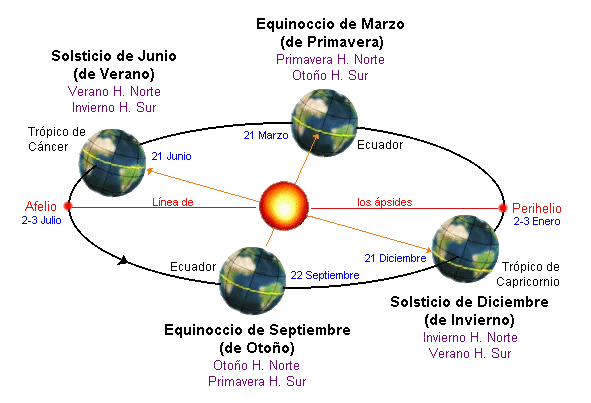
If the reader developed the previous calculations in a spreadsheet, it would be very easy to use it to calculate when Pi Day would fall starting from any of those six dates.
We must consider that any of these "starting dates" will vary over time. The March equinox will not always be on the 20th of that month. It may fall on the 19th or the 21st, depending on the year. The same for the others.
THE BEGINNING OF THE END
To conclude, one could think that Earth's orbit has no beginning or end. Every day it begins and every day it ends. Every day is Pi Day.
And to honor this fabulous human discovery of a fascinating constant that appears in Nature, I must say the following:
Today is a date on which it is possible to celebrate, for those of us who use the Gregorian calendar and regardless of our language, Pi Day. Is it possible to find a more ecumenical date?
Sources and related links
About the images
- Images 1 (initial), 2 and 3 are based on a graphic from Kalipedia.
- Image 4. Credit: Agrupaciò Astronómica de La Seu d'Urgell (AASU).