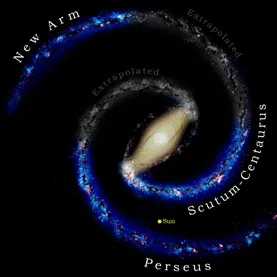
Beyond the first galactic quadrant, in the Outer Arm, they have identified a new arm that would be the continuation of the Scutum-Centaurus Arm.
It is possible to see fantastic photographs of spiral galaxies, some very similar to our own, like the neighboring Andromeda, but having the same view of the galaxy that shelters us is a bit more difficult.
Just as if we tried to know what we look like without the help of a mirror, astronomers try to describe the Milky Way without being able to see it from the outside.
But a new structure, 70,000 light-years (21 kpc) away from the Sun, appears to have been discovered by astronomers from the Harvard-Smithsonian Center for Astrophysics.
Thomas Dame and Patrick Thaddeus report their finding in a paper to be published in ApJ Letters.
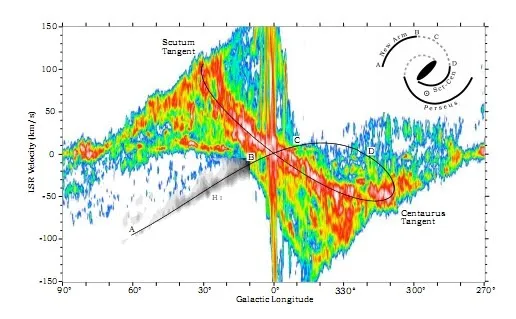
Researchers can create maps of the most distant structures of the galaxy using radio telescopes to identify the spectral signatures of specific atoms or molecules. What the astrophysicists at CfA did was trace the known Scutum-Centaurus Arm that should extend toward the far side of the galaxy. In the telescope surveys that scanned the galaxy looking for microwave emission from hydrogen atoms, something appeared. But with so much hydrogen it was difficult to identify structures.
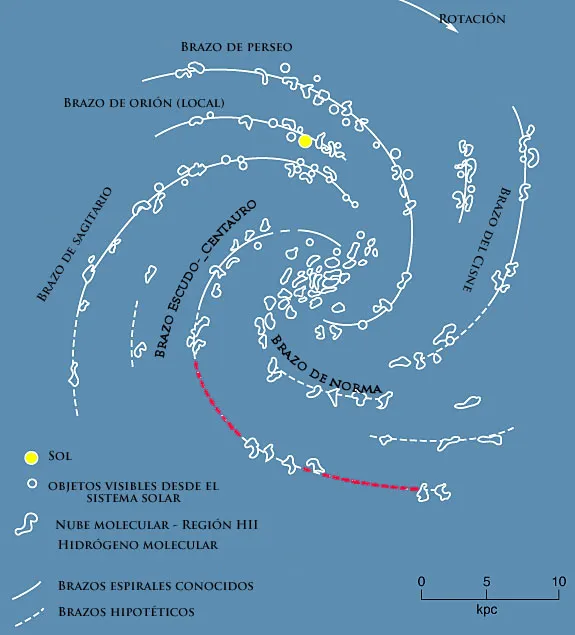
So this pair of researchers looked for carbon monoxide, which also seems to be a reliable tracer of the kind of molecular gas clouds that form stars. Finding clouds along the supposed arm would verify that what has been detected so far is a genuine piece of the galaxy's structure. And what they discovered are molecular clouds along the arm, one of which has been mapped in detail. It is a cloud 300 light-years in diameter (47 pc), with the mass of 50,000 suns. The location of the arm matches the extension of the Main Arm, on the other side of the galactic center.
It makes sense that the Scutum-Centaurus Arm (or Crux-Centaurus) continues toward where this new structure is found. Such an extension would preserve the general symmetry of the galaxy. The Perseus Arm, a sort of mirror image of the Scutum-Centaurus Arm, arches around the galaxy in the same way that the Scutum-Centaurus Arm did in the opposite direction.
So the finding is not unexpected, since it was supposed to be there. But seeing is believing.
Sources and related links
- Scientific American: Arm's Trace: Astronomers Spot a Newfound Piece of the Milky
- A Molecular Spiral Arm in the Far Outer Galaxy
T. M. Dame, P. Thaddeus
ApJ 734 L24
DOI: 10.1088/2041-8205/734/1/L24
arXiv:1105.2523v1 [astro-ph.GA] - The first image is a simplified diagram of the Milky Way showing only the two long spiral arms that are thought to originate at the tip of the central bar. The gray areas are extrapolations made from what is observed. Credit: THOMAS DAME
- Wikipedia: Arms of the Milky Way
- Sur Astronómico: Galaxies
- The Third Quadrant of the Milky Way
G. L. Baume, UNLP, in Asociación Argentina de Astronomía, BAAA, Vol. 49, 2006
About the images
- The diagram in light blue and white is based on the one by Rien van de Weijgaert: Galactisch Gas en Stof