What is the most important object in cosmology? Perhaps it is a variable star, but not exactly one of the most famous ones.
First of all, let me ask the reader: What is the most famous variable star, which one first comes to mind?
To be honest, the first thing I thought when I asked myself the question was: Alpha Orionis and then, Delta Cephei. This Saturday I personally met the renowned variable star observer Sebastián Otero who is very kindly helping me get started in observing these changing stars. And I took the opportunity to ask him this question. His answer was probably the most appropriate: the Sun.
But, will the most important one be among these variables? Actually, Sebastián's answer combines both things, at least anthropically. But let's remove ourselves from the middle and the Sun will be just another star, it won't be much more important than others.
Is there a variable that is?
If we think within the theoretical framework of current cosmology, possibly yes.
At least that's what occurred to me when reviewing some concepts of Modern Cosmology. That topic is also the title of a popular science work by Dr. Daniel Carpintero (1). This Saturday he came to the Asociación Argentina Amigos de la Astronomía where he gave a lecture on the subject. Before attending, I reviewed some concepts and at that moment the idea for this post occurred to me. By the way, Dr. Carpintero is a very good speaker and the lecture was a success, packed with people. There I met Sebastián.
The story of the most ignored one
We all probably know part of the story.
Cepheids are a type of variable star that played a crucial role in determining the expansion of the universe. For that to happen we must name at least three researchers.
Vesto Slipher had been making spectroscopic measurements of Jupiter, Mars, Saturn and Uranus. In 1912 he detected that the spectrum of the Pleiades nebula (NGC 1435) had the same spectral signature as the nearby stars, concluding that it was "pulverized material" shining by reflected light, a reflection nebula.
At the request of another astronomer, he decided to try his luck with other "nebulae" and thus obtained the spectrum of Andromeda. Of the 25 radial velocities measured, only 4 were approaching, while the rest were receding at high speed. The significance of such a measurement was not recognized at the time. (Some point out three reasons why Slipher did not get his deserved recognition).
In those first decades of the 20th century, there was a "debate" about whether those "nebulae" belonged to the galaxy or were other galaxies distinct from the Milky Way. Historically it was called "The Great Debate" of Curtis-Shapley, although the idea of a debate usually denotes a confrontation of arguments orally and in person, which never happened.
It is said that at a scientific meeting, Slipher reported these measurements and in the audience was Edwin Hubble, a young and ambitious astronomer who saw in those measurements a way to end the debate.
But for that, a third person was needed: Henrietta Leavitt, who found a relationship between the periods and luminosity of Cepheid variables.
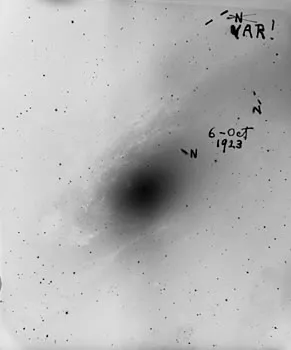
It was with these antecedents that in October 1923, with the 2.5-meter (100-inch) telescope at Mount Wilson, Hubble began an observation program.
The first good plate in the program, in Andromeda (M31), led to the discovery of two ordinary novae and a faint object (magnitude 19) that was first thought to also be a nova. But then, upon comparison with other plates, the third object was identified as a typical Cepheid with a period of almost a month. More or less, that's what Hubble himself recounted in The Realm of the Nebulae.
Thus he calculated that that "nebula" lay at a distance of 900,000 light-years (2).
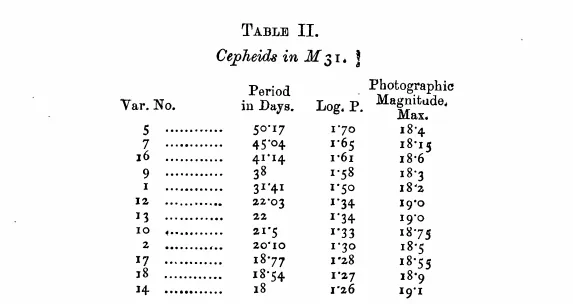
Today we know it is three times farther away, but in the historical context, it was a boost for Curtis, though also much more. That first determination would be added to others that would finally give rise to current cosmology.
But, which was that first Cepheid variable that changed our worldview, our scale of the cosmos?
Let's browse the web, explore the library, and perhaps we won't find much data about it.
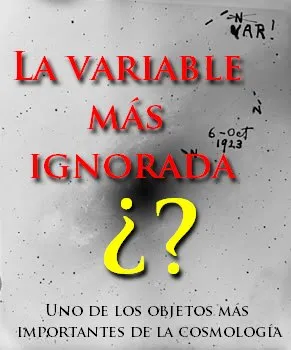
The plate is indeed known, already famous, on which Hubble wrote "N" (for "Nova") and then, after comparison, crossed out the letter to write below: "VAR!"
But which was the Cepheid photographed on the night of October 5 to 6, 1923?
No one better than the AAVSO to answer this question. Alert number 422 was to inform about an observation campaign of Hubble's first variable in Andromeda: M31_V1.
The Hubble Legacy team with Dr. Keith Noll of STScI as principal investigator, planned to observe that star with...the Hubble Space Telescope!
They contacted AAVSO because although some basic parameters of the star are known, there is no recent photometry.
The Hubble-Hubble relationship
From what is indicated above, we can point out a first contact between the variable observed by Edwin Hubble and the telescope that bears his name. But it was not the only contact. Astronaut John Grunsfeld took the original photographic plate on the final servicing mission in May 2009. And he brought it back!
This Sunday at a meeting of the American Astronomical Society (AAS) taking place between the 22nd and 26th of this month, David R. Soderblom (STScI) gave a presentation on this very topic.
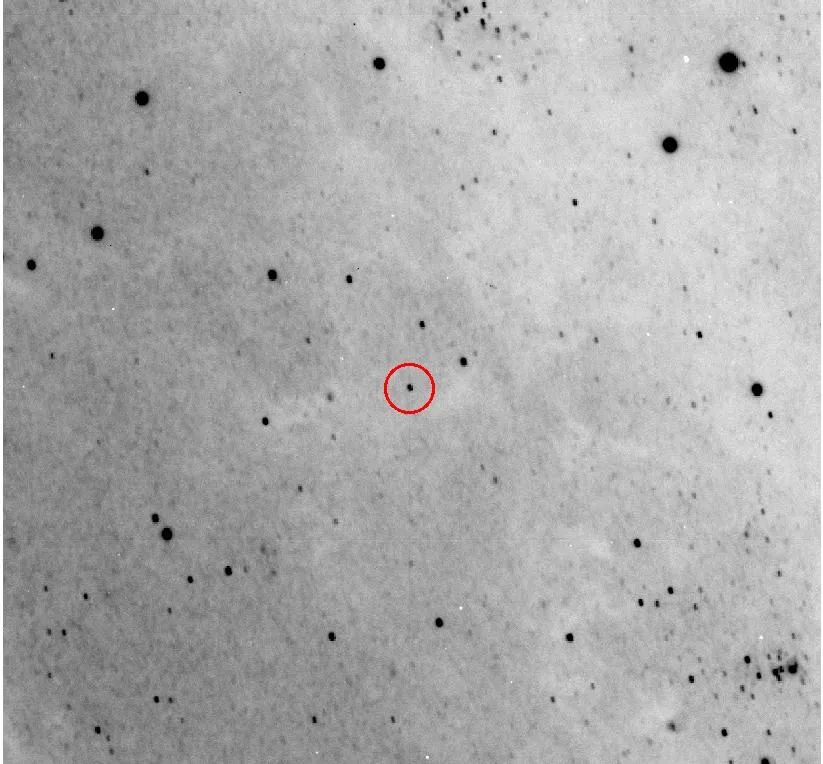
According to the AAVSO alert, the Cepheid M31_V1, of 19.4 visual magnitude (not suitable for visual observation, but suitable for CCD), with +1.28 B-V and a period of 30.41 days, peaked on June 19, 2010 and is located at the following coordinates: 00:41:27.30 +41:10:10.4 (J2000.0)
With these we can go to VizieR and we get:
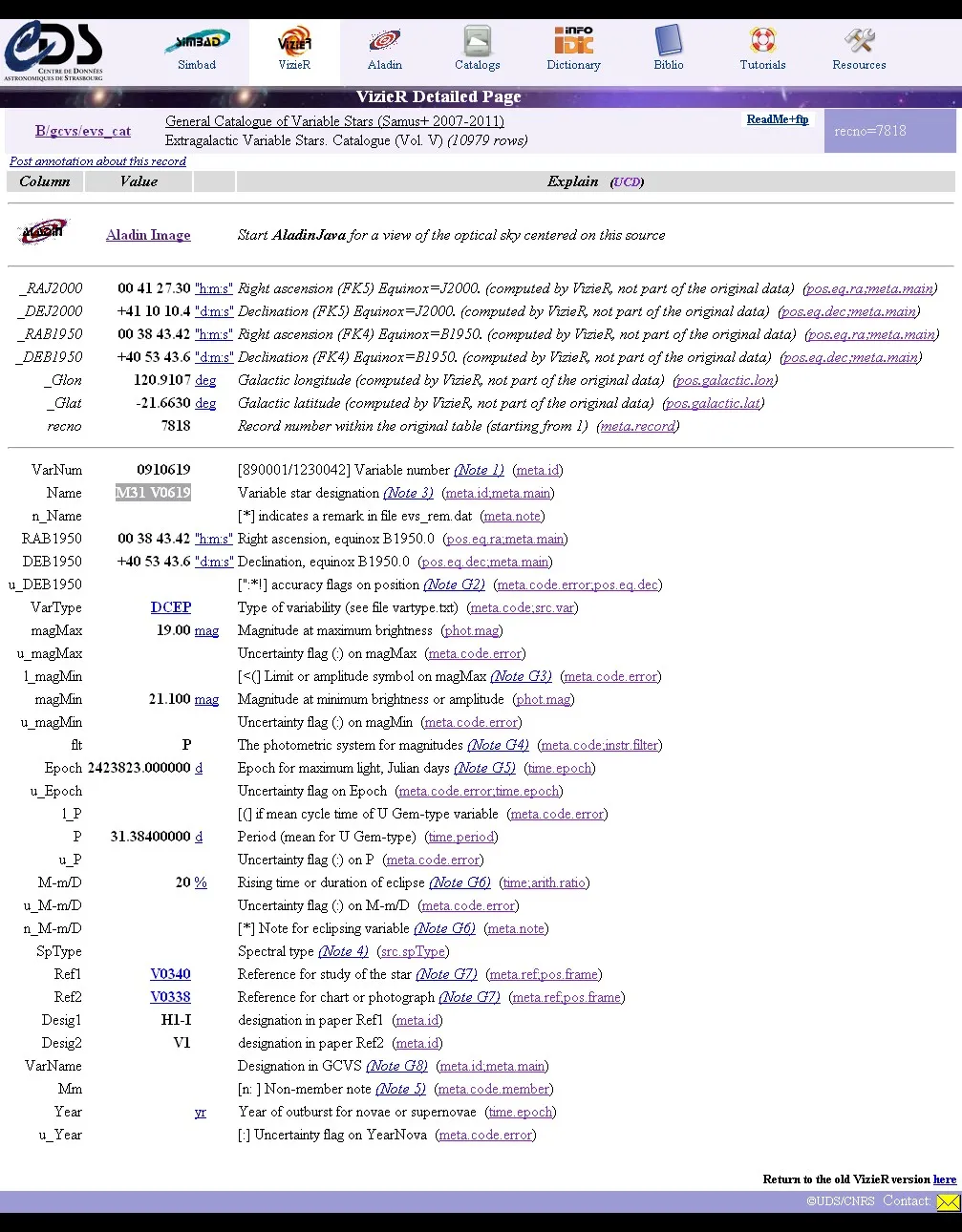
As we see, it does not have a GCVS designation, although it does appear in Vol. V.
It is variable 0910619. The first three numbers designate the galaxy, in this case M31, and the other four numbers the variable within the galaxy. That is why the name of this ignored Cepheid is M31 0619.
And with Aladin we can get an image:
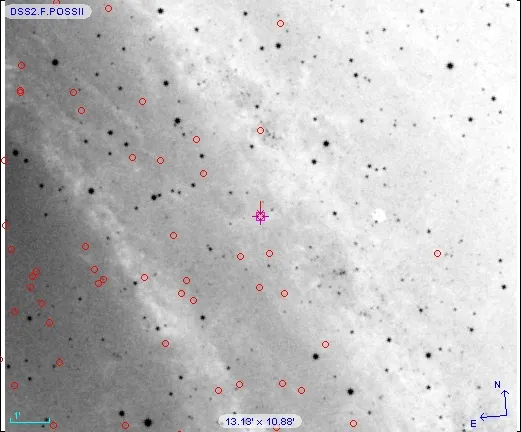
Or this other one, pointed out in the AAVSO alert, taken by Arne Henden:
If until now the reader was unaware of it, in the future they will know the name and coordinates of this variable. They might even capture it with the right equipment. And there will be no shortage of some stellar merchandising, with t-shirts bearing the inscription M31 V0619, so that some curious person might ask and we can "show off" with the answer. But if I spout this speech to a brunette with mischievous eyes, she will most likely ignore me. Although perhaps, someday, that will vary too.
Note written for the XIX Carnival of Physics, in this edition hosted by Scentia. To join and read the entries there is a social network on Ning.
Sources and related links
- #1: Modern Cosmology, Dr. Daniel D. Carpintero, 1st ed. Buenos Aires, Kaicron, 2010.
- #2:Cepheids in spiral nebulae, Hubble, E. P., The Observatory, Vol. 48, p. 139-142 (1925), 1925Obs....48..139H
- Historical Publications FCAGLP
- The Great Debate and the island universes
- Astronomy- Vesto Slipher and Galaxy Redshifts