Some experiments agree with a signal that could be linked to dark matter, but astrophysicists still have their doubts.
It is possible to make a long list of unresolved "mysteries" in astronomy and astrophysics. That is possible because scientists know things and there are also other things they know they don't know.
In the first case is gravity. For centuries, we have inquired into why we are "tied" to Earth, why the Moon circles our planet, and the same with the other wanderers around the Sun.
Galileo, Newton, Einstein provided answers to those questions and although the last word will never be said, the enormous number of experiments performed give researchers much confidence in the theories of gravity.
That is something they know they know.
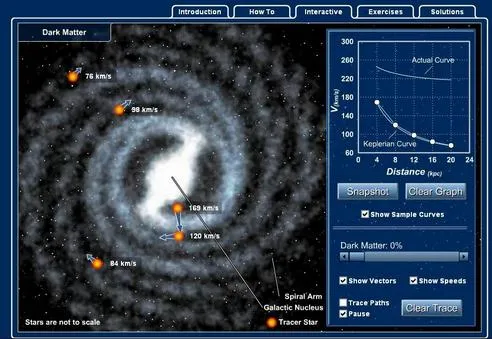
In the second case is the so-called dark matter. If gravity works as physicists assume, then there is something wrong with galaxies. The stars closest to the nucleus should move at a greater speed than those farther from the galactic centers. Gravity, as understood today, extends its influence in inverse proportion to the square of the distance.
But observations of galaxies indicate that is not exactly what happens. Although stars farther from the centers of galaxies have a lower speed than those surrounding the nuclei, their speeds are greater than predicted by theory. Why does that happen?
It is possible that:
a-The theory is wrong, but this would imply modifying the theory of gravity which until now has been proven in very many cases. Perhaps, by doing so, one fixes one thing to "unfix" many others. Or not, maybe there is a way to modify something in the theory that solves everything. There are researchers working on a modified theory of gravity (MOND).
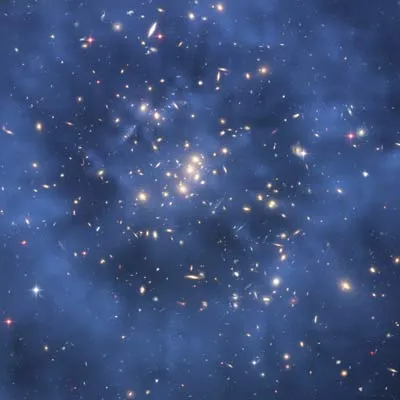
b-That there is something in those galaxies that, although not detected directly, is there. They could be objects that do not generate their own light, like black holes, exoplanets, brown dwarfs. But there would have to be many to account for the motion of stars in galaxies. In this case it would be matter like the rest, composed of protons and neutrons, just not directly visible. They are called MACHOs.
c-Another option is that it is not "normal" matter, but another class of matter that would be composed of another type of particle that interacts little with normal matter. They are called WIMPs.

There are experiments that have been conducted for several years trying to find clues for each of these hypotheses. Among them is the DAMA Project with its experiments DAMA/Nal and DAMA/LIBRA.
In those experiments the researchers believe they have found evidence of weakly interacting particles, but their results have been called into question because other different experiments did not confirm those results.
New Scientist reports that another experiment, called CoGeNT, reports results similar to DAMA, although these remain in conflict with two other research teams.
Since 1998 the DAMA researchers at the Gran Sasso mountain in Italy have claimed that they found evidence of the so-called WIMPs, an English acronym for Weakly Interacting Massive Particles, which in short indicates the possible existence of massive particles that interact very little with normal matter.
DAMA uses an array of sodium iodide detectors to detect the rare events in which WIMPs collide with atoms in the detectors producing a flash of light. The number of flashes detected so far changes with the seasons and the DAMA team argues that this occurs because the relative speed of Earth around the sea of dark matter changes as the planet orbits the Sun.

But two other experiments found no such signal in their detectors. One, XENON100 uses 100 kg of liquid xenon and the other, CDMS II, uses ultra-pure germanium crystals.
But a fourth experiment, CoGeNT did find seasonal variations after 442 days of observations, as reported at the American Physical Society (APS) Meeting in California on Monday.
The CoGeNT detector is small as it uses only 440 grams of germanium crystal. The experiment suffered an unfortunate episode on March 17: a fire in the Soudan mine, but until then they had achieved 442 days of observations. Their analysis yields results similar to DAMA, regarding the annual modulation, that is, that the signals change during the year.

Perhaps this discrepancy between these different experiments could be explained if we assume that WIMPs interact differently with protons and neutrons. If so, that could explain the differences in the signals from xenon and germanium in the detectors since each has different proton/neutron ratios (isotopes).
This is argued by Jonathan Feng (arXiv:1102.4331v2) who told New Scientist: "These experiments might seem inconsistent, but a small theoretical change could explain everything".
The different teams also participated in a dark matter symposium at STScI (Space Telescope Science Institute), held between May 2 and 5.
Is it a matter of believing or not believing?
Juan Collar of the University of Chicago noted: "Perhaps the DAMA results are wrong, perhaps they are correct, but we must remain neutral. I find myself caught between the believers and the pagans," the researcher stated according to Scientific American.
Here it would be good to establish differences and similarities between "believing" and "knowing", but it would demand a lot of space-time. But we could make a hyper-simplification:
We cannot be 100% sure of almost anything. That, however, does not prevent us from making decisions and acting. We do so based on incomplete information, but we choose that which we have greater confidence in. Those decisions are not blind, because they do not arise from nothing, nor are they absolute, since we know they are not complete. They are probable, provisional conclusions. Believing in dark matter is possible in this context. Given the observational data obtained by researchers, it seems quite probable that particles different from normal ones exist. It is not certain, just as it is not certain that gravity works as physicists believe, nor is it 100% that you are reading this article now (it is possible you are dreaming). Nothing is completely certain.
But believing based on data, knowing that they are incomplete and that the conclusions are only probable, is not believing in other senses, like the religious one. There are exceptions, of course, but it is known that many people believe in "supernatural" beings, but they do not consider that belief as incomplete and probable knowledge, but as something absolute.
This is not the case. Since we use similar words with different meanings, noise is produced in communication. We must not confuse. Believing in dark matter is as scientific as believing in gravity. The difference between both hypotheses is that one has been proven countless times and the second has not, so we will have enormous confidence in one and not the other. And that is scientific, not dogmatic. Even if the opposite is said.
Sources and related links
- Scientific American: WIMP Wars: Astronomers and Physicists Remain Skeptical of Long-Standing Dark Matter Claim
- New Scientist: Second experiment hints at seasonal dark matter signal
About the images
- Logos of DAMA, XENON100 and CoGeNT.