Can there be dark matter in a star? In what way would it alter stellar evolution?
From the fantastic blog Astrobites, Maria Drout brings us a paper by three researchers from the Institut d'Astrophysique de Paris.
As she points out, we have heard about dark matter in galaxies, galaxy clusters and the large-scale structure of the universe. But Maria Drout, an astronomy student at Harvard, brings us a work that addresses the topic from another angle: what effects would the presence of dark matter have on the structure and visible properties of a star? Specifically, the work examines the case of a solar-mass star in an environment with a certain density of WIMPs.
As Maria does in her post, some introduction is in order.
What is dark matter?
It would not be incorrect to say that for now it is an idea. The idea arises because there is a difference between models and observations. In this case, the models are those linked to gravity (Kepler, Newton, Einstein) and the observations are of galaxies and galaxy clusters.
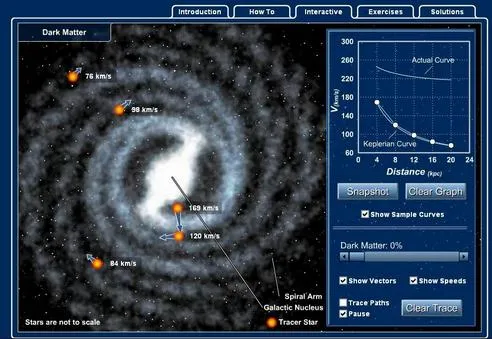
Let's take the case of a galaxy. Current ideas about gravity allow us to know that much more matter accumulates in the nuclei of galaxies than far from their hearts. Due to gravity, the stars closest to the nucleus should have a greater velocity than those farther away. Because of that thing where gravity is inversely proportional to the square of the distance. But many observations began to say the opposite many years ago. Indeed, the objects closest to the nuclei have greater velocities than those found in the outer regions, but the difference is not what it should be. In particular, it seems that the outer objects have a greater velocity than they should. The example was given with galaxies to make it simpler, but the idea comes from observations of galaxies and groups, clusters of galaxies. At this point, it is worth citing the pioneering work of astronomers like Fritz Zwicky and Vera Rubin. An illustrative graph can be found at Astroverada. [1]
The Dark Matter Interactive may also be useful.
This discrepancy could be explained in two main ways:
A) The models are partially wrong/incomplete
B) The models are good, but there is something else.
We could add C) The discrepancy could be explained, at least in some cases, by magnetic fields [2].
Physicists have been working on both hypotheses. For case A) we have Modified Newtonian Dynamics (MOND).
But among those who support hypothesis B) there are some differences:
B1) That "extra" is normal matter (baryonic matter)
B2) That "extra" is NOT normal matter (non-baryonic matter)
Even within B2) there are distinctions between hot and cold matter.
In B1 would be matter composed of baryons, like protons. It has been proposed that there could be compact and massive objects in the halos of galaxies, such as black holes, or brown dwarfs or rogue planets. That is, massive objects that, unlike stars, do not emit light, to put it crudely.
In B2 different alternatives have been proposed, for example WIMPs which would be "weakly interacting massive particles". It is a hypothesis that posits the existence of particles that have no electromagnetic interaction, but do interact with the weak force and gravity.
With these characteristics it would be difficult to detect them directly like stars, but they would reveal their presence gravitationally, causing stars or galaxies far from the nuclei to have higher velocity.
They are hypotheses, ideas, assumptions based on theories and observations.
Now then. Although these WIMPs have no interaction with photons, they do interact with other particles through gravity and the weak nuclear force. Therefore, Maria points out, as a star travels through the galaxy and through dark matter halos, there is a small probability of capturing dark matter particles inside it. A star traveling through regions of the cosmos with higher dark matter density, for example the galactic center, would capture more particles over the course of its stellar life.
Stellar balance
As a general rule, the structure of a star represents a point of equilibrium between gravity, which tends to collapse the structure inward, and radiation pressure, which pushes outward. This balance will depend on the amount of different elements/particles in the star, among other things. In large quantities, dark matter particles add another variable to the equation.
WIMPs
When considering the balance described above, one must remember that WIMPs do not interact in the same way as other particles in stellar interiors. Although they would be capable of transporting energy out of the star's core, by colliding with other particles, they do not contribute to radiation pressure because they do not interact with photons.
Dark matter in stars
That said, let's go to the paper in question developed by Fabio Iocco et al.
What the astronomers say is that in environments with a high density of dark matter, such as near the centers of galaxies, stars would capture many particles. That could cause the energy transported out of the stellar cores by the dark matter particles to exceed the amount of energy created by nuclear reactions. The effect is to decrease the temperature in the inner core and lower the efficiency of the reactions occurring there. This, in turn, would decrease the amount of radiation pressure produced. This would be a significant consequence and the final result in the star could be of two forms.
1-In the first case, the dark matter only transports more energy from the core than that produced in the innermost region of the stellar core, but not from the entire region with nuclear fusion. Under those circumstances, the outer core would respond by increasing the temperature and the nuclear reaction rate to create enough radiation pressure to balance the star.
2-However, if the amount of dark matter present in the star is sufficient, it is possible that the temperature of the core drops across the entire fusion region. In that case, the star would be unable to compensate and would be forced to contract under the gravitational pull. These two cases are illustrated by Fig.2 that follows below, which shows the temperature profile in the core of a star. The black line is the case without dark matter, the blue dotted line is the first case and the black dotted line, the second.
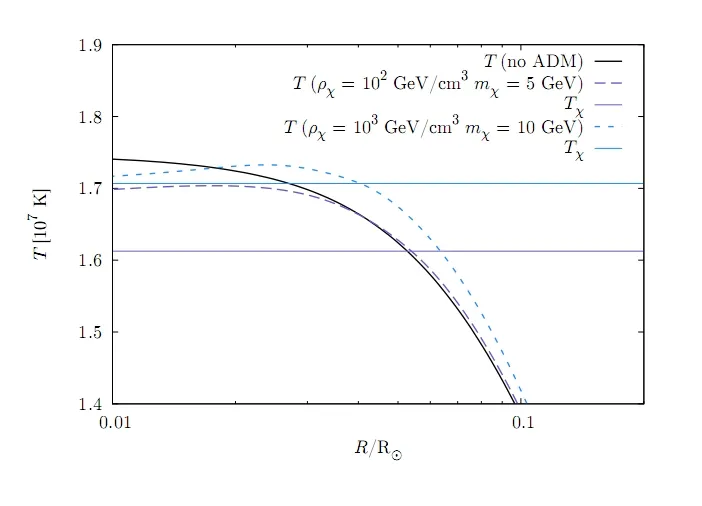
It is interesting, as Maria points out, that in both cases the star's appearance and its location on the HR diagrams would be altered. How much? It would depend on the amount of dark matter, which in turn depends on the density of the environment and on the properties of dark matter itself.
How did the researchers do this?
With simulations. They used a modified numerical code (called Darkstars) that solves the equations for WIMP capture and stellar evolution and considering different environments. They also used ZAMS adopting a dark matter density environment of 103GeV/cm3, which for an NFW profile corresponds to Rgal (galactocentric radius) ~10pc from the Galactic Center.
Another figure in the paper is the following graph (Fig.3):
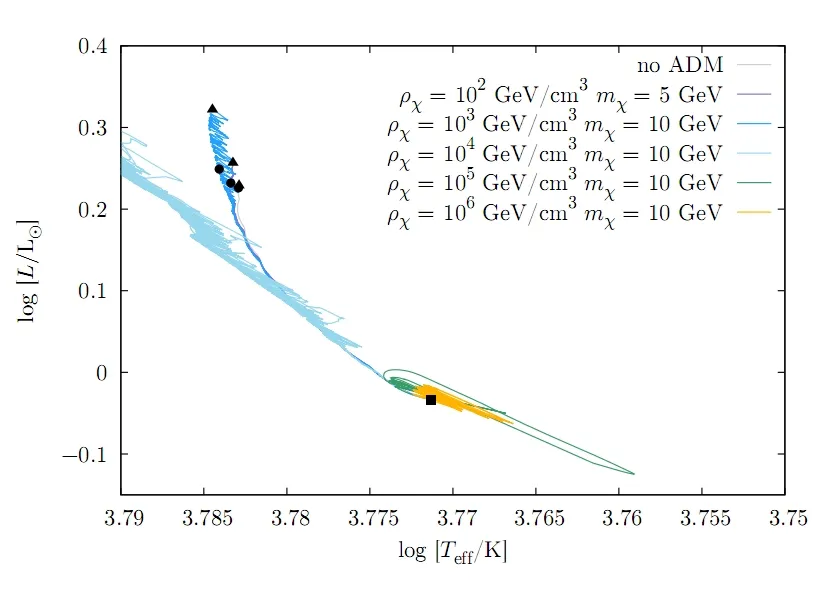
This is an HR diagram (Hertzsprung–Russell) for a 1 Solar Mass star for different dark matter parameters. The solid black square is the starting point of the simulation. The black circles mark an age of 6 billion years, not reached for the cases where the density is greater than 103 GeV/cm3. The triangles mark the drop of the central hydrogen fraction below 0.1. This takes place at an age of 6.05; 6.36; and 6.39 billion years for a case without dark matter, with a density of 102 and 103 respectively.
Sources and related links
- Astrobites: Dark Matter Inside a Star
- Main Sequence Stars with Asymmetric Dark Matter
Fabio Iocco et al
Phys. Rev. Lett. 108, 061301 (2012)
DOI: 10.1103/PhysRevLett.108.061301
arXiv:1201.5387v1 [astro-ph.SR] - [1] Astroverada: The dark matter of the universe
- [2] Magnetic fields and the outer part of the rotation curve of M31.
Ruiz-Granados, B., Rubiño-Martín, J.A., Florido, E. and Battaner, E.
(2010) The Astrophysical Journal Letters, Volume 723, Issue 1, pp. L44-L48
See at IAC.
About the images
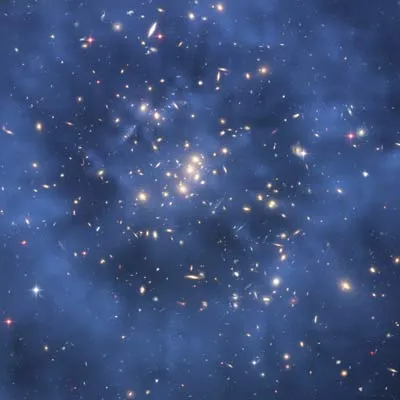
- Initial figure: Dark matter ring in the galaxy cluster Cl 0024+17. Credits: NASA, ESA, M.J. Jee and H. Ford (Johns Hopkins University). See at HubbleSite.
- Fig. 2 and Fig. 3. Credits&Copyright: Fabio Iocco et al. Phys. Rev. Lett. 108, 061301 (2012)