A collection of links to music, images and videos that relate art and science. Today: Edge-on galaxies and a cluster of celebrities; music of the wind, music with the Sun and Bach on other worlds; Time, a video sequence.

Images of the decade
A cluster of celebrities
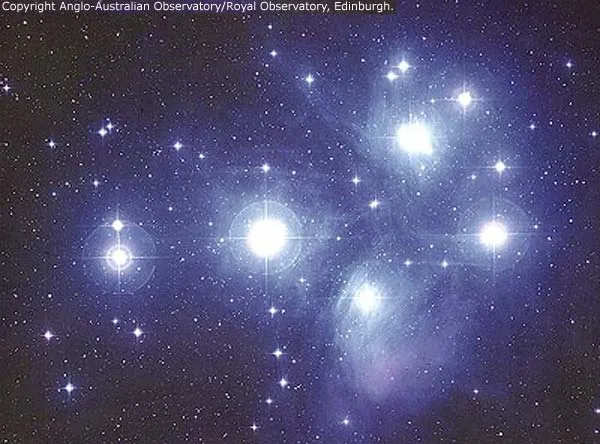
The Pleiades form the most famous open star cluster in the sky. They are also known as the Seven Sisters or M45. The cluster contains more than 3000 stars and lies 400 light-years away.
It was the Astronomy Picture of the Day on May 6, 2001 and on Observatorio.
Credit: David Malin (AAO), ROE, UKS Telescope
Spirals, edge-on
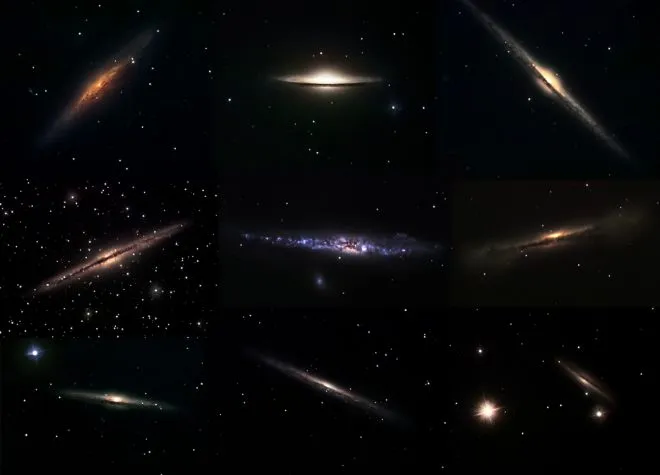
This majestic mosaic shows nine prominent edge-on galaxies: top: NGC2683, M104, NGC4565; middle: NGC891, NGC4631, NGC3628; and bottom: NGC5746, NGC5907, NGC4217. Perhaps the best known is M104, the Sombrero Galaxy. Notably, this perspective of galaxies allows measurements of their rotation using the Doppler effect. That type of measurement historically led to the first evidence of mysterious dark matter.
In Astronomy Picture of the Day (APOD) of May 10, 2001. And on Observatorio.
Credit: Robert Gendler
Space Music
Today: Natural music
The sound of the wind
The Aeolian harp was created in the 17th century by the Jesuit scientist and inventor Athanasius Kircher. It consists of twelve to fifteen strings that sound with the passage of air currents over a long, narrow rectangular resonance box upon which twelve strings are stretched. It sounds like this:
Video: Wind plays Aeolian harp
http://www.youtube.com/watch?v=M8ThB4uCYp4
The sound of the Sun
For the March equinox, the Indianapolis Museum of Art celebrated the beginning of spring with a concert... from the Sun!
It is a creation by sound artist Craig Colorusso of 20 pieces of solar-powered speakers. Each box is programmed with a different loop of guitar notes of different length. Furthermore, with more or less energy received, the volume of each speaker will increase or decrease.
Watch the full episode. See more PBS NewsHour.
More at:
PBS: Sound Boxes that Strum in the Sun http://muudmusic.blogspot.com/
http://www.sun-boxes.com/
SPACE MUSIC: AEOLIAN HARPS AND SOLAR SOUND BOXES
There is a video on YouTube, but the microphones were not covered from the wind and the result is not very good.
Bach on Titan, Venus and Mars
Surely you never asked yourself this: How would Bach's music sound on other worlds?
If sounds are oscillations in air pressure, we certainly won't hear an explosion in empty space, as happens in movies. But what would happen on the planets of our solar system?
Well, that did occur to a brilliant duo: physicist Andi Petculescu and acoustics professor Tim Leighton, who with atmospheric data created a computer model of the atmospheres on Mars, Venus and Titan (one of Saturn's moons).
Here is a sample: a small part of Smoke on the Water repeated three times with a short separation between each. The first corresponds to a sound with our feet on Earth, the second would be as if we were on Titan and the third on Venus.
Next, a fragment of Toccata and Fugue in D Minor with a pipe organ, processed with the model and propagated 50 meters on Earth, Mars, Titan and Venus (it is necessary to increase the volume to hear the Mars file and the Venus one).
Planetary music ▼
In a press release from the University of Southampton, Leighton noted:
"The atmosphere on Venus changes the pitch dramatically (from D Minor to F minor), making children sound like the Smurfs, while the atmospheres of Mars and Titan lower the pitch, transforming my ten-year-old daughter's voice into that of an adult. However, while sound on Titan propagates better than on Earth, on Mars the atmosphere absorbs sound so much that almost nothing is audible when you are 20 meters from the organ. The calculations indicate how that instrument would sound in various "open-air" locations on different planets. One thing is certain: you won't sell many tickets on Mars!"
More on Andi Petculescu's page.
Science in motion
Today: Time
Is time a human creation? Certainly not. What we have created is a bureaucracy of time, a way to measure and calculate it so that it is useful in our daily lives.
But it is difficult to say what time is. One way to interpret it is as change. Movement is another way. And everything moves, everything changes. Like Nature:
Time is the name of this video sequence by Tomás Sironi, a telecommunications engineering student from Córdoba at Blas Pascal University:
Time from Tomas Sironi on Vimeo.
The music used in the video is The Mist, by Solaris.
To access previous editions of this section, consult the Multimedia Selection Series.